|
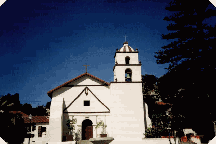
Mission San Buenaventura was originally destined to be the 3rd mission, however, its construction was delayed 12 years because of lack of funding from Spain and problems affecting the other missions. Spain was also engulfed in wars with other European countries at that time and there was a growing sentiment that white settlers would be more preferable than converting Indians. A new code of authority by Viceroy Bucareli was made into regulations by the then California Governor Felipe de Neve. No new mission would be founded on Indian labor and there would only be one father to a mission. In de Neve's absence, Father Serra established Mission San Buenaventura.
The Chumash Indians were the local natives and were already renowned for their cone shaped homes, skilled canoe makers and basketweavers. They were very friendly and helped make the mission prosper. A unique aqueduct, seven miles in length, helped create a bountiful agriculture that included exotic items such as bananas, coconuts, figs and sugar cane. It was the 7th most productive of the missions. It was also a popular stop for whaling ships to replenish their supplies.
The first church burned down and was seriously damaged in the earthquake of 1812. Attacks by the infamous French pirate Bouchard and mistreatment by visiting Mojave Indians, led to their both becoming bitter enemies of Spain and added to their problems. The mission was also caught in Mexico's uprising during the battle for governorship.
Secularization came in 1836, but went more smoothly compared to other missions, thanks in-large to Rafael Gonzalez, the first administrator. However, by 1845, all mission land was dispersed under Governor Pio Pico. Mission property was returned to the Catholic Church in 1862, after the United States government had taken over. Around 1893, the resident priest began a series of "improvements" which basically obliterated much of the original craftsmanship and the Indian wall paintings. Fortunately, restoration which was completed around 1957 removed much of the "improvements".
Located nearby are the Archaeological Interpretive Center, Albinger Archaeological Museum and the Ventura County History Museum, which has many relics of mission life, including the original mission bells.
|
|