|
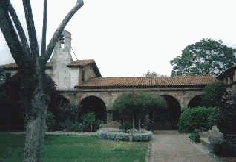
Mission San Juan Capistrano was founded twice, first in 1775 by Father Lasuen, but an uprising in Mission San Diego forced the party to abandon the endeavor. A year later, Father Serra returned and renewed the founding on November 1, 1776. The first church, built out of simple adobe, is still standing and is known as Father Serra's Church, since it is one of the two sites where it is known that he said mass. It is considered to be the oldest church in California. The mission was successful from the start and soon yielded great crops and supported substantial livestock. The Indians were friendly and reached a peak of 1,361 neophytes in 1812. The Indians learned many crafts ranging from candles to leather saddles. Due to its livestock, the mission had a successful trade in hides and tallow with trading ships. Because of the large neophyte population, a second larger church was constructed out of the nearby sandstone. The second church was a magnificent structure and took 9 years to build. It was completed in 1806, but sadly, the great structure lasted only 6 years until the 1812 earthquake severely damaged it, killing 40 Indians during mass. Afterward, Father Serra's Church became the main church and further construction was limited to meet necessities. After Mexico's independence in 1821, the soldiers assigned to the missions no longer received salaries and thus turned to the mission for support, bringing more work for the Indians. Secularization came in 1833 and the Indians eventually would lose their inheritance of the mission. By 1844, no priest was assigned to the mission, only a few Indians remained and the mission deteriorated from neglect. Vandalism also wrought havoc as tiles and timbers were stolen. In 1865, the mission was returned to the Catholic Church by the United States government and a priest was assigned to the mission from 1866-1886, but he was unable to keep the mission from deteriorating and soon only the chapel was left standing.
In the 1880's, the Landmarks Club restored some of the walls and roofs of the most important buildings, including the chapel. But the most extensive restoration was the result of Father St. John O'Sullivan, who rebuilt and restored the mission from 1910-1933, beginning the work with his own hands. He is buried in the nearby cemetery. During his time, he made Serra's chapel an active parish again and had the statue of Father Serra built. After the 1987 Whittier earthquake, Monsignor Paul M. Martin started the latest rounds of restoration. He also began the construction of a new church built to resemble the original stone church. The mission is also famous for the swallows that return annually on March 19th, St. Joseph's Day each spring to build their mud nests in the ruin of the stone church. Their arrival is met with much public excitement. They fly south in October.
|
|