|
Mission San Gabriel Arcangel |
||
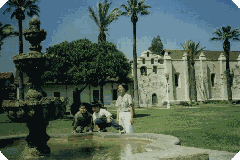
|
Mission San Gabriel Arcangel is the 4th mission and was founded on September 8, 1771, by Father Pedro Cambon and Father Angel Somera. It is named after Arcangel San Gabriel (Saint Gabriel), the angel of the annunciation sent to Mary of Nazareth to tell her of her destiny. |
||
|
Mission San Gabriel Arcangel served as an important stopover for travelers into Alta California from Mexico and became one of the richest of all the missions because of its bountiful crops and numerous livestock. It served both as an agricultural and spiritual center for the local ranchers. Its original site was not very productive, with the frequent flooding by the San Gabriel River that destroyed both the crops and the first mission in 1771. In 1775, the mission was relocated to a new site that proved to be fertile, well wooded and well irrigated. Under the influence of Father Antonio Cruzado a second mission was built. Its unique Moorish architecture is based on the design of the Cathedral of Cordova, Spain where Cruzado was born and raised. The Indians would become skillful in the crafts of weaving, leatherwork, soap making, candle making and wine making. The mission prospered under Fathers Cruzado and Sanchez and later Father Jose Zalvidea. Father Zalvidea worked there for 20 years and under him, directed the building of the "Church of Our Lady of the Angels" in the Pueblo of Los Angeles. It is still standing in downtown Los Angeles. Due to the constant trouble by the military against the Indians, there were not a large number of neophyte conversions. One incident in particular would create a lasting mistrust of the Indians for the military. During the founding period, a soldier assaulted an Indian Chief's wife. When the Indians attacked in revenge, the Chief was decapitated and military presence was increased. Another outcome of this incident was the postponement of the founding of San Buenaventura, since its military was now assigned to San Gabriel. In 1834, the mission was secularized and Governor Pio Pico took possession of the mission's wealth. The Indians remained on the land and the church continued to be cared for by Franciscan padres until 1852. In 1846, to pay off a debt Governor Pico sold the mission buildings and its immediate surroundings to two Americans. This sale was later declared illegal. In 1859, United States President Buchanan returned the deserted mission to the Catholic Church, which used it as a parish from 1859 to 1908. In 1908, the church became the property of the Claretian Fathers, who turned it into their headquarters and preparatory college. They still occupy it to this day. |
||
|
Back to History index |
||
|