 |
 |
 |
 |
 |
 |
 |
| (Sebree, 2006) |
| LEADERSHIP DEVELOPMENT
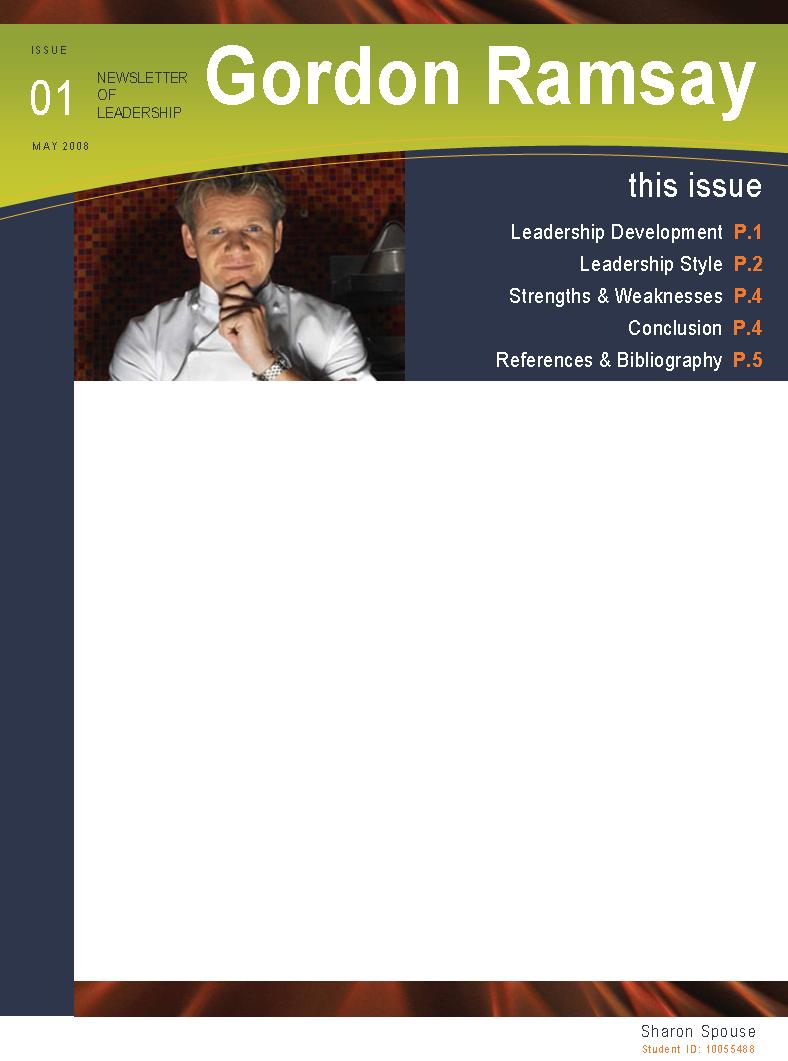
The following information is sourced from Gordon Ramsay�s autobiographies Ramsay, (2006, 2007), his official website �Gordon Ramsay� (2008a) and Wikipedia �Gordon Ramsay" (2008b). Gordon Ramsay was born on 8th November 1989 in Scotland and had an imperfect childhood. His family was poor, moved around a lot, his father was an alcoholic and violent to his wife and even Gordon�s brother is a heroin addict. Gordon started in the hospitality industry by completing a hotel management course. After working long hours learning culinary skills, Gordon developed a strong passion for food. He realised no other person in the kitchen had the same energy, enthusiasm, drive, efficiency or standard and as such he would quickly rise to senior chef positions. Each time he would rise to the top of one restaurant, he would seek other teachers and mentors. Gordon adapted to the tough stressful conditions of a kitchen, which included working |
| long hours and poor pay. Industry leaders would notice his skills and determination and as such, he began working with these leaders.
After working in London, Gordon moved to France to develop his skills in French cuisine. After a few years, he took a year�s break to work as a chef on a luxury yacht where he developed his own style of cooking. When Gordon returned to London, he became a small partner in restaurant Aubergine. Aubergine would become instrumental in Gordon�s career. Gordon turned Aubergine from a failing restaurant into a huge success. Things were not perfect however, as his right hand chef was sacked and Gordon did not agree with the major shareholders plans for Aubergine's future. After seeking advice from his father in law Chris Hutcheson, a businesses man, he secured his first restaurant. Gordon was so revered approximately 80% of Aubergine�s staff followed including his right hand chef. This staff would play an important role in Gordon�s success by many of them now head up his restaurants around the world. Overall Gordon�s leadership developed through study, working with great leaders and working |
| (Rosenburg, 2007) |
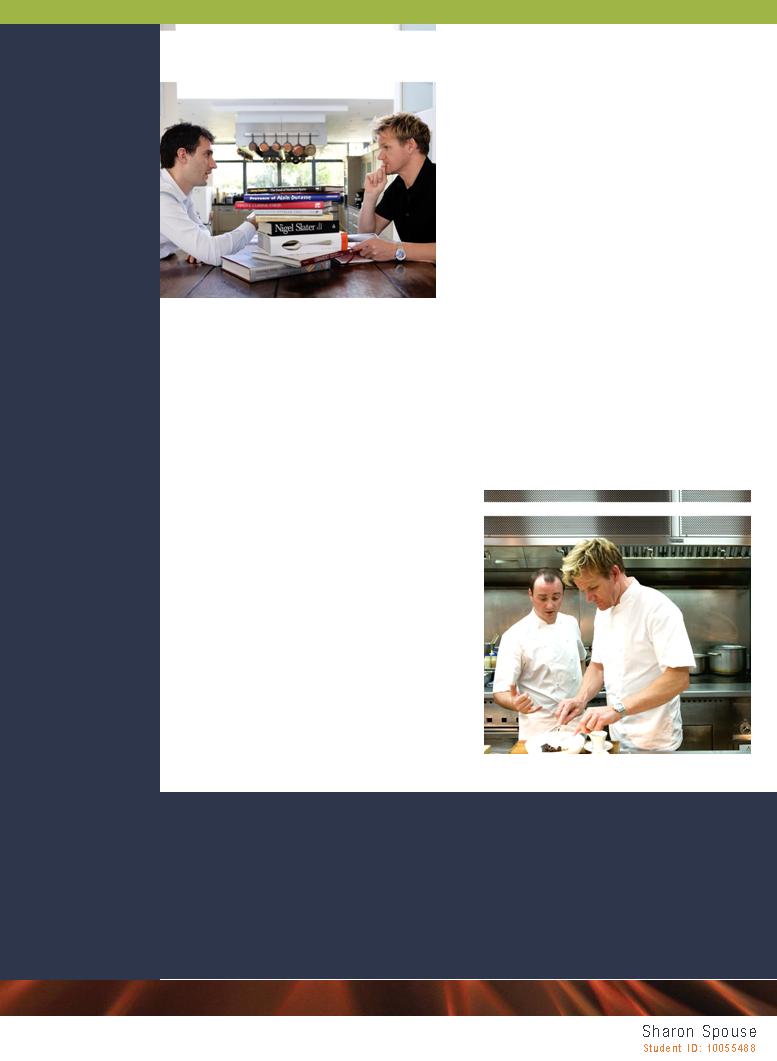
| as head chef in successful and elite restaurants. Gordon has great culinary skills but still realises that he can learn more. Gordon continues to take interest in other industry leaders and regularly consults cookbooks for inspiration.
Some of Gordon�s achievements to date include 12 Michelin stars; 18 restaurants; 3 pubs; cookbooks; autobiographies; OBE medal; awards; television series including Boiling Point, Beyond Boiling Point, Ramsay�s Kitchen Nightmares (UK), Kitchen Nightmares (US), Hells Kitchen (US) and the F-Word; glassware, tableware and cookware with Royal Doulton; catering consultant for Singapore Airlines; partners with Tante Marie School of Cookery and Gordon�s Gin; and, food and drink column in the UK�s Times. LEADERSHIP STYLE The following is my interpretation of Gordon Ramsay�s leadership style through leadership theories outlined in Daglish, Dubrin, and Miller (2006). Background information has been sourced by viewing episodes of his television series; autobiographies Ramsay, (2006, 2007); his official website �Gordon Ramsay� (2008a); and, Wikipedia �Gordon Ramsay" (2008b) . Gordon�s favourable traits for leadership are self-confidence as he sees himself as a high quality chef; assertiveness due to his famous open and frank communication; extroversion as a television personality; honesty as he says things as he sees it; and, full of enthusiasm. |
| Gordon is task related as he is passionate about food; has courage by trying different ideas and exposing himself to public criticism; and, shows flexibility and adaptability by trying was to improve restaurants as seen in �Kitchen Nightmares�.
Gordon�s leadership motive is through having a strong work ethic, high drive, need for achievement and determination in achieving his personal goals. Gordon is knowledgeable about his business. �There are only a few real variables: the food, the location, the design, the price, the staff, the ambience and the clientele� (Ramsay, 2007, p. 20). Gordon has vision, creativity and insight into people and situations. �Ramsay is a self-professed foodie, and he has to be in his high-end restaurants. But, he is not too removed from the rest of society to understand what other people want to see on his menus. He understands his customers and tailors his dishes accordingly� (Carmichael, n.d.-f). In the kitchen, Gordon has high concern for structure and low consideration for people. He has task-related attitudes and behaviours as dishes to be finished within a short period thus creating a need for a sense of urgency and control. Gordon exhibits these attitudes and behaviours by adapting to situations, delegating, demanding high and consistent standards, risk taking, leading by example and communication style. Since Gordon is mainly task-related, his style is autocratic, meaning he is mainly concerned with productivity and makes decisions confidently without concern for his employees. |
| Gordon displays entrepreneurial, transformational and charismatic leadership. His most recognised attributes are his charisma, industry knowledge and communication style.
Gordon�s communication style is clear, straightforward no nonsense approach and full of profanity. He makes no apologies for his use of profanity, which makes him look more human. His communication style is common and necessary in running a busy kitchen environment. �Ramsay communicates clearly and continuously with staff. He lets them know exactly what he expects and provides them with both positive and negative feedback. The result is a highly-motivated workforce� (Winterman, 2005). Gordon�s leadership is entrepreneurial as he has a strong achievement drive; has high enthusiasm and creativity; acts on opportunities; portrays urgency, shows eagerness; is a visionary; dislikes bureaucracy nonsense, is concerned with customers, has unconventional strategies, is innovative, emotionally expressive and is definitely a one of a kind. Gordon has many visions. According �Gordon Ramsay� (2008); Ramsay (2006, 2007) some of these visions are to have the highest number of Michelin stars; have 3 sets of 3 star restaurants; getting families to eat together for Sunday lunches; change British eating habits; high audience ratings; sell more cookbooks than any other celebrity chef; and, get people�s |
| passion back for food. Gordon shares his vision with staff. �Ramsay always has a well-defined vision - delicious, simple food. He hates pretension and makes sure the whole team understands what his vision is so they are all working towards the same goal� (Winterman, 2005).
Gordon is transformational which is evident in �Kitchen Nightmares� where he attempts to transform failing restaurants into thriving ones. Gordon achieves this by raising awareness, clarifying areas for change, creating a sense of urgency and committing to the restaurateurs by teaching them how to succeed. Gordon Ramsay is charismatic as young aspiring chefs look up to him for his industry knowledge. Gordon inspires others by his success, cookery school, scholarships, training programs, television series and his cookbooks. His charismatic characteristics are his vision, passion, energy, determination, confidence, courage, high standards, outspokenness, enthusiasm and his in-your-face attitude. As with being a charismatic leader he has leadership polarity as people, strongly like or dislike him. Gordon is also ethical. Gordon uses seasonal and high quality food in his restaurants. �Ramsay insists on buying meat for his restaurants that have been ethically bred and collected� (Carmichael, n.d.-b). He has no tolerance for liars; he values respect, |
| excellence, and strong work ethics and is very passionate about his customers. �Gordon Ramsay" (2008b) proclaim some his charity works as being marathons that support a range of charities; an appeal and gala dinner for the Spina Bifida Association; Soccer Aid for UNICEF; promotion of UK�s National Blood Service; charity event for HIV in India; ambassador for Women�s Aid; and, donation of recipes for a cancer fundraising cookbook.
Gordon Ramsay�s leadership style is dependant on his work situation. His leadership style in the kitchen varies when he is running the whole business. As mentioned earlier Gordon Ramsay�s style is autocratic in the kitchen however when running Gordon Ramsay Holdings he consults with his business partner and father in law, Chris Hutcheson. Gordon believes teamwork is paramount for a kitchen to run effectively and efficiently. �I�m only as good as my team� (Carmichael, n.d.-a). Teamwork is essential for a dish to come together and for good morale. �Ramsay still has 85 percent of his staff that he had in 1993 which is relatively unheard of in the industry and speaks volumes about his abilities as a team leader. Part of his secret to motivating his troops involves keeping them focussed on the task at hand� (Carmichael, n.d.-c). |
| Motivation and energy are key essentials for a kitchen to run smoothly. Gordon motivates and coaches his staff through leading by example and aims for his staff to become industry leaders themselves. �The secret is to make sure the business is running to perfection, with or without me� (Carmichael, n.d.-a).
Gordon has shown innovation from experience in other restaurants. Initiatives include table seating, reservations and flexible bookings. According to Ramsay (2007), Gordon will always have a table for one, only accepts reservations up to one month in advance, so anyone can secure reservations, and makes sure there is enough flexibility to accept a last minute booking for people who want to dine unexpectedly while having a night out. STRENGTHS & WEAKNESSES Gordon�s strengths are his passion, confidence, expert knowledge, energy, drive and pursuit for excellence. He has strong self-discipline and expects discipline from his staff. �Discipline yourself, become hard on yourself,� says Ramsay. �I�ve never had dinner in my own restaurant. I�ve never sat and had a glass of champagne with customers. Don�t indulge yourself in your business � treat it as a |
| (Carmichael, n.d.-a) |
| (�Chef�s Kitchen: Gordon Ramsay�, 2008) |
| business� (Carmichael, n.d.-e). He also sees his age as a positive as similar standard chefs are approximately ten years older. Gordon also has common sense to delegate jobs that he is unable to do. �Play on your strengths, and improve your weaknesses� (Carmichael, n.d.-d).
Gordon improves his weaknesses by turning them into strengths. His need to impress and being a perfectionist are turned into positives by improving his culinary skills. When he moved to France, he learnt a foreign language. He does not dwell on his strengths he wants to know his weaknesses. �We don't think in terms of what we've got and how good we are. I'm not interested in reading a complimentary letter; I want to see a complaint letter� (Carmichael, n.d.-c). |
| (Gordon Ramsay , 2008a) |
| (Gordon Ramsay , 2008a) |
| CONCLUSION
Gordon Ramsay is an exemplary leader by his success, attributes and passion, which I find admirable. As with being a charismatic, transformational and entrepreneurial leader, he inspires me to be passionate about food and business. Sadly, I believe many people due to his autocratic and communication style misunderstand Gordon. For this reason, I have chosen to examine Gordon to gain understanding and explain why he selects his leadership style, which has brought about his many achievements and success today as an industry leader. |
| (Spouse, 2005) |
| REFERENCES & BIBLIOGRAPHY
Carmichael, E. (n.d.-a). Gordon Ramsay quotes. Retrieved April 19, 2008, from http://www.evancarmichael.com/Famous-Entrepreneurs/1498/Gordon-Ramsay-Quotes.html Carmichael, E. (n.d.-b). Lesson #1: Standards are the staple of any business. Retrieved April 19, 2008, from http://www.evancarmichael.com/Famous-Entrepreneurs/1498/Lesson-1-Standards-Are-The-Staple-of-Any-Business.html Carmichael, E. (n.d.-c). Lesson #2: A strong team leads the trail to tomorrow Retrieved April 19, 2008, from http://www.evancarmichael.com/Famous-Entrepreneurs/1498/Lesson-2-A-Strong-Team-Leads-the-Trail-to-Tomorrow.html Carmichael, E. (n.d.-d). Lesson #3: Do not let your business become static. Retrieved April 19, 2008, from http://www.evancarmichael.com/Famous-Entrepreneurs/1498/Lesson-3-Do-Not-Let-Your-Business-Become-Static.html Carmichael, E. (n.d.-e). Lesson #4: Discipline yourself so your customers do not have to. Retrieved April 19, 2008, from http://www.evancarmichael.com/Famous-Entrepreneurs/1498/Lesson-4-Discipline-Yourself-So-Your-Customers-Do-Not-Have-To.html Carmichael, E. (n.d.-f). Sampling success: How bad chef Ramsay makes good Retrieved April 19, 2008, from http://www.evancarmichael.com/Famous-Entrepreneurs/1498/Sampling-Success-How-Bad-Chef-Ramsay-Makes-Good.html Chef�s kitchen: Gordon Ramsay. (2008). Retrieved April 19, 2008, from http://www.lifestylefood.com.au/chefs/chef.asp?id=101 Dalglish, C., Dubrin, A. J., & Miller, P. (2006). Leadership: 2nd Asia-Pacific edition (2nd ed.). Australia: John Wiley & Sons Australia, Ltd. Gordon Ramsay. (2008a). Retrieved April 18, 2008, from http://www.gordonramsay.com/ Gordon Ramsay. (2008b). Retrieved April 19, 2008, from http://en.wikipedia.org/wiki/Gordon_Ramsay Ramsay, G. (2006). Gordon Ramsay Humble Pie. London: Harper Collins Publishers. Ramsay, G. (2007). Gordon Ramsay's Playing with Fire. London: Harper Collins Publishers. Rosenberg, J. (2007). Hell's kitchen. Retrieved April 19, 2008, from http://www.google.com.au/imgres?imgurl=http://www.smh.com.au/ffximage/2007/05/14/ Gordon_Ramsay_070514093452553_wideweb__300x375,1.jpg&imgrefurl= http://www.smh.com.au/news/tv-reviews/hells-kitchen/2007/05/14/1178995061555.html&h=122&w=98&sz=30&tbnid= ex4glcnB100J:&tbnh=122&tbnw=98&prev=/images%3Fq%3Dgordon%2Bramsay%2B pictures&sa=X&oi=image_result&resnum=1&ct=image&cd=1 |

| REFERENCES & BIBLIOGRAPHY CONTINUED
Sebree, R. (2006). Head chef Gordon Ramsay fox's hell's kitchen. Retrieved April 19, 2008, from http://www.google.com.au/imgres?imgurl=http://l.yimg.com/img.tv.yahoo.com/tv/us/ img/site/87/31/0000008731_20060920154601.jpg&imgrefurl=http://tv.yahoo.com/ gordon-ramsay/contributor/1280114/photos/1&h=124&w=98&sz=34&tbnid=3lRkyxcUN-kJ:&tbnh=124&tbnw=98&prev=/images%3Fq%3Dgordon%2Bramsay%2Bpictures& sa=X&oi=image_result&resnum=1&ct=image&cd=2 Spouse, D. (2005). Sharon Spouse, Personal Camera. Technology business newsletter. (2008). Retrieved April 19, 2008, from http://office.microsoft.com/en-au/templates/TC102580291033.aspx?pid=CT101043281033 Winterman, D. (2005). Compliments to the chef Retrieved April 19, 2008, from http://news.bbc.co.uk/2/hi/uk_news/magazine/4114484.stm |

| Page 1 |
| Page 2 |
| Page 3 |
| Page 4 |
| Page 5 |
| Page 6 |
| Page 7 |
 |
|
 |