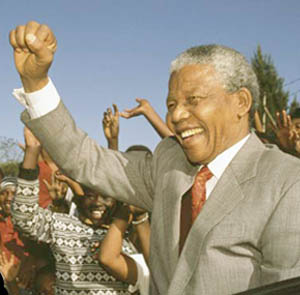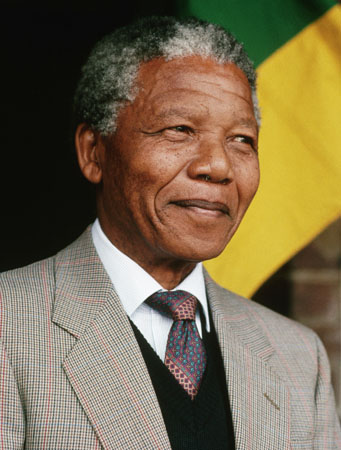
Nelson Mandela
In order to analyse Mandela�s leadership style, we need to have an understanding of his life. This gives us the insight to suggest that he was an optimist, and placed a high priority on values such as human dignity, reconciliation of people and national identity. These all drove Mandela to be one of the greatest leaders in our history.
Childhood
Rolihlahla Mandela was born on July 18, 1918 in the village of Mvezo in Transkei, South Africa to Chief Henry Mandela of the Thembu Tribe.
Mandela�s childhood was peaceful, spent cattle herding and other rural pursuits, until the death of his father at age nine landed him in the care of a powerful relative, the acting regent of the Thembu people, Chief Jongintaba.
Having run away from his guardian to avoid an arranged marriage, Mandela joined a law firm in Johannesburg as an apprentice. While working here he completed his B.A degree via correspondence.
The apartheid-driven National Party won the 1948 election and drove Mandela to join the ANC Defiance Campaign of 1952 and the 1955 Congress of the People, both of which supported the anti-apartheid cause. He also opened the Mandela and Tambo legal firm with his friend and helped under-represented black South Africans to obtain legal representation.
Years of daily exposure to the inhumanities of apartheid, where being black reduced one to the status of a non-person, kindled in him a kind of absurd courage to change the world.
Due to increasing conflict between political sections of South Africa, Mandela helped open the armed wing of the ANC. Although he believed in peaceful protests and the work of Gandhi, Mandela also recognized that their non-violent actions were being fought with violent means, a tactic that was only increasing in danger. He helped arrange a sabotage of targets of the current government in order to end apartheid.
Imprisonment
Mandela ran from the government for seventeen months whilst still trying to raise awareness for the fight against apartheid. He was eventually caught on August 5, 1962 and sentence to five years for illegally leaving the country. During his sentence the ANC leaders, including Mandela were sentenced to life in prison for attempting sabotage and treason in previous years.
Mandela spent the next eighteen years on Robben Island where he was forced into hard labour at a lime quarry as part of his classification as a political prisoner. Whilst serving his sentence he studied law via correspondence with the University of London.
In 1982, Mandela was moved to Pollsmoor Prison with other political prisoners in order to seclude him from influencing the prison population and other outsiders. During his time here, President P.W Botha offered Mandela freedom in exchange for giving up the struggle against apartheid. Mandela refused, and remained in prison.
Release
On 2 February 1990, State President F.W. de Klerk reversed the ban on the ANC and other anti-apartheid organisations, and announced that Mandela would shortly be released from prison. Mandela was released from Victor Verster Prison in Paarl on 11 February 1990. The event was broadcast live all over the world.
On the day of his release, Mandela made a speech to the nation. He declared his commitment to peace and reconciliation with the country's white minority, but made it clear that the ANC's armed struggle was not yet over. He also said his main focus was to bring peace to the black majority and give them the right to vote in both national and local elections.
In 1993 Mandela was awarded the Nobel Peace prize for his advocacy of non-violent rule. One year later he was inaugurated as South Africa�s first black President.
�During my lifetime I have dedicated myself to the struggle of the African people. I have fought against white domination, and I have fought against black domination. I have cherished the ideal of a democratic and free society in which all persons live together in harmony and with equal opportunities. It is an ideal which I hope to live for and to achieve. But, if needs be, it is an ideal for which I am prepared to die.� (Mandela, N, 1990)
Leadership Style
Mandela witnessed the dynamics of leadership early on. His guardian presided over tribal town meetings which often lasted for days and did not end until everyone had had a chance to speak his mind. Nelson sat and watched as his guardian listened in thoughtful silence. Only at the end would Chief Jongintaba speak, and then it was to nurture a consensus. Mandela learned a leader does not impose a decision, he moulds one.
His lessons learnt from watching his guardian were evident in his chair meetings of the National Executive Committee. His face becomes a mask as he notes each person�s views and registers the course of the discussion and argument. He knows the weight of his opinion and holds it in reserve until it is deemed necessary. If there is a deadlock he attempts to resolve it. Otherwise, he tries to steer the argument toward consensus. (Stengel, R, 1994)
Mandela has one distinct leadership style, transformational whereby �individuals who use their power to influence followers to behave in such a way as to accomplish the leader�s goals.� (Dubrin, A, et al 2006, PG 105)
However, he also displays qualities of a servant leader style. �A servant leader places service before self-interest, being more concerned with helping others than acquiring power, financial reward and status.� (Dubrin, et al, 2006) Mandela shows his servant leadership style when he was offered freedom from prison if he gave up, but he refused.
Transformational leadership focus on what a leader accomplishes rather than personal characteristics. (Dubrin, A, et al, 2006) Mandela drove change by appealing to followers values, reframing or realigning issues and operating at a high stage of moral development.
He accomplished the above three issues by raising peoples awareness of the apartheid; he helped people look beyond self interest and encouraged them to look for self-fulfillment. He helped people to understand the need for the changes he was trying to make. Mandela was only able to manage this because he was committed to greatness and adopted a long-range, broad perspective of the issues he was faced with. (Dubrin, A, et al, 2006, figure 4.2, pg 106)
According to Dubrin et al, there are four key qualities a transformational leader must posses and Mandela certainly has all four. These consist of the following;
- Charisma
- Inspirational Leadership
- Intellectual Stimulation
- Individualized Consideration
The biggest quality Mandela possesses is charisma. �Charisma is the special quality of leaders whose purposes, powers and extraordinary determination differentiate them from others.� (Conger, et al, 1988). The following quote was said by one of Mandela�s bodyguards �I used to do it for the money, now it�s for him. I�d take the bullet for him.� (Sampson, 1999)
Mandela is such a charismatic figure that no-one would suggest that he leads from behind. However, he has always made his authority felt on two levels. He has at times moved out ahead of his colleagues and audaciously created policy, other times he has been content to plant the seed of an idea that bears fruit only many years later. This suggests that Mandela understands the importance of combining a range of leadership styles.
�When you want to get a herd to move in a certain direction, you stand at the back with a stick. Then a few of the more energetic cattle move to the front and the rest of the cattle follow. You are really guiding from behind that is how a leader should do his work.� (Mandela, N, 1990)
Inspirational leaders display great strengths and one of Mandela�s colleagues made note that he had nerves of steel and that he could be brutal in a calm collected manner at the negotiating table. (Sampson, 1999) Mandela also negotiated in a manner whereby he didn�t compromise his principles and made a point of not humiliating the opposition. �He realized that if somebody is humiliated, their outlook could become dangerous.� (Sampson, 1999)
Mandela�s determination is evident in the amount of time he spent in jail. Serving twenty seven years inside a cell would have broken most people�s spirit and they would have come out looking for revenge, but not Mandela. �It is simply that he harbours little bitterness in his heart; he knows that bitterness will not move him an inch closer to his goal.� (Stengel, R, 1994)
Criticisms
If there has been a consistent criticism of Mandela over the years, it is that he is too willing to see the good in people. Mandela defends himself by noting that thinking too well of people sometimes makes them behave better than they otherwise would. (Stengel, R, 1994)
In the midst of his election Mandela regrets the fact that he did not have enough time to play with his grandchildren. However, he accepts that this is a burden of the leadership he was born to and has achieved. (Stengel, R, 1994)
Conclusion
When in jail Mandela was surrounded by armed guards who never took their eyes off him. Now, wherever Mandela goes he is still surrounded by armed guards who never take their eyes off him.
In a sense, he has exchanged one form of prison for another, and the revolutionary who was a threat to the state has now become the prisoner of fame and power. (Stengel, R, 1994)
From this analysis we gain a great understanding of Mandela�s qualities and can classify him as a transformational leader. His vision of freedom, his determination, and his hard work allowed him to accomplish the abolishment of apartheid in South Africa, and consequently become one of the greatest leaders in our history.
References
Dubrin, A.J, Dalglish, C, & Miller, P, (2006), Leadership 2nd Asia Pacific Edition, John Wiley & Sons, Australia
Sampson, A, (1999), Mandela the Authorised Biography, Harper Collins Publishers, London
Stengel, R, (1994), The Making of a Leader, retrieved from www.time.com/time/time100/leaders/profile/mandela_related.html on 17th March 2008
Business Matters, Nelson Mandela Biography, retreieved on 14th March 2008 from http://www.woopidoo.com/biography/nelson-mandela/index.htm
Nelson Mandela Biography, Retrieved on 14th March from http://en.wikipedia.org/wiki/Nelson_Mandela