 |
 |
 |
| Tenzin Gyatso - THE DALAI LAMA |
 |
|
| Introduction
This essay attempts to delve deep into the life of the Dalai Lama and the reasoning behind his success as the political and spiritual leader of the Tibetan people. We first look briefly at the life history of the 14th Dalai Lama and this uncovers many of the strengths to his leadership style in line with the servant and also trait theory of leadership. On the other hand we will look at the challenges he faces and the weaknesses in his approach. The 14th Dalai Lama Tenzin Gyatso was born Lhamo Dhondrub in Taktser, Tibet in 1935. He was chosen at the age of 2 years old as the Tibetan people believed he was the reincarnation of the previous Dalai Lama. Therefore through no choice of his own he was thrust into this position of leadership and began being prepared for it at a very young age. The Dalai Lama is not only the spiritual leader of the Tibetan people he is also the political leader as he is the Head of State. Consequentially he faces a larger range of challenges and in order to be successful he has had to adapt his leadership style accordingly. The Tibetan people believe the Dalai Lama to be the manifestation of the Bodhisattva or Buddha of compassion (The Government of Tibet in Exile, 1997) reincarnated time and time again to serve the people. As a result of this he believes that his spirit will serve the people for eternity and his physical form is just a mechanism enabling him to walk the earth. |
| Short Life History
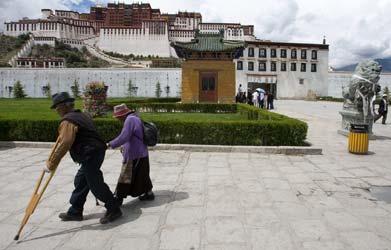
The Dalai Lama began his education at the age of 6 and by the time he was 25 he had completed a Doctrine of Buddhist Philosophy or Geshe Lharampa (The Government of Tibet in Exile, 1997). In 1950 he assumed full political power of Tibet and soon after the Peoples Liberation Army invaded Tibet. He conducted peace talks with Chinese leaders in 1954 but to no avail. This caused an uprising of the Tibetan people calling for their independence from China although this was brutally stopped by the Chinese army (The Government of Tibet in Exile, 1997). In 1959 the Chinese army attacked Tibet and thousands of Tibetan people including their political and spiritual leader had to flee to Dharamsala, India, where they still live in Excile today (Kustra, M 2004). During this time the Dalai Lama has appealed to the United Nations numerous times resulting in a call for China to respect the human rights of Tibetans (The Government of Tibet in Exile, 1997). The Dalai Lama immediately started to rehabilitate refugees in agricultural settlements, develop and education system and promote economic development (The Government of Tibet in Exile, 1997). In 1989 the Dalai Lama won the Nobel Peace Prise for continuing to pursue peaceful methods of regaining and preserving the culture and heritage of his people, not once advocating war and violence. |
 |
| http://www.boston.com/news/globe/city_region/breaking_news/Dalai%20Lama.jpg |
| Leadership Theories and Strengths
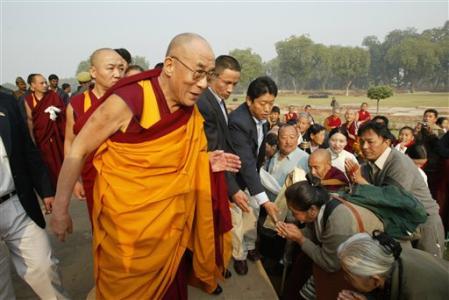
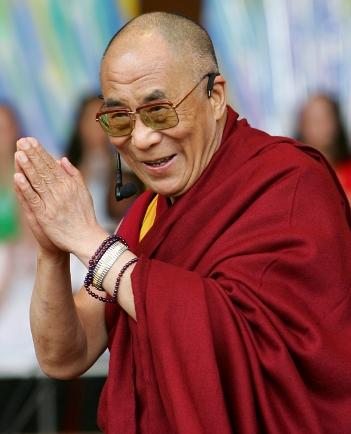
This amazing inspirational leader has a vision for the future of a free liberated Tibet. The Tibetan people share this same belief system and strongly agree with the direction and together they are working towards this common goal. Consequently his success as a leader can be attributed to this. Tenzin Gyatso is an exemplary leader as he places the people he serves before himself with absolutely no goal of personal gain or power (Kustra, M 2004). This is directly inline with the Servant Theory of leadership. Many of the Servant Theory attributes as outlined in (Dubrin et al, 2006 page 69) are seen in the Dalai Lama. He places the people he serves before his own interests and even his own personal safety. An example of this is in 1959 when he marched out of his home alone to confront the Chinese military which had just invaded his compound (Kustra, M 2004). This demonstrated bravery and a participative leadership style as he is not afraid to get his hands dirty and the people respect him for this. This also proves his commitment and willingness to sacrifice for his people. The Tibetan people are continually fighting against repression from the Chinese and there are many accusations that they are trying to destroy their Buddhist faith. This became evident in the 1960s when thousands of monks were killed at monasteries throughout Tibet by gangs of students (Lak, D 2008). The Chinese do not admit to having any policies in place to diminish their culture and heritage. Even today you do not have to look far to see the population shift of Chinese people into Tibet overwhelming local culture, ethnicity and language (Lak, D 2008). It is important to understand the circumstances and the environment in which the Dalai Lama operates in, in order to understand the type of leader he is and how he has developed these skills. Leadership success or effectiveness is often �judged in terms of attainment of goals in a manner that is not forcefully resisted by group members� (Frank, M 1993 page 382). The Dalai Lama has had many successes during his time in power together with gaining support from the west and recruiting many more followers from outside Tibet, including celebrities and law makers from several different countries (Gartner, H 2004). This can be greatly attributed to the Dalai Lamas empowering enlightenment and charisma. Charisma is defined as �The ability to develop or inspire in others an ideological commitment to a particular point of view� (Frank, M 1993 page 383) and in the case of the Dalai Lama one of these commitments is to improve human rights in Tibet and the world using peaceful approaches. The Dalai Lama�s charisma stems from his ability to deeply touch people of all religions (Gere, R 2005). He can be classified as a divine charismatic which is defined as a person with a gift of divine grace, a saviour who would lead people through a crises (Dubrin et al, 2006 page 96). This divine grace extends from the common belief that he is the reincarnated manifestation of the Buddha, the Buddhists equivalent to the Christians God. The 14th Dalai Lama�s amazing appeal is created by his big smile, infectious laugh, honesty, calm personality, sense of humour and his ability to explain complex Buddhist Theories to anyone. The fact that he is not bitter or filled with any hatred towards the Chinese people places him in a unique category of people that are greatly admired. Evidence of this is that Time Magazine places him in the world�s top 100 influential people (Gere, R 2005). Furthermore he empowers people giving them a hope of the possibility of a better world and no one leaves his presence without feeling uplifted (Gere, R 2005). Additional evidence of the Dalai Lama success as a leader of his people includes being awarded honorary citizenship of Canada and winning the US Congressional Gold Medal therefore joining other successful leaders such as George Washington, Pope John Paul II and Nelson Mandela (The Times of India, 2006). This acknowledges his peaceful efforts for improving human rights throughout the world. Leadership Weaknesses There are a number of conflicting stories about the Dalai Lama as a person causing some outsiders to remain sceptical. These mainly come from the Chinese people who portray him as a totally different person. According to (The Shadow of the Dalai Lama, 2003) there is �overwhelming evidence� of his autocratic and undemocratic leadership style, coming from within his ranks. This may seem like a contradiction as he is fighting communist China for a democratic Tibet. On the other hand the Dalai Lama continually emphasises the fact that once regaining independence for Tibet he will step down as the political leader (The Government of Tibet in Exile, 1997). The contradictions continue as he is portrayed by some to have an autocratic style of leadership and acts as a dictator to suppress any political opposition and for that reason goes against what a true democracy stands for. The Dalai Lama is known to develop his political policies not through dialogue and discussing the needs of his people but through spiritual oracles and what the faith believes the people need (The Shadow of the Dalai Lama, 2003). The spiritual power of the Dalai Lama is quite evident although he actually has almost no political power at all. His government is in exile and is not recognised by any other state and he does not control any territory (Sappenfield, M et al, 2008). His spiritual approach to politics has frustrated many young Tibetans who believe in taking a different approach towards China. This has come to light recently with radical Tibetans defying the Dalai Lama with aggressive protests, burning of the Chinese flag and calling for a boycott of the 2008 Olympic Games (Sengupta, S 2008). Although this is only a handful of Tibetan radicals it shows the Dalai Lama may be out of touch with some of his people. The protestors are angry and believe that the �middle way� approach has achieved nothing for 30 years and are calling for total autonomy of Tibet (Sengupta, S 2008). This political weakness is contributed to by the fact that he still must act as a Buddhist monk and the Buddhist vision is not always in line with the demands of politics. |
 |
| http://atrocitynews.files.wordpress.com/2006/12/dalai_lama.jpg |
| The Development of Leadership Skills
The development of the Dalai Lama�s leadership skills began at a very young age when he began his training to become a Buddhist Monk. This taught him compassion, warmth, enlightenment, self awareness and his role as a servant to the people. These are the key fundamentals to what the Buddhist faith is based on. Coincidently this coincides with many of the general personality traits of effective leaders as outlined by the Trait Theory of leadership in (Dubrin et al, 2006 page 29). Some of these are intrinsic and some are developed by the culture in which the Dalai Lama was brought up in. The Dalai Lama has developed and enhanced components of his charisma, previously discussed, by improving his communication skills and engaging in more subtle self promotion. He has done this by going on many world tours, taking part in interviews, making speeches about the Buddhist faith and to gain support and create awareness for the rights of his people. Evidence of this is his recent Australian tour in 2007. He also creates relationships with other leaders and people in a position of power, for example his recent visit to the Vatican to meet with Pope Benedict (Foxnews 2008). Also he maintains a high level of energy, enthusiasm and optimism throughout his entire day even though his government and he personally are in exile. This as well as his intense persistency contributes to his charisma and therefore a very powerful leadership tool. |
| Conclusion
The 14th Dalai Lama is an inspirational leader. He has never given up on his vision or his people despite the many challenges and hardships they have faced together. The situation that he finds himself in is quite hard to believe in today�s world although he has used his charismatic and servant leadership skills to gain great support and additional followers from around the world. He has done this by peaceful methods, never once advocating violence or showing any hatred or anger towards the regime that has repressed his people for so many years. The Dalai Lama has had to juggle the roles of political and spiritual leader and this has developed a weakness in his leadership style. First and foremost he is a Buddhist monk and the peaceful vision of this faith is not always what is required politically. |
 |
| http://www.lamayeshe.com/podcasts/lamas.jpg |
 |
| http://www.boston.com/news/ |
| References
The Times of India (Sept 2006). Highest US Civilian Honour for Dalai Lama. Retrieved on 18/04/08, from http://timesofindia.indiatimes.com/articleshow/1992398.cms Gartner, H (April 2004). CBC News: In depth � The Dalai Lama. Retrieved on 18/04/08, from http://www.cbc.ca/news/background/dalailama/interview.html Frank, M (1993). Library: Dictionary. Retrieved on 18/04/08, from http://www.latinoleadership.org/research/library/dictionary.html Gere, R (2005). The 2005 Time 100: The Dalai Lama. Retrieved on 18/04/08 from http://www.time.com/time/subscriber/2005/time100/heroes/100lama.html Foxnews (October 2006). Pope Benedict XVI Meets With Dalai Lama. Retrieved on 19/04/08, from http://www.foxnews.com/story/0,2933,220497,00.html Sengupta, S (March 2008). Scotland on Sunday: Tibetan Radicals Defy Dalai Lama. Retrieved on 19/04/08, from http://news.scotsman.com/latestnews/Tibetan-radicals--defy-f hDalai.3906497.jp The Government of Tibet in Exile (September 1997). The Dalai Lama�s Biography. Retrieved on 19/04/08, from www.tibet.com/dl/biography Kustra, M (June 2004). Spiritual and Political Leadership: The Path to Enlightenment for the Dalai Lama. Retrieved on 17/04/08, from www.markkustra.com/pdf/developing/pdf Lak, D (March 2008). CBC News: Flames on the Roof of the World. Retrieved on 10/04/08, from http://www.cbc.ca/news/background/dalailama/ The Shadow of the Dalai Lama (2003). Critical Forum for the Investigation of the Kalachakra Tantra and the Shambhala Myth. Retrieved on 10/04/08, from http://www.iivs.de/~iivs01311/SDLE/Annex.htm Barboza, D (March 2008). New York Times: Growing Gulf Divides China and Dalai Lama. Retrieved on 10/04/08, from http://www.nytimes.com/2008/03/29/world/asia/29china.html?_r=1&pagewanted=2&hp&oref=slogin Ni, C.C ( March 2008). Los Angeles Times: Dalai Lama�s Threat Shakes Buddhism. Retrieved on 16/04/08, from http://www.latimes.com/news/nationworld/world/la-fg-dalai26mar26,1,1572034.story Sappenfield, M. Ford, P (March 2008). The Christian Science Monitor: Dalai Lama Must Balance Political and Spiritual Role. Retrieved on 19/04/08, from http://www.csmonitor.com/2008/0324/p01s03-wosc.html?page=2 |
 |