Logbook of the Nausikäa
Home
The Boat
The Crew
The Logbook of the journey
Sign Guestbook
View Guestbook
The Weather forecast on our route
Falmouth-Laxe (Spain) 22 August-28 August
On our way to Falmouth we had met the crews of ‘the Three Brothers’, a traditional 100 year old Folkstone Lugger (a bit like a cornish crabber, beautiful wooden 12m sailing boat with 2 masts) and ‘the Hambledon’, an ex navy utility vessel (35 m, built solid like a trawler which had been used to carry numerous sailors to the warships (photos)).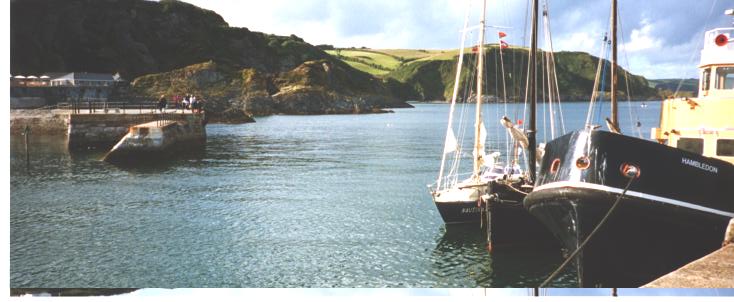
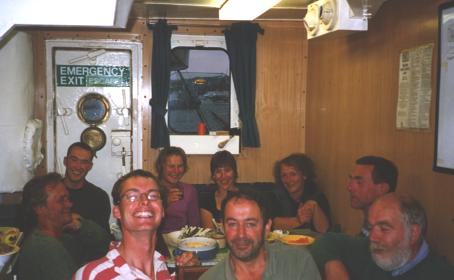
In the tiny fishing harbour of Mevagissy, 15 miles before Falmouth, where our boats were moored together, friendship between the crew of this odd couple of boats was soon formed when the Hambledon invited us to have a (much desired) hot shower, after which the Three Brothers invited us for drinks and we brought schippersbitter (liquor) and borrelnootjes and crisps. Curious about the two other boats, one being huge, with a high bridge, industrial kitchen which would easily cater for a few platoons of hungry marines after D-day and impressive engine room full of pipes and pumps, the other one being old but very well cared for, its surprisingly large cabin filled with tasteful interior like brass portholes and oil lamps, we gladly excepted the invitations for tours on the other boats.
The showers, drinks and discussions (to join or not to join the Euro, what else…) were so good that we gladly accepted the invitation to raft together in Falmouth: Hambledon would drop her big anchor and three brothers and us could tie up to her for two nights in Falmouth. We learned that the invitation for the showers by Humbledon had come because our newly made friends had served on submarines and if anyone, they knew the luxury of a hot shower.
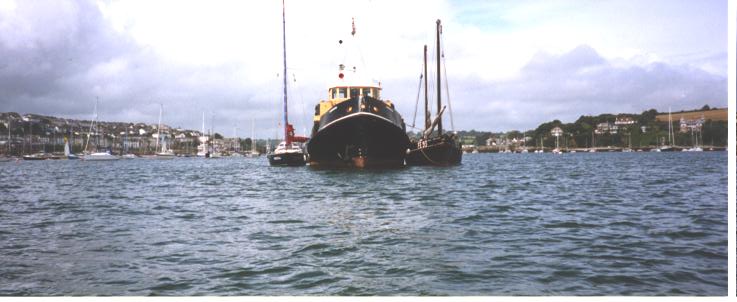
Falmouth
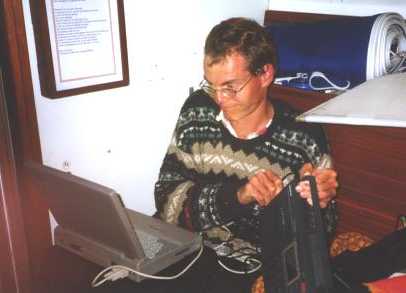
Joint meals were cooked and enjoyed while we discussed the future: Hambledon would be sold soon, the Three Brothers would go to Bristol where Jeremy and Mariana would teach and we had the crossing to Spain ahead. And the weather was not very stable at all: lots of depressions all over the Atlantic, rapid changing weather patterns combined by our desired to cross, formed an unhealthy combination. After two nights, both neighbours went their way and we started to become even more anxious to leave. Preparations were made to bring the boat and sails in top condition for the crossing: the cutter stay (a stay from the middle of the foredeck to the mast at spreader height) was completed for the storm jib, the rigging was checked, last shopping done and I worked hard to get the laptop and shortwave radio to receive weather faxes (finally succeeded in receiving part of a map of the North Pool weather and then had to stop due to power problems-no sun, bl…. English weather (photo of jeroen receiving a weather fax)).
Falmouth fireworks (at the end of the Falmouth regatta week) had raised high expectations but were a bit of a disappointment. The first attempt was made on Friday night and people had lined up at the quays and sea side to watch the fireworks being launched from a barch in the bay. We were well positioned to have a first class view when an unhappy harbourmaster (‘it has nothing to do with us’) who had been very active in chasing away boats that came ‘too close’, announced that the ship with fireworks was stuck on a bank up river and could not make it in time. Fireworks postponed 24 hours. On Saturday night the fireworks did start and were building up but suddenly ceased. We turned on the VHF again and just heard the (very unhappy) harbour master explain to the fireworks man that the sparks from his fireworks were landing on the huge tanker in the Falmouth dock and that the captain had complained. Could the firework man guarantee that no sparks would land on the tanker again?
After 20 minutes the fireworks resumed and were stopped again. Obviously the harbour master was not very popular after this event and (good for us) we did not see him again to charge the harbour fees…
A daily visit to the library (internet computers) provided us with all kind of weather maps from 24 up to 120 hours ahead, but most of the time, the weather proved unpredictable and the maps wrong. On Wednesday 22 August, when the actual situation looked better and the predictions rather good (kind N-W winds for some days ahead) we decided to go. It was a dead calm day and against all principles, we motored for 4 hours past Lizard point. There, it showed once again that we indeed do have a sailing boat and that just like in the old days, these boats are for sailing: oil pressure dropped to near zero and I was just in time to stop the engine before it would have stopped it self. … Guess what, the wind picked up and we hoisted the Spinaker and sailed past the Scilly Islands.
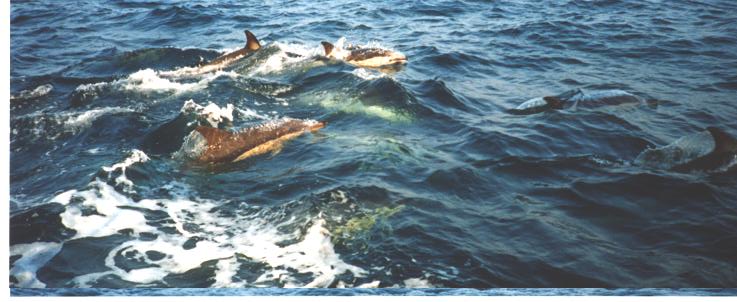
The following days there was not much wind, and if there was, it was on the nose. On the 4th day at sea, we were only half way with over 250 miles to go and seriously counted the pieces of fruit and fresh vegetables that we had left. During one of the lulls Ton saw small plumes of ‘smoke’ at the horizon. Smoke? In the middle of the Bay of Biscay? That must be something else! Whales!! Observing the smoke fountains exploding and slowly vanishing with 1 minute intervals (there were about 5 of them), we were hoping to see part of the whales, but no, they were very far away. Later on there were dolphins around the boat also, very close.
 After a few (grey and windless) days at sea, a regular life started to appear. For a change, Mira organised a party to which Ton and I were invited. The food was good: Greek dolma’s from a can and a nice red Cape wine. Also we had music for a change, as there was no sun, and the top light was on all night, the battery was running low without a chance to charge from the engine so we did not use the fridge or the radio. Mira had also invited some whales apparently, but this time they had a different spout of ‘smoke’: much smaller but nearer to the boat and we saw the tail, head and back fin of the whales, about 1,5 mile away. We were all very excited and Ton was calling the whales to come closer while Mira and I were not too sure whether we would like to have these whales closer, as they were huge. A big whale can be 3 times longer than our boat (9m) and can weigh just under 200 tonnes (we are about 4,5 tons). Even with the slightest itch on its tail, a large whale could just wipe out our whole boat, perhaps even without noticing it.
During the crossing, the Met office (weather forecast) had been predicting N and NE winds for days and when we finally got them, the fifth night, they picked up rapidly to gale force and we were running with all sails down and just the storm jib left. It was a bit scary but good because we were finally making miles now. The last night at sea, 50 miles from the Spanish coast, we got into a bad thunderstorm that raged for 3 hours and was quite wild. Some times the lightening was so intense that you could read a book with the light. Lightening went from east to west in the clouds over our heads and some times it struck down to the sea. Alone at sea our mast was by far the highest point and I was worried that we would be hit by lightning so I made a cable that ran from one of our back stays into the sea and we disconnected the most important electronics (radio, VHF) from their antennas. Remembering some of my highschool physics classes, we put the GPS (our most important electronic gadget for navigation) and the handheld VHF (necessary to call for help in case of an emergency) in the pressure cooker, a perfect stainless cage of faraday. When the thunderstorm was over, I was exhausted and went to sleep while Ton and Mira took the watch from me and we started sailing again as the wind slowly picked up again.
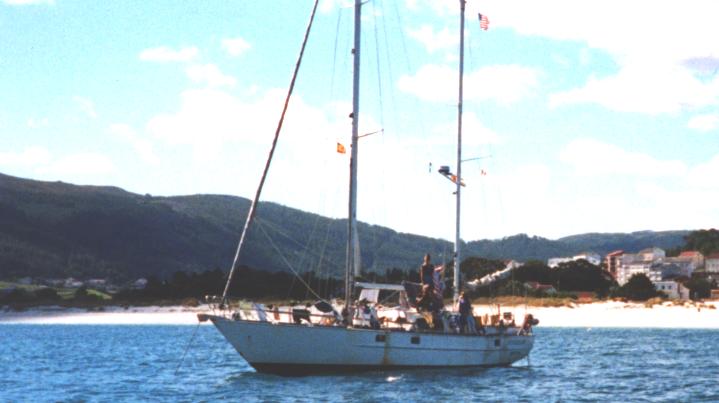
The following evening, after a total of almost 7 days of sailing, we made landfall in Laxe, a tiny little fishing village in Galicia, Spain. Much to our surprise there was a pontoon (brand new and not yet mentioned in our almanac) and we found a fresh water shower on the beach to shave, wash the salt from our faces and hair and the smell from our feet etc.
Laxe
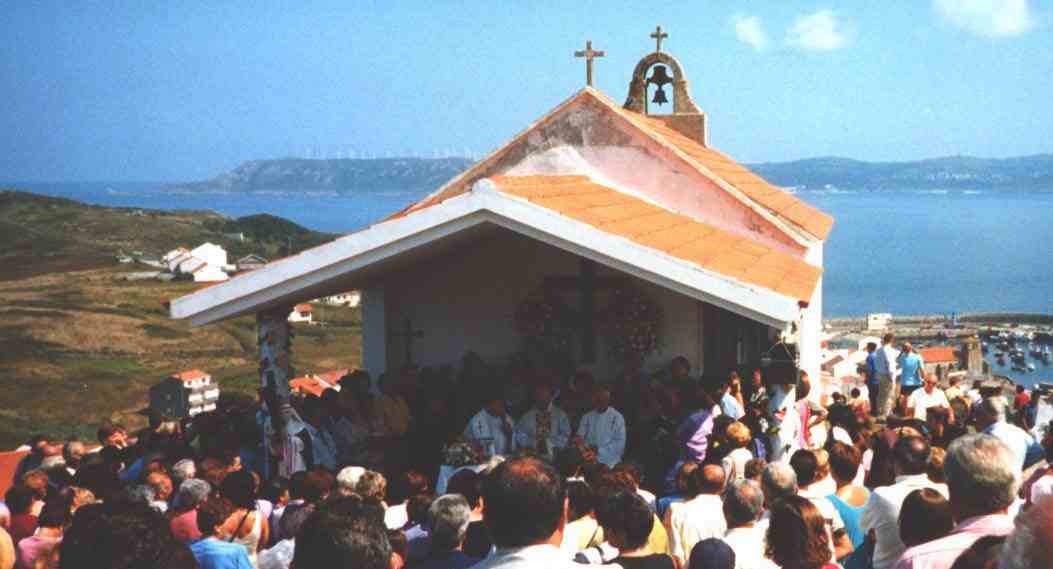
Laxe proved to be a nice place to have some rest after the crossing, but the third day there was the fiesta de Santa Rosa de Lima, the local ‘virgen’, and there was an open air mess at the chapel on the hill top overlooking the atlantic on the one side and the village and beach on the other. After the mess there was a procession with statues and bagpipe (!) music. There were lots of fireworks, official and unofficial ones, during the procession, and in contrast to Falmouth, while burnt fireworks were landing in the crowd, no one seemed to worry. More fireworks at all times of the rest of day. The fiesta was closed at 2 at night with tremendous fireworks from the beach that started again and again, each time bigger and better and rocked the whole village for half an hour.
 <
<