m i m a i o n l i n e
who ::
what ::
when ::
where ::
why ::
whoa
|
| m i m a i o n l i n e |
| |
| 
| 
| 
|
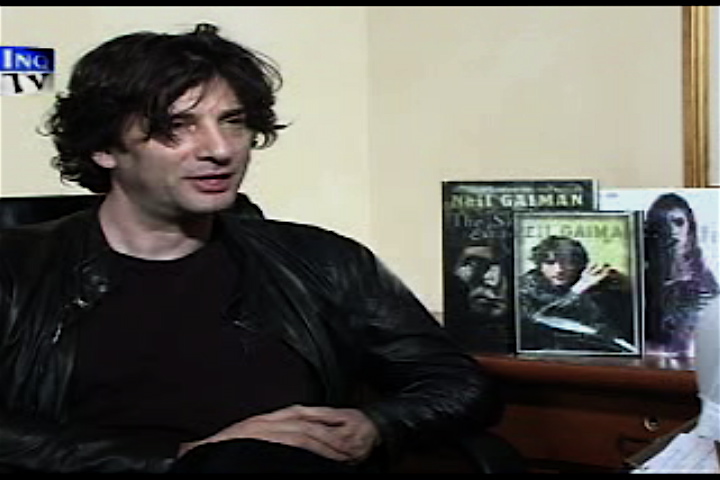
Neil Gaiman on Harry Potter, morning TV show hosts
and the joys of writing for porn magazines
|
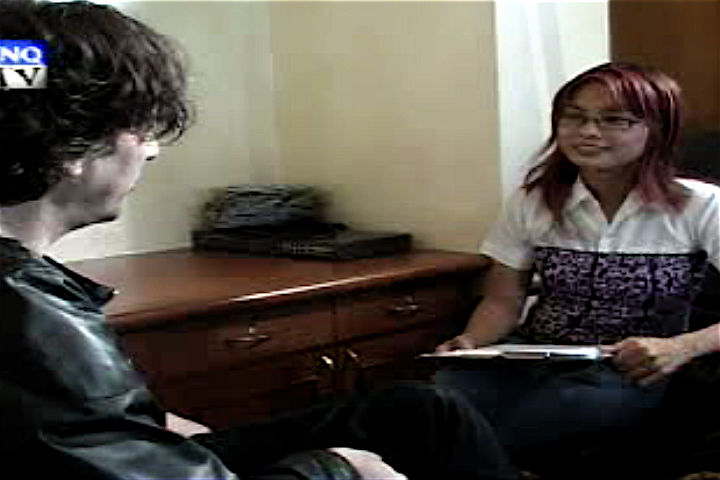
July 9, 2005 From Singapore to Manila... You mentioned in your journal that you found Manila funky. You dropped by Rockwell earlier today. Well, I heard people talking about it... News travel fast. So you�ll get to meet those artists later on? That's on Monday, right? Here we go. Here, we have a very high level of literacy, 93 or 94 percent can read and stuff but we actually don't do it. For example, when I was a student we barely even touched our textbooks. We didn't do anything in the form of reading. So how did you get started on reading when you were a kid? You said you were one of those kids who were born to read. How about those kids who weren't born to read? How would you encourage them? It happened with Sandman as well. You know, the joy of comics. We live in a world in which comics have gone from being, over the last 25 years, a completely despised medium around the world to being a powerful commercial force taken seriously academically. I'm not saying that every teacher in the world will love it if you're reading comics but most of them have actually noticed that comic books have 200 words on that page. I was one of the kids, my teachers would tell me not to read comics and I'd say, "Why not?" And they'd say, "Well, they stop you reading real things." And I said, "I just won the school English prize. The only reason I know how to spell all these weird words is I found them in comics." That's where I found them. On the one hand, I don't think there's anything wrong with reading comics. Technical difficulties Do we have to do it over and all? But I liked the first ones. So Neil, you have actually stumbled unto a country that doesn't do a lot of reading. We have a very high literacy rate, about 93 to 94 percent, but we don't really do actual reading of books, even textbooks. So how did you get started on reading at such an early age? And you were saying, family events... So now I've grown up... One thing that I love doing is just trying to get kids hooked on books by writing kids' books and books like Wolves in the Wall, and The Day I Swapped My Dad for Two Goldfish, and Coraline. The first one's a picture book so they have funky words. You want kids to enjoy the sound of the words and for parents to enjoy reading them to them. You have something like Coraline which I'm hearing a lot is now working for kids who are reluctant readers because it has... The trouble is when kids get a little behind these readers, there's nothing to read. If you are an 11-year-old with a seven-year-old reading age, you don't want to read the books seven-year-olds are reading because they're really boring. So the nice thing about Coraline is, it works its way up to fairly old readers but it also... (laughs, gets distracted) Sorry. So the thing about Coraline is it works its way up, adults like it and kids like it. The kids who are not very good readers are fairly good at it. I think the most important thing, honestly, for a lot of readers is comics. We have seen comics go from 25 years ago being a completely despised medium to being one where, you know, teachers and educators have now noticed that most comics have 100 to 200 words on that page as well as the pictures. The idea, people who didn't like comics think the words are stupid or kids skip over the words. That's not actually how it works. In order to make sense of comics, you have to read them. So with something like Sandman, you're looking at something that you're gonna be getting as much chewing material out of it as you might get out of a novel. But it's a really different experience; it's not the same experience you have reading a novel. It's pictures, it's comics. But it's there for the reluctant readers. And I have to say that from my perspective, it's very strange being told that the people of the Philippines don't like reading because I'm an author. I'm not a movie star, I'm not a rock star. I'm just somebody who writes. I make stuff up and write it down. Coming here and finding a sort of Beatle-mania early in the morning tends to indicate I would have thought an enormous respect for both the written word and the stories. Maybe the problem is that the things that are actually in the reading list are not the kind of books children want to read. We�ve been talking about natural reader as opposed to these kids who don�t get to read very much in their early childhood. Now let�s talk about frustrated writers. There are a lot of writers here who don�t actually get to practice their craft because they don�t think they have an audience. How can you advise them? What would you say? I�m fascinated by this enormous set of fan fiction community that has sprung up. I think that�s terrific. Everybody�s writing, everybody�s commenting on everybody�s writing. They have all sorts of rituals� I think that�s quite wonderful. I find some of the things they write about a little bit odd� �Coming from you. You�ve actually preempted about three of my next questions. They were going to be about online literature, fan fiction and Good Omens. So thank you for saving me the time of asking them. So next... We were taught in creative writing classes to keep the audience in mind. In some of your interviews, you were quoted as saying �I keep the artist in mind. I keep myself in mind, not just the audience.� Do you even try to strike a balance or how do you keep everyone happy? With Sandman, I remember looking online. I discovered there were online people talking about comics. Around 15 issues in, I thought, "What are they saying about Sandman?" And what they were saying was that it wasn�t quite as good as it was, as it used to be. And that was at issue 15. I spent my entire Sandman career with everybody online carefully posting that Sandman was not as good when it used to be. What I discovered was, what they meant was the point they started reading it and liked it and now it wasn�t doing that anymore, it was doing something else. The Kindly Ones, it was hated by readers when it came out but now it's probably the most popular �cause it�s all finished. It has the highest rating on Amazon.com. But then once you finish Sandman, what they want is more Sandman. With American Gods, which was the last big novel that I did in America for adults, and it won the Hugo Award, the Nebular Award, the Bram Stoker Award, and a bundle of other awards. And I had a publisher who offered to publish me. And I said, "Why not?" They were looking at me and they were very happy with my project. And they said, "Oh, we�re going to make you huge." And I said, "Oh, well, that�s great. How are you going to do that?" And they said, "Well, we�re going to make sure that all your next three books are exactly like American Gods, only maybe a bit more acceptable so that all the people who liked American Gods will like these just as much." And I said, "Great, I�m not signing with you." And I didn�t because I like a world which I can sort of... Neverwhere was an adventure, Stardust was a fairy story, American Gods was a great big sort of state-of-the-nation novel about America and mythology, and the new novel Anansi Boys is a comedy. I�ve decided it was time to write a comedy mostly I think because I started talking to people who now had figured out how they thought Terry Pratchett and I had written Good Omens all those years ago. And they figured I must�ve written a very serious novel and Terry must�ve walked behind me throwing jokes around, scattering them like that. And I just thought that�s just a very silly way, of you know� I wrote half that book, dammit. I wrote funny bits, too. Thought it would be nice to write a novel that makes people feel good and that�s what I did for Anansi Boys. In an interview with Colleen Doran, you mentioned something about being insecure at one point in your life. Tell me about not being considered a real writer since you were into comics. It was very weird, especially in the early years. But these days� It was really nice once I started writing the prose and getting the awards for the prose, because perhaps we helped make the comics more respectable to all. In the old days when I'd be invited to universities, it would be by the arts department and the English department would boycott the event or something ostentatiously. And these days, of course, all the professors there at the English department are inviting me out to talk. You might be happy to know that there is at least one university here in the Philippines that actually offers a course called comic book writing. So if I catch up with the professor later at the signing, maybe you could talk to him. What�s the first story you remember writing? As a kid, I�m sure you were already tinkering around and stuff. Do you still have the copy? People might probably love to� Didn�t she like it? But you told her that you wrote it, right? Did you really want to become a journalist at first or was it like just a stepping stone to you? But in even in journalism, you kind of went against the grain. You wrote for Knave, which is not exactly� (To crew) I think we should change careers. (To Neil) Was there ever a time when you wanted to go back to journalism, like screw all those graphic novels? Knowing that as opposed to� I just got off recently from a television project doing with a couple of other people from America. The other people that I was working with desperately wanted to do it and I don�t really mind; I�m really busy. So when they got their first set of notes back from the studio, the original outline... And they read all of the notes and took them as gospel and threw out most of the interesting things about the stories they�ve come up with and wrote this incredibly dull thing. And nobody wanted it and nobody liked it. It was boring. So I said okay, let me take over. And I went back and looked at it and� You�re not meant to believe all these notes from the studio. The studio basically is just saying "We�re not comfortable with that. We think you should change this." But mostly what they want is something really good. So I took half of the things that the studio had told them to take out and decided to put them back in. And sent it off and the studio loved it and everybody loved it because it was interesting. It can be really useful sometimes just to ignore what you�re told. My favorite story from that time as a young journalist who, on occasion, would write fiction: I gave a short story to an editor who rejected it about three weeks later. And I sat down and looked it over a few days, a few days after that. "You know, there�s nothing wrong with this. He�s being an idiot." So a week after that, I gave it back to him and said "I hope you enjoy the rewrite. I had completely rewritten it and let me know what you think." He phoned up the next day and said, "I just read it. Your rewrite really just makes it sing." And umm, and bought it the next day. (Gets distracted by something noisy) We were doing so well� The point being that, you know, you sort of don�t have to change things as much as people want. The joy, for me, of doing Sandman was it was my comics. How did you pitch Sandman to DC? In the past few years, Philippine comics have undergone a sort of evolution. But the problem is that, as with anything here in the Philippines, funding is kind of a problem at every stage. So it�s kind of difficult to convince readers to patronize them and hard for businessmen to believe that this is a project that is worth investing in. So what were the problems that you encountered at first? (Crew changes camera�s batteries) Going back to more comparisons between England and the Philippines, you�ve always been passionate about the Comic Book Legal Defense Fund. Here in the Philippines, it�s kind of the reverse. Press freedom is granted and guaranteed under our Constitution. But the problem with that is sometimes it can go a little overboard. What scenario would you prefer, the one in England or the one we have here? I happen to believe that I would much rather have press freedom; I would much rather have artistic freedom. I would much rather be able to say what I want to say and assume that any adult also has the right either to watch it, not watch it. Somebody doesn�t like what I�ve written, let them write about it. If you are in America and you hate what Michael Moore did, the solution is go make your own movie and talk about how much you hate what Michael Moore did. The solution is not trying to shut out Michael Moore. I think the First Amendment� you know, coming from a country where there are stuff you couldn�t say and you couldn�t see and you couldn�t read to a country in which it was guaranteed but was always under attack, I would much rather be out there manning the barricades and absolutely keeping the freedom. Head out to Singapore and explain to any of the people on the street the situation out here and which you would rather have, the government making sure there are things you can�t see or the situation out in Manila, I don�t think there�ll be an awful lot of them saying, "Oh, we really like censorship. We love not being able to see nipples on our screens. We think that�s so great." More on the media, in American Gods there is a modern-day deity called Media. You yourself, you come from the media. And this deity is self-absorbed, insincere and sometimes just downright annoying. So what�s your real take on the media? I think the media can be incredibly shallow. I think the media often is incredibly shallow. I figured if you were lifting things that get worshipped these days, TV gets worshipped. People sacrifice their time to it the way they sacrificed animals. Going back to that, the kind of religions that are popping up lately. Being an author, you�ve always had the power to influence a lot of people, but sometimes this influence goes to extremes like in the case of L. Ron Hubbard. What�s your take on the entire Scientology thing? So what would happen if you found out that someone was starting this religion in honor of you or in honor of Dream or something like that? I get weird enough honestly on account of the whole cult of personality stuff anyway. The reason for doing the blog, I have this blog over at www.neilgaiman.com, is� I could see the weird cult of personality that was growing in the 1990s and I really wanted to do something to deflate it because I�d turn up places and it would be obvious that people would expect me to be eight inches taller, much more pale, dressed in beautiful Gothic clothes and sort of mournful and beautiful, which is not me at all. And I said, "Well, if I�ve got my blog, people actually get to see the idea the work of a writer, what you do if you make stuff up, and it�s very hard to think somebody as a lonely, romantic figure when you're seeing them cleaning up cat vomit at three o�clock in the morning," which is why, you know, I tend to leave in cleaning up the cat vomit in a blog. I�m not sure it works probably because I never expected blogs to have the weird kind of power in their lives. It got to a point where we got several million people reading so it has become this sort of strange... on its own. (Iya de los Santos of Fully Booked reminds us to wrap it up) Last question. I�m sorry for using somebody else�s time� And downright self-absorbed� My last question: Here in the Philippines religion is a very big thing. And there�s a lot of gods and mythology in your books but somehow you�re kind of distant from everything and you�ve never mentioned Jesus. I�ve heard a lot of people... For one thing, that is something I�ve heard a lot of people ask, why don�t you talk about Jesus? Jesus was hitchhiking in Afghanistan in American Gods but he was not actually there. If I ever meet Steven Spielberg, I�ll tell him that you based your Jesus on him. Oh, cool. I guess we have to go� really, really great to talk to you. I don�t know if you�ll have time to sign all this stuff� Have you heard from Tori lately? They�re actually running out of numbers� They gave out 800 numbers� Jaime Daez of Fully Booked: Click here and know what it feels like for a (fan)girl. | ||||
Copyright 2005 Inquirer TV