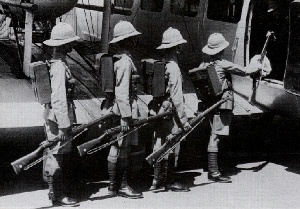
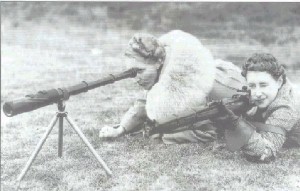
The first Lee-Enfield rifle was introduced in 1888. It was designed by James Paris Lee and It was named the Mk I. This first rifle had an eight round capacity and utilized Metford's seven groove rifling. Rounds on these rifles were loaded individually, charger clips not yet having been devised. It had a magazine cut-off which allowed the Mk I to be used as a single shot rifle while the rounds in the magazine were kept in reserve for emergencys. It fired a compressed black powder cartridge. 1890 saw minor changes, another minor redisign added a ten round magazine and a new Mk II model registration. In 1891 the rifle was modified to fire the higher velocity 303 cordite round. This new rifle was named the Lee-Metford Mk 1*. Sights for this rifle were revised for the new cartridge. Also the safety catch was deleted, which was reintroduced in 1893 with a new name, the Lee-metford Mk II*. By 1894 a Lee metford Cavalry carbine came into service which was shorter (by nearly 10 inchs), had only a six round capacity and a close fitting bolt knob. Metford's shallow rifleing was abandoned in 1895 due to wear resulting from the new cordite round. Deeper grooves were developed by Enfield and the Lee Enfield MkI rifle and Lee Enfield Mk I cavalry carbine were born. These magazine rifles quickly prooved their worth. In 1898, in Sudan, at the battle of Omdurman, some 10,000 Dervish tribesmen died at the hands of British troops armed with new magazine rifles. This design would continue to serve valiantly for nearly fifty more years.
The rifle met a major redisign in 1903. The new rifle, the SMLE (Short Magazine Lee Enfield) Mk 1, was intended for use by both cavalry and infantry units. Length decreased from 49.5 inchs to 44.7 inchs. In 1906 the rifle 's sights were changed and it was renamed the No 1 Mk III. These all carried Charging bridges which permitted a 5 round charger-clip to be used for quick reloading. This magazine accepted ten rounds. During world war I, in 1916, the rifle was again simplified to aid in production. This rifle did away with the magazine cut off and volley sights and was redesignated the No 1 Mk III*. This design lasted well into the middle of the second world war when it was replaced by the No 4 MK 1.
The No 4 was much like the No 1 Mk III*, except that it revized the nosecap exposing three inchs of the barrel and adding a apeture sight hinged over the bolt body. In addition these rifles bolt assembly was altered for easier removal. These were adjustable to 1200 yards. The No 4 Mk 1* was a design simplifing the rear sight to a flip up two apeture of 300 and 600 yards, these were produced at Lonbranch in Canada and Savage in the United States. Other war time designs included the No 5 Mk 1 jungle carbine , with shorter barrel and light weight, it was constructed for use in the jungles of the Pacific. The final design, appearing in 1949, was the No 4 Mk 2. It redesigned the trigger mechinism, hinging it integrally to a bracket on the body.
This is only a brief description of the major designs and major revisions of possibly the best Military bolt-action battle rifle ever devised. There are many other Enfield models, such as Lee Metfords thet were shortened to No 1 MkIII dimensions, but these are beyond the scope of this article. So Mr Lee's rifle saw wide service from the plains of south Africa to the icy cold waters of Normandy for over half a century. It also saw issue with most Of England's allies and colonies such as Australia, New Zealand, Malaya , Ireland, South Africa, India and Canada after WWI. |