|
| The |
| Number 5 MK I |
| Jungle Carbine |
|
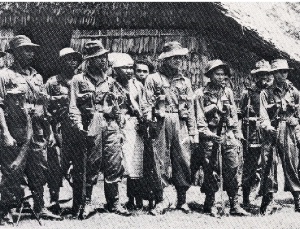 |
| SAS trained Malayan 'Ferret' unit, organized to battle communist insurgents. Note that they carry #1 MK III Enfields. #5s would also serve units like this. |
| The Conflict In Malaya |
| Arms In Action |
| The Jungle Carbine, with its light wieght and short lenght, was devised for close quarters jungle fighting in the Pacific Theater. It saw only limited use against the Japanese and it would see far more use in the fight against communism. In 1948 Britain re-occupied Malaya. Shortly after their return to the area, communist insurgants began to wage vicious guerilla fighting against the English Imperialists. The insurgants captured stores of old Japanese and English weapons and began their reign of terror, murdeing local European planters and laying seige to the region. A state of emergency was called on June 18, 1948. By 1950 the Rebels had killed nearly 1,300 civilians, soldiers and policemen. English consternation grew and a plan was devised by General Sir Harold Briggs to put pressure on the guerillas. The Briggs plan, named after the general, called for inhabitants of the countryside to resettle in fortified villages, deny the rebels food stores and create a military force to live in the jungle and harass the guerillas. Much of the plan had been devised by J.M. 'Mike' Calvert and it was he that implemented it. He formed a regiment of Gurkhas, SAS (special air service) reservists and territorials. Calvert instituted the plan by deploying small patrols into the jungle. These established outposts from which soldiers could lay ambushs along guerilla supply routes. The plan worked and the rebels, cut off from supplies, retreated deep into the interior. The rebels became so scarce that it took nearly 600 man hours to find just one, by 1956 it took an estimated 64,000 man hours. Soon the hunt for terrorists became a kind of game, units keeping score of kills in competition with other battalions. In his book, The Gurkhas, Byron Farwell reported that the civilians kept track of these kills and even distributed awards. Upon killing their two hundredth terrorist the officers' mess of the first and second Gurkhas received four silver beer mugs from the Jahore state counseller for their accomplishment. The pressure continued with thrusts deep into the jungle with paratroop drops in concert with ground troop advances. The English further courted aboriginal groups in the area and soon brought them into the fight against the communists. The terrorist acts shrank and by 1959 the state of emergency was over. In 2000, a large cache of No 5 carbines was discovered in a Malayan wharehouse and imported into the United States. It has been noted that some of these carbines still bear the Malayan police stamp of the unit to which they were issued. These Carbines, now on sale at local outletes, such as Big 5, were most certainly the rifles used by english soldiers and Maylan police in the fight against communism. |
| Caliber; 303 SA Ball Length: 39.5 inches (overall) Weight unloaded: 7lbs 2.5 ounces(3.25kg) Barrel: 20.4inches, 5 grooves,left hand twist Magazine: 10 rounds Muzzle velocity: c.2000fps (600mps) |
|
| Statistics |
 |
| An interesting product to come from Britain was the Enfield No 5 'Jungle carbine.' It was the last bolt action design adopted by a major power. It is as rugged and mean looking bolt action firearm as one may ever encounter. Unfortunately, its success as a military mainline rifle was limited and its service short lived. Despite its service performance, it is a wonderful shooter and collectable to military enthusiasts. In 1943, a request was made for a reduced size version of the SMLE. What resulted was a new rifle based on the No 4 action. The new rifle was nearly 5 inches shorter and 2 pounds lighter, representing a great weight savings over the No 4. The barrel was reduced in lenght from 25.2 inchs to 20.4 and the furniture was reduced, exposing much of the barrel. The rifle also featured a a series of lightening cuts where metal was removed where strength would not be compromised. Other features were added to the the carbine such as a rubber buttpad. The intent here was to absorb some of the extra recoil produced by the lightened rifle. Also added was a flash suppressor which gave the rifle a distinctive look. The rear sling swivel was moved to the side of the buttstock and the rear sights were graduated to 800 yards instead of the standard 1300 yards of the No 4. Production of the new rifle began in 1944 at Fazakerly and Shirley arsenals. The Number 5 saw use in Malaya and Kenya, but eventually fell out of favor with the British government. This was mostly due to the problem of the wandering zereo that the carbine was reputed to have. Much effort went into determining the cause for this problem, but an effective solution was never discovered and production of the No 5 was halted. Over a quarter of a million No 5s were produced by the time production ceased in 1947. Despite its limited military service, they are now highly sought after collectibles. They are immensly fun to shoot if you do not mind the recoil. The report of these little rifles is also quite amazing. For the time, jungle carbines are more affordable than they have been in years and easily obtainable. If you have been thinking about one, now would be the time to get a N0 5 before prices rise again. |
| History of the |
| No 5 mk I |
 |
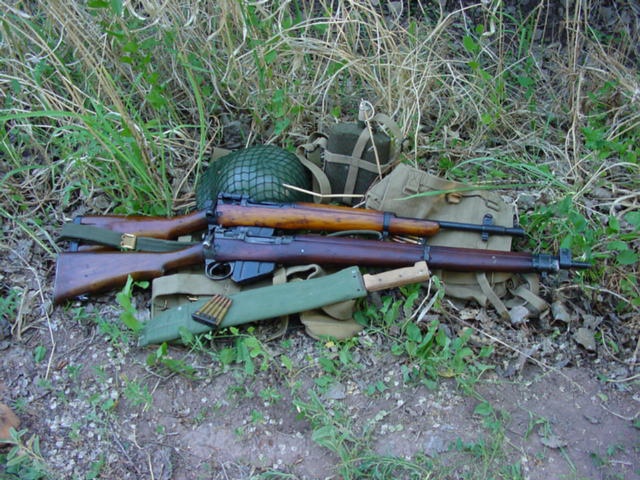 |
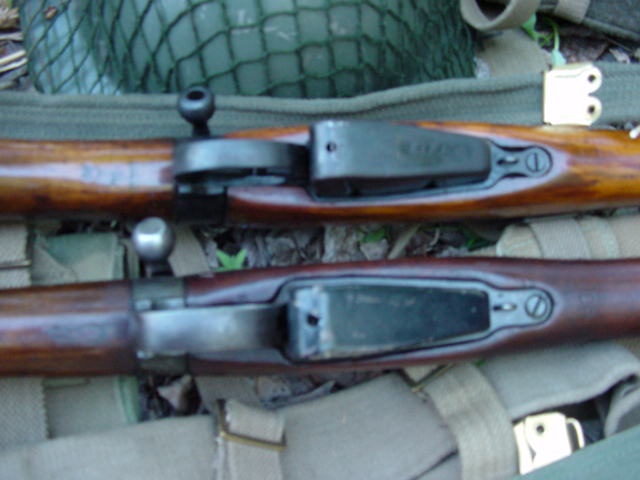
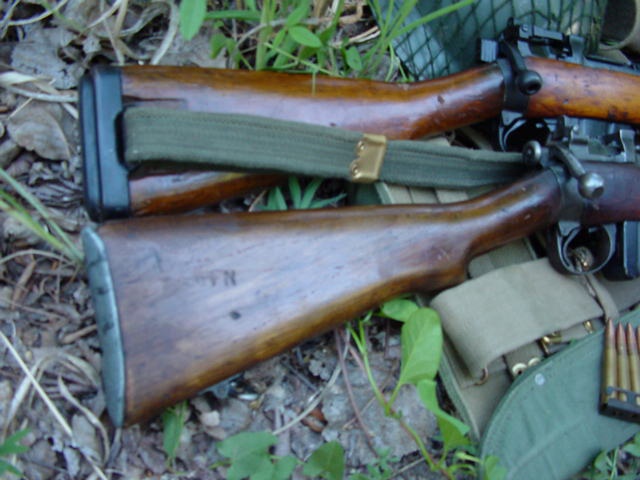
| No 5 Mk Is- on the left is a pre-1968 imported 1947 dated carbine from England, on the right is one of the recent imports from Malaya, dated 1945, both are Fazarklys. Shown with P-37 web gear, WWII vintage bandalior and English military machete. |