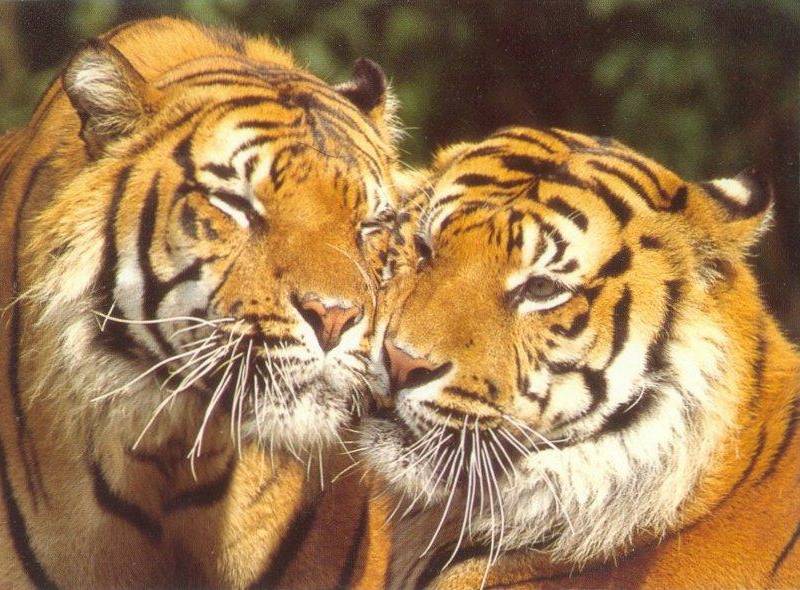
Tigers are the largest of the cat family, with the Siberian tiger being the largest of the species. They are easily recognisable, with thick black vertical stripes covering an orange body. The belly and throat are a creamy white. Male tigers have a ruff around the back of the head.
No two tigers have the same stripe pattern - each is unique, like human fingerprints. Tiger stripe patterns commonly differ between the two sides of an individual's body. The last recorded wild white tiger was documented in 1951. This male cub later became the progenitor of most white tigers in captivity. The stripes of white tigers are brown.
Life span Tigers live for 8-10 years in the wild and 26 years in captivity.
Statistics Body length: 140-280cm, Tail length: 60-110cm, Shoulder height: 80-110cm, Weight: Male: 180-280kg, Female: 115-185kg.
Females will give birth to 2-4 cubs after an amount of 104 days. They will stay with their mother for up to two years before leaving to find their own territories. Males look for territories away from their birth site, but females may sometimes share their mothers territories
As with lions, male tigers may kill a female's cubs if the cubs are the offspring of another male. This ensures that the female will come into the new male's offspring.
They are active at dawn and dusk.
Behavior
Tigers are solitary (with the exception of mothers with cubs) although they may sometimes come together to share a kill. Unlike most other cats, tigers are fond of water and are strong swimmers. Tigers stalk and ambush their prey. They use dense covering to conceal themselves and sneak up on their prey. When the tiger is close enough it suddenly rushes at its prey and kills it by grabbing the throat or nape of the neck.
Females occupy ranges between 25-1600 sq. km. Males occupy larger ranges which may overlap with the ranges of several females.
More than other big cats, tigers have a reputation as man-eaters. In truth, it is rare for a tiger to attack people. It is normally old or injured tigers who are the culprits, as they are less able to catch their usual prey.