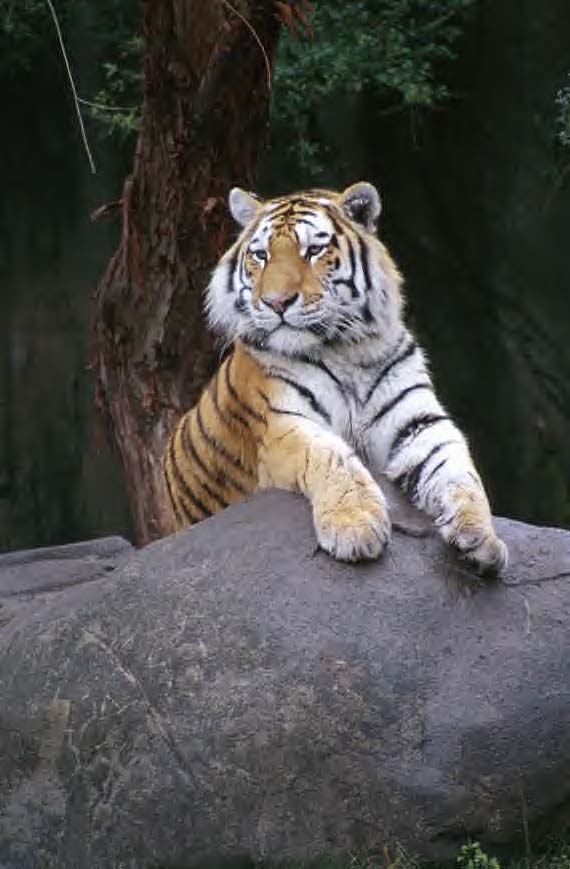
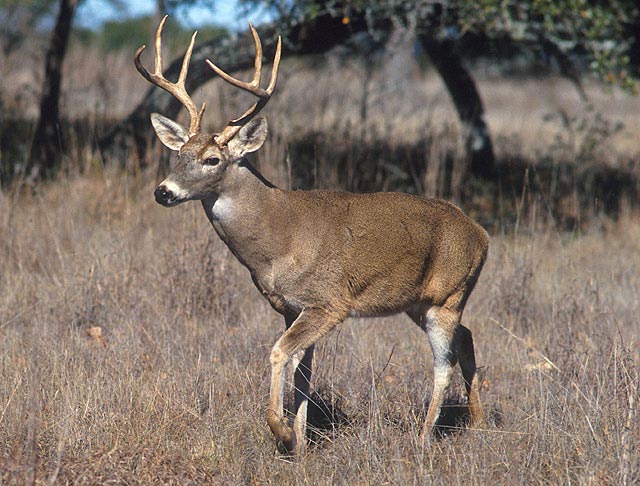
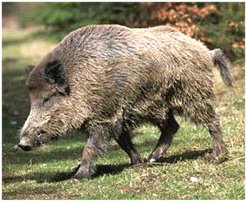
1. A tiger's favorite prey is deer and wild boar. Deer species may include sambar, chital, sika deer, swamp deer, and hog deer, among others. Depending on the habitat, tigers may also eat antelope, buffalo, guar, domestic livestock, peafowl, monkeys, civets, porcupines, fish, frogs, crabs, large monitor lizards, pythons, and young elephants or rhinos. Grass, fruits, and berries are also eaten.
2. Prey living in dense, forested areas (where tigers are found) tend to be more scattered in distribution. Because of this, tigers will attack most any animal that places itself in a vulnerable position. Tigers kill animals of all ages and physical conditions, including animals in their prime.
Method of feeding
1. Tigers are solitary hunters and actively search for prey using their eyesight and hearing. They depend on concealment and a stalk and ambush approach to capture prey.
a. When prey is located, the tiger begins its stalk. It approaches the prey from the side or rear, in a semi-crouch or crouch position. Remaining concealed, quiet, and cautious, the tiger attempts to get within 20 m (66 ft.) of its victim.
b. Once the tiger is close enough, it suddenly rushes the prey. Using its powerful forelimbs and sharp claws, the tiger seizes the prey by the shoulder, back, or neck, and forces it to the ground. Unless the prey is quite large, tigers usually keep their hind feet on the ground.
c. During or after the attack, the tiger administers a lethal bite to the nape (back) of the neck or the throat of its victim.
(1) When prey weighs more than half as much as the tiger, the tiger will usually bite the throat, causing suffocation.
(2) When prey is smaller, the tiger commonly bites the nape of the neck, damaging the spinal cord.
(3) Tigers mainly attack prey weighing 50 to 200 kg (110-441 lb.), but regularly take animals weighing up to 400 kg (882 lb.).
d. Before feeding, kills are often carried or dragged to an area of dense cover. Tigers usually begin eating at the animal's rump.
2. Because of their size and build, tigers can kill prey large enough to provide meals for several days.
a. Tigers can consume 20 to 35 kg (44-77 lb.) of food at one sitting; but they usually eat about 15 to 18 kg (33-40 lb.) of food a day, over several days. They don't seem to mind eating decaying flesh.
b. After meals, tigers cover the remains of the kill with vegetation or debris. This conceals the carcass from scavengers such as vultures and jackals.
c. Tigers mainly rest and drink between meals, but may kill other prey if the opportunity arises.
d. Tigers usually gorge themselves at a kill, and they may not need to eat again for several days. If their food requirements are averaged per day over a year, female tigers need about 5 to 6 kg (11-13 lb.) of food per day and males need about 6 to 7 kg (13-15 lb.) of food per day.
3. Kill frequency varies between tigers.
a. Researchers in Nepal found that female tigers without young killed every 8 to 8.5 days (42-45 kills per year). Researchers in India had similar findings.
b. Female tigers with two cubs ages six to ten months old killed every five to six days (61-73 kills per year).
4. Not all attempted attacks are successful.
a. Tigers probably have only one successful attack in every 10 to 20 tries.
b. Potential prey may see the tiger and escape before the attack, or if the prey is large enough, manage to escape after attacked. Tigers will not chase prey over long distances.
c. Powerful prey animals, like buffalo and guar, may injure or kill tigers during attacks.
d. Packs of Asiatic wild dogs, called dholes, are quite dangerous, and may actually pursue and kill tigers.
5. Tigers don't always kill their own food. They'll drive other predators, such as leopards, away from their kills.