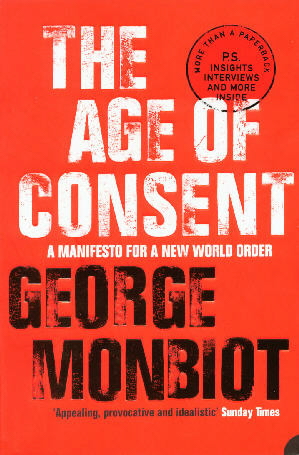
This book, manifesto, treatise- call it what you will, is utterly provocative, magnificent in its scope and is a revelatory joy to read. It asks us to look hard at notions that may pass through our minds in under-formed globules that never quite coalesce into a pattern of logical, well-ordered thought. At its centre, in my view, our views of that over-worked and misapplied idea of democracy need to be rethought- how democracy, as it has been applied in one state or a collection of states can oppress vast swathes of the globe. I suppose there is nothing really original in that, but where this book really scores is the scheme it offers to remedy the world�s inequality, and by implication, increase global security.
This isn�t going to go down terribly well with the American Republican Party, or the Democrats, or most of the world�s mainstream parties for that matter, but what Monbiot proposals include the establishment of a representative World Parliament; a reformed and empowered UN general Assembly with voting rights weighted to population, tied to the abolition of the veto-wielding membership of the Security Council; an International Fair Trade Organisation, which would be followed by the establishment of an International Clearing Union to balance world trade. Monbiot�s counter to the globalisation now encumbering and many would argue, wrecking the planet is breathtakingly simple: globalise democracy.
Well, you may say he�s a dreamer, but he�s not the only one. Let�s all just take a few steps back and look at the world, and ask ourselves these eternal questions, is this sustainable? What is going to happen to states and their populations perpetually and ever-increasingly indebted? Just read the chapter on the truly scary IMF and the original hopes that the British negotiator prior to the founding of the organisation, one John Maynard Keynes had, and it�ll make you weep.
Monbiot is unafraid to state that his plan would entail severe changes in the developed world. We have to accept that- either we believe in democracy- power of the people- or we do not, and yes, we should look forward to an �era in which humankind ceases to be bound by irrational loyalties of nationhood�. Am I, after all, being na�ve in accepting his analysis that developed states have, almost without exception, built up their wealth through centuries of protectionism before then allowing underdeveloped countries the same opportunity, in effect, queering the pitch in our favour?
The author admits that what is required before any of this happens, before any of the constitutionally unreformable world institutions may be broken down and rebuilt, is a fundamental metaphysical mutation in the way people think. He even suggests a few ways in which this might be precipitated but rather like not revealing who did the murder in the Mousetrap,
I would urge you to read the book yourself to find them out, and let your pre-conceived notions be challenged.
I sometimes wonder why I did a Politics degree, after all�
go to: www.monbiot.com |