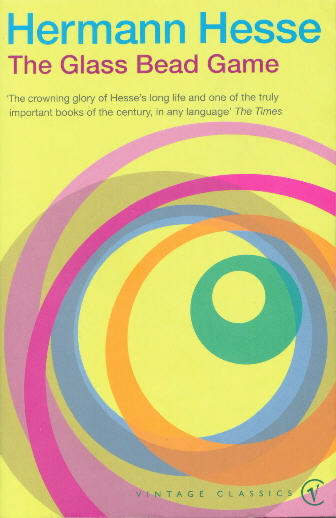
The Glass Bead Game
I think it is fair to say that I have never read a book which is about so much, which instantly says rather a lot about me, I'm afraid- it is a work of art to be apprecieted in its totality, and any mere discussion or thumbnail review can never do it justice. The plot, on which all the ideas and themes hang rest on the career of Joseph Knecht, who lives in a pseudo-monastic 23rd century Order devoted to philosophical enquiry in general and the Glass Bead Game in particular.
The mysterious Glass Bead Game is a philosphical exercise in which devotees try to marry together different areas of learning, art, music. language and philosophy in order in order to prove relationships between all of them. Meditation is used to further the process, and the results and progress of the game are recorded using a complex series of hieroglyphics and symbols.
If the above sounds as if it is rather a difficult concept to get hold of, rather like a universal theory of the forces of Nature combined with Mornington Crescent, then you won't be surprised to hear that actual details of how the game is played are elusive in the text. This does not really matter- it is the fact that the game exists as a concept that is important- the Order which pracises it seeks to build relations with the Vatican, and sees this way of thinking as on a par with, or indeed above conventional religion.
As Knecht moves up the hierarchy of the Glass-beaders, eventually becoming Grand Master, he becomes increasingly troubled by the limitations placed on him by following the order's rules, which paradoxically inhibit him whilst the glass bead game itself allows intellectual enquiry across so many fields. In the end he manages to divests himself of his office in order to become a tutor to the son of a former associate.
What are we supposed to draw form the book? Is it a plea for intellecual freedom in all spheres: that the rules and procedures of any hierarchical organisation can be so limiting that only free, independent thought outside of them can result in true liberation? The implications therefore, for all organised societies, religions, and London Borough Revenues Services Departments are frightening.
Anyway, The Glass Bead Game deserves several re-reads. The above represents some initial thoughts.
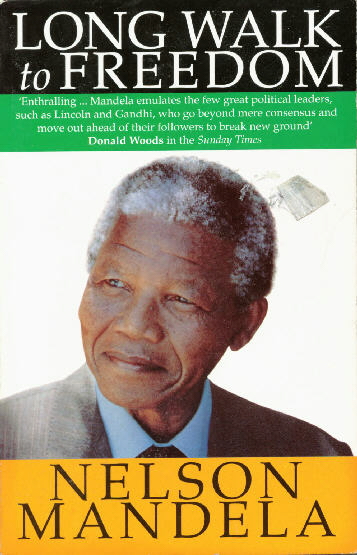
I really thought the book was fantastically well-written, detailing the history of the ANC lucidly, and offering a cogent justification for the armed struggle. What, indeed are the options available to a right-thinking person when a state closes off all other meaningful forms of protest?
Those readers of a male and squeamish persuasion might wish to avoid Chapter 4, which tells us more than we are ever really going to need to know about Nelson's circumcision.
Click here for Mandela's page on the ANC website (excerpts from Long Walk to Freedom are available)
Captain Corelli's Mandolin (Louis de Bernieres) - lots of people have said to me that they hated the ending, but I thought it worked fine.
King Leopold's Ghost (Adam Hochschild) I don't for one moment suppose that British colonialism in Africa was a model in liberal democracy, but this account of the Belgian King Leopold's "Congo Free State" is rather frightening.
The Night Listener (Armistead Maupin) A father-son tale with a wicked twist. Read it in one sitting.