
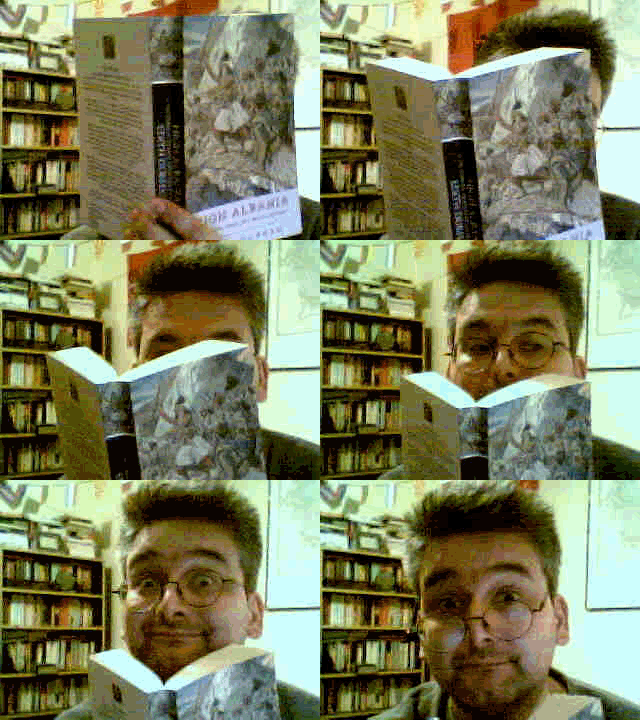
What next? Oh, travel, I suppose. Edith Durham's High Albania- A Victorian Traveller's Balkan Odyssey was originally published in 1909, and is an account of Durham's progress through the north of Albania (an area still best-avoided today due to reports of banditry) into Kosovo. It puts my little jaunt down the main Shkrodra-Tirana road last year into its place, I can tell you. Tales of blood feuds and the difficulties of life abound, but in some ways Orbital by Iain Sinclair, a 551-page account of a walk around the M25 is an even weirder read. Sinclair writes of the strange world of former mental hospitals, new housing developments, and exclusive estates that pepper the chain of vehicular insanity that keeps us all in its deadly embrace. I'm not good at describing writing styles, but I guess it gets rather dreamy and at times impressionistic, but I could be wrong- I've probably forgotten. It probably sells well in Albania though, with its tales of wanderings in strange lands.
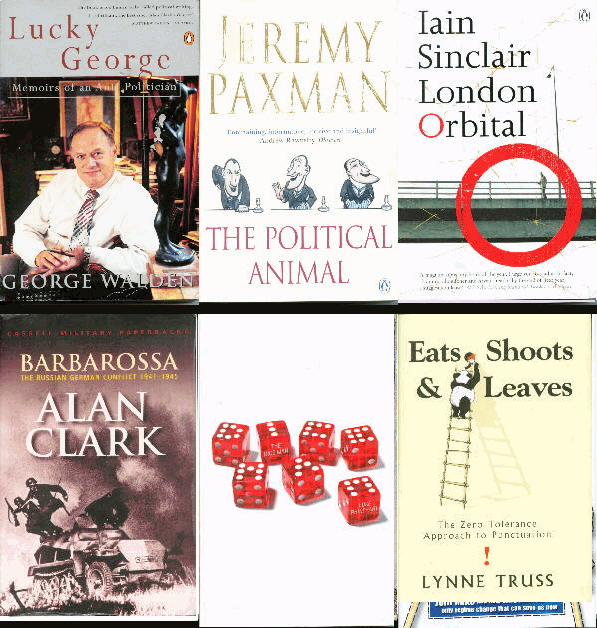
Novels. I read The Little Friend, by Donna Tartt over Christmas, and whilst I enjoyed the adventures of Harriet, the eleven year-old Nancy Drew struggling to make sense of her brother's death, find the killer, and live her life in a contradictory and dangerous adult world of 1970s Mississippi, I have to admit that I much preferred her first novel The Secret History, which I am aching to re-read. Dead Air,by Iain Banks (from which I have quoted here) starts with a 9-11 opening but reads like something that is going to be made into an ITV drama premiere (which I pray will not star Michelle Collins, Ross Kemp and Robson & Jerome). It's a tale of a right-on liberal disc jockey who finds himself involved with a gangland moll; there's quite a lot of caustic comedy and satirising of media life, but I much preferred the weirdness of the Wasp Factory, his first novel, the ending of which I would defy anyone to predict. Plain daft, rather silly, and in the end moderately entertaining though, was The Wimbledon Poisoner by Nigel Williams. In retrospect, I think it was full of holes, but I don't really think I'll read anything else by him. Is that a bit snobby? Probably. Oh, I don't know why I'm doing this anymore....
The Dice Man, by Luke Reinhart though,is one of those cult books from the 1970s that I really ought to have got around to reading by now.Imagine giving up free will and determining all your life's actions on the toss of a dice. The dice becomes your god, and you have to keep faith with it longer than I did when I seem to remember choosing to do English Literature A level rather than German in 1984 by casting lots, which is just as well da ich nicht denke, dass ich wirklich viel gutes am Deutschen gewesen sein wurde und ich wirklich keine Lander eindringen wollte, lederhosen Abnutzung oder rufen unrealistische nationale Merkmale. Anyway, the book is a riot, and I encourage you to go to www.lukerhinehart.net to discover more. Just don't blame me if your life goes wrong if you throw a double three.
I 'm sure that Barbarossa, by Alan Clark (yes, he of the infamous diaries), is a great historical account of the German-Soviet war of 1941-1945, but I think that military history and me just don't really get on. His accounts of the great battles are doubtlessly technically excellent, but I could feel my eyes glazing over, and my eyelids dropping rather as they did between all those accounts of fighting between hobbitts, orcs, flying monkeys and whatever in the Lord of the Rings.In its favour though, I did find the occasional accounts of the privations of individual soldiers fascinating, and there was no poetry in it.
Two Christmas presents to finish off with: the first expected; the second, somewhat inevitable. Michael Moore's Dude, Where's My Country is full of the entertaining material we have come to expect from him: the Chapters Home of the Whopper (10 lies about the Iraq war), and How to Talk to Your Conservative Brother-in-Law should be photocopied and attached to every refridgerator door in the land. The inevitable present, though nonetheless received with open and grateful arms was Eats, shoots and leaves by Lynn Truss, the first bestseller to be devoted to the humble? ,.;:'()"!-and ? (oh dear, should there have been commas between those?). This book has had the unfortunate effect of leaving me even more paranoid than normal, but I feel that I am now irrigating semi-colons all over my text rather more than before. The book has also alerted me to the existence of the Apostrophe Protection Society, whose website can be found here, an organisation every bit as needed as the Hear'say fan club isn't.
Well, that's my lot. Back to Internet Pool for me.

