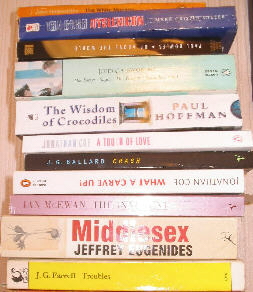
and To Let, I have ploughed an enjoyable furrow through 1200 pages of John Galsworthy's The Forsyte Saga. I can quite see how the TV adaptation of the novels apparently gripped the nation back in 1967, and the characterisations of the central characters just seem to lift off the page. Do I ever really feel any pity for Soames Forsyte, though? I think I'm hooked.
To be honest, in my teens, I wasn't much of a reader of novels, and I can remember with a certain amount of pain having to anatomically dissect JG Farrell's The Siege of Krishnapur for English Literature O level. It was with a fair amount of trepidation therefore, that I started Troubles, also by this quondam nemesis of mine, and I found myself delighted to have made the effort: the crumbling Majestic Hotel is a supertanker-sized metaphor that works brilliantly throughtout the entire novel, as British rule implodes in Southern Ireland. Some of the imagery in the narratve is so great that I would almost be happy to sit an exam on it at this very moment. Steady now, Mike.
I was reading a so-so Ian McEwan, The Innocent, the other week when a former work-colleague suggested that I should read something by Jonathan Coe. I was embarassed to admit that I had never heard of him, but I think I can safely say that if you take his advice, you won't be disappointed. Spurred on by his reccommendation, I bought What a Carve Up! and enjoyed everything about it. A brilliant comic wide-ranging satire with multiple targets, the dreadful, grasping Wilmshaw dynasty are disected, and ultimately disposed of through the account of an author commissioned to write their family history. The mock-Agatha Christie ending had me in stitches, and the jaw-dropping ending just seemed utterly appropriate. Any members of the ruling classes that happen to scan a few of its pages wouldn't find it a very comfortable read, and that's always a good thing.
There were a few weirder reads too... The Wisdom of Crocodiles by Paul Hoffman was one of them. Lots of big themes here, but a comment from www.remoteinduction.co.uk gives you an idea of how
complicated the plot is " Setting everything up as he goes along, spinning each character out so that they take on a unique life of their own, while at the same time managing to tie those lives back into the body by linking them back in to a thread other than the one which they originally spun out from. While at the same time also having to work each of these threads to a point where they each have enough of a sense of closure that he can let them lie - bringing it back down to the original characters and the climax of their stories." I think I preferred the chapter The Dark Figure the most in which the world economy is once again starkly revealed to be the monster it really is..as if we didn't really know. It's a satisfying read, though, even if I felt that everything didn't all seem to me to get tied up in the end.
I had previously read The Sheltering Sky by Paul Bowles, and thus had a fair idea of what to expect from Up Above the World, his last novel, although by the end of this book, I felt almost as confused as Kit Moresby ended up in the former, and believe me, that wasn't a pretty sight. Still, I ought to scold myself and say that just because I found it confusing, doesn't mean that I shouldn't keep at it.."we do these things not because they are easy, but because theya re difficult," someone once said..or words to that effect. I guess you've just got to keep at it with existentialism.
I think I shall end with The Bush Dyslexicon by Mark Crispin Miller. Everything was just getting a little bit too serious out here for my liking. A former Governor of Texas once said of Dubya's father that he was "born with a silver foot in his mouth," and this is clearly on genetic trait that has multiplied over only one generation. It would be easy for this book to have been simply a cheap jibe at the 43rd President, and whilst I can honestly say that I am not averse to that, in fact, the author places Bush's mangled speech in the context of his political actions, his possible dyslexia, and his..not to put too fine a point on it..hypocrisy. Maybe it's because I'm tired, but you might as well see a graphic example of this: click here for the Smoking Gun website and decide for yourself if the GWB depicted in the video attachment on that page could be inebriated, six years after he allegedly gave up alcohol for good.
|