Home | Contact | Guestbook


The A to Z about MP3

Home | MP3 Format | MP3 Usage

The MP3 Format

In a Compact Disc (CD) songs are stored as digital information. The data on a CD uses an uncompressed, high-resolution format. Here's what happens when a CD is created:

  • Music is sampled 44,100 times per second. The samples are two bytes (16 bits) long.

  • Separate samples are taken for the left and right speakers in a stereo system. 

Therefore a CD stores a huge number of bits for each second of music which is around 14,11,200 bits per second.  This is calculated by using the following data:

44,100 samples/second * 16 bits/sample * 2 channels

Let's break that down into simple words. 1.4 million bits per second equals 176,000 bytes per second. If an average song is three minutes long, then the average song on a CD consumes about 32 million bytes of space. That's a lot of space for one song, and it's especially large when you consider the bandwidth most people have for their Internet connections at home or at work. Over a 56Kbps modem, it would take close to two hours to download one song.

The MP3 format is a compression system for music. The MP3 format helps reduce the number of bytes in a song without hurting the quality of the song's sound. The goal of the MP3 format is to compress a CD-quality song by a factor of 10 to 14 without losing the CD-quality sound. With MP3, a 32-megabyte (MB) song on a CD compresses down to about 3 MB. This lets you download a song in minutes rather than hours, and store hundreds of songs on your computer's hard disk without taking up that much space or 10 to 20 songs on an MP3 player using a relatively small amount of memory.

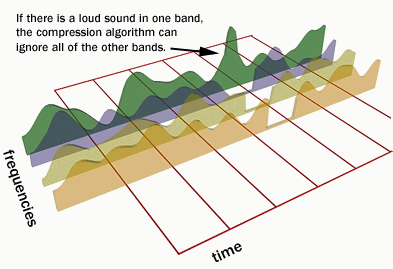
To compress a song without hurting its quality, compression algorithms are used. Compression algorithms are used for images all the time. For example, a GIF file is a compressed image. So is a JPG file. We create ZIP files to compress data. So we are familiar with compression algorithms for images and data and we know they work. To make a good compression algorithm for sound, a technique called perceptual noise shaping is used. It is "perceptual" part because the MP3 format uses characteristics of the human ear to design the compression algorithm such as:

  • There are certain sounds that the human ear cannot hear.

  • There are certain sounds that the human ear hears much better than others.

  • If there are two sounds playing simultaneously, we hear the louder one but cannot hear the softer one.

Using facts like these, certain parts of a song can be eliminated without significantly hurting the quality of the song for the listener. Compressing the rest of the song with well-known compression techniques shrinks the song considerably -- by a factor of 10 at least. From this description you can see that MP3 is nothing magical. It is simply a file format that compresses a song into a smaller size so it is easier to move around on the Internet and store.

The various Rippers and Compressing tools and its uses can be found in the Software Section.  Now let us see the Usage of MP3 formats.


Counter

Graphics & Designing

MERVIN STANIS XAVIER
10E - WINDBROOK PLACE
VELLAYAMBALAM P.O.
TRIVANDRUM - 10
KERALA - INDIA
TEL: +0471 - 329821

Supporting Members

OFFICIAL SITE OF 2002 BATCH MECHANICAL PRODUCTION
MERVSOFT DIGITAL MEDIA
Sorry, your browser doesn't support Java(tm).

 
Hosted by www.Geocities.ws

1