
Temel donanım bilgileri
© Copyright Brian Brown, 1992-2001. All rights reserved.


 Tape
storage
Tape
storage
Tape storage is primarily used for archival storage. The
recording medium is a thin polyester tape between 0.38cm and
2.54cm wide, about .025mm thick and coated with magnetic
particles.
The tape is wound on wheels of various sizes. Data is recorded sequentially, one byte after the other, from the beginning of the tape to its end. Access times for tape storage are much slower than for floppy diskettes or hard disks.The following diagram shows how data is stored on the disk. The read/write head is comprised of several tracks, 9 tracks being very common. This means nine bits are recorded across the width of the tape simultaneously.
Using nine tracks, one byte of data plus a parity bit is recorded at a time (vertically). Characters are grouped together to form a record (often called a block). Each record is separated from the next record by a blank inter-record gap (IBG). Each record is preceded by a header field. The IBG allows the software to position the tape for recording or playing at specific record numbers.
Physical markers are used to indicate the ends of the tape, and may be metallic foil, clear plastic or software markers encoded on the tape. Software encoding uses BOT (beginning of tape) and EOT (end of tape) indicators.
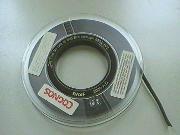
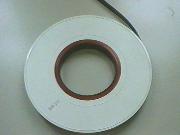
Write protection is provided by a groove in the reel (or notch tab in cartridge systems). If the ring is fitted, this is detected when the reel is mounted on the tape drive. This then enables writing to the tape. Removal of the ring enables write protection.
 |
 |
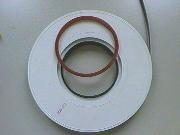 |
| Reel tape | Reel tape, reverse side showing red write protect ring in place. | Reel tape, reverse side showing red write protect removed, tape is now write protected. |
Many operating systems and application programs are still provided on tape systems, though this is quickly being replaced by CD-ROM.
Characteristics
of tape storage
The most common from of tape storage today is the tape cartridge.
This uses a cassette-based system to hold the tape on two reels
(similar to an audio cassette). The tape width varies in size,
common widths are ¼" and 8mm.
| The capstan is a roller that grips the
tape and pulls it past the read/write heads at a constant
velocity. The rotating drum had a read/write head and scans the tape on a diagonal (this increases the amount of information that can be stored on the tape compared to storing data horizontally along the length of the tape). This is the similar to the way that video cassette-recorders operate. |
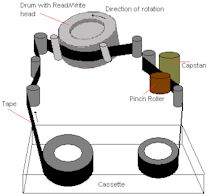 Fig 5.12: Cassette Tape Transport mechanism |
Digital Audio Tape (DAT)
The most common form of cassette system used for large storage
archival is the DAT (Digital Audio Tape) system. Data is recorded
using a helical scan (similar to video recorders), diagonally
across the tapes surface.
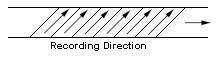
Fig 5.13: Helican Scan used on DAT
A DAT cassette is about half the size of a standard analog cassette and is 3.81 millimeters (1/8") wide.
Each cartridge can hold several gigabytes of data, and access times are very quick (somewhere between floppy and hard disk). Data transfer rates are faster than floppy (but slower than hard disk). Cartridges cost about NZ$50 each.
Digital Data Storage (DDS)
The DDS format for tape drives was developed in 1989, in order to
meet the need for high-capacity, compact tape backup for network
servers and multiuser computer systems.
DDS is derived from the DAT standard and has been extended to DDS-2 and DDS-3 as backup capacity requirements have increased.
DDS-1 (1989) supports 1.3 GB, DDS-2 (1991) supports 2GB. DDS-3 (1993) supports 4 GB. DDS-1 and DDS-2 use 120 minute tapes while DDS-3 uses 125 minute tape. The storage capacities mentioned above are without compression.
The DDS (Digital Data Storage) format was designed for storing computer data storage. It was originally implemented for DAT subsystems, giving a capacity of 1.3 GByte on a 60 metre tape. This was quickly expanded to 2 GByte with the introduction of 90 metre tapes.
The DDS format has been extended to include data compression. This newer format is called DDS-DC (Digital Data Storage - Data Compression), allowing up to 8 GByte of compressed data to be stored on a tape.
QIC40/QIC80
and Other Standards
QIC stands for Quarter Inch Cartridge tape.
| Capacity | Type | Length | Tracks |
| 80MB | QIC40 | 120ft | 15 |
| 120MB | QIC40 | 300ft | 15 |
| 160MB | QIC80 | 200ft | 28 |
| 250MB | QIC80 | 300ft | 28 |
maximum tape speed is 90ips
recording density is 12500ftpi
| Standard | Capacity | Tracks | Speed | Rec-Density | Cartridge |
| QIC-11 | 15/30MB (300ft) | 4/9 | 90ips | ||
| QIC-11 | 20/40MB (450ft) | 4/9 | 90ips | DC300XL | |
| QIC-11 | 27/60MB (600ft) | 4/9 | 90ips | DC600A | |
| QIC-24 | 45MB (450ft/137m) | 9 | 90ips | 8000bpi | |
| QIC-24 | 55MB (555ft/169m) | 9 | 90ips | 8000bpi | |
| QIC-24 | 60MB (600ft/183m) | 9 | 90ips | 8000bpi | DC600A |
| QIC-120 | 125MB (600ft/183m) | 15 | 72ips | 10000bpi | DC600A |
| QIC-150 | 155MB (600ft/183m) | 18 | 72ips | 10000bpi | DC600XTD |
| QIC-150 | 250MB (1000ft/305m) | 18 | 72ips | 10000bpi | |
| QIC-320 | 320MB (600ft/183m) | 26 | 72ips | 16000bpi | DC6320 |
| QIC-525 | 525MB (1000f/305m) | 26 | 72ips | 16000bpi | DC6525 |
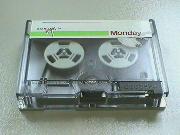
Fig 5.14: QIC-80 cartidge which can hold 120MB of data
QIC-Wide-3010
425MB Native, 850MB Compressed
References
Memory Storage (pg 77) : Computers and Electronics, December 1982
Winchester Disk Drives (pg 133) : EDN, June 28, 1984
VideoDisc (pg 129) : ETI, May 1981
Hard Disk Drives for the masses (pg 46) : Computers and
Electronics, April 1985
Optical Disks (pg 23) : Computer Design, March 1985
Principles of Optical Storage (pg 70) : Electronics and Wireless
World, March 1985
Store it with Light (pg 61) : Computers and Electronics, July
1984
Tape Backup for Hard Disks (pg 80) : Computers and Electronics,
September 1984
Data Storage in a Nutshell (pg 36) : Computers and Electronics,
July 1983
The Floppy Disk (pg 141) : Byte, September 1984
Summary
Magnetic media has been used for a long time. It has offered
large storage capacities, low cost per bit, and medium access
times.
As optical storage improves, it will make inroads into the area of mass storage devices like hard disks.
The hard disk drive is divided into a number of Tracks. Each track is subdivided into a number of equal sized Sectors, each of which hold data. The minimum unit that can be read from or written to a disk unit is a sector.
As software sizes have increased, CDROM has become the preferred method of shipping Operating systems and software, as it reduces the number of diskettes, is cheaper to produce, more reliable and faster to install.
DVD promises large storage capacities which currently match those of current hard disk SCSI storage devices.
Tape cartridges, especially DAT, is used for archival purposes in backing up large amounts of data and computer systems software.
Home | Other Courses | Notes
| Tests | Videos
© Copyright Brian Brown, 1992-2001. All rights reserved.