
Temel donanım bilgileri
© Copyright Brian Brown, 1992-2001. All rights reserved.


 Floppy
Drives
Floppy
Drives
The floppy drive uses a thin circular ceramic disk for data
storage. The disk is coated with magnetic particles and is
flexible (hence the term floppy).
The disk rotates at 360rpm. A read/write head makes physical contact with the disk surface. Data is recorded as a series of tracks subdivided into sectors. Typical values for an IBM-PC compatible are
| Size | Capacity | Tracks | Sectors |
| 5¼ | 360KB | 40 | 9 |
| 5¼ | 1.2MB | 80 | 15 |
| 3½ | 720KB | 40 | 18 |
| 3½ | 1.44MB | 80 | 18 |
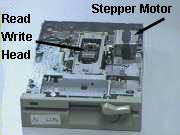
Fig 5.5: 5.25" Floppy Drive
The two main methods of identifying the beginning sector of a track are
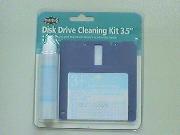 Fig 5.6: Floppy Drive Cleaning Kit |
The image on the left shows a floppy diskette cleaning system. It consists of a floppy disk containing a cleaning disk and some cleaning fluid. The fluid is placed on the floppy disk and then the disk is inserted. Any foriegn material on the read/write heads are transferred to the disk. The cleaning disk can only be used a limited number of times. |
Hard
Disks
Hard disk drives use a thicker non-flexible disk. The disk is
made from aluminium or ceramic material, and coated in magnetic
particles. The disk rotates at a much higher speed (3600rpm). In
addition, multiple disks are stacked on top of each other (with a
gap in between), with a read/write head allocated for each
surface (top and bottom).
Storage capacities range from 10MB (first PC disk used in XT) to several gigabytes.
This allows a flexible method of data storage. As each disk pack becomes full, it can be removed and a new pack inserted to handle the next lot of transactions etc.
Optical
Disks
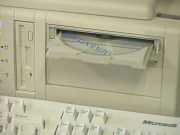
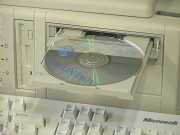
Optical disks use laser technology and special crystalline
ceramics (amorphous crystal) to implement data storage. They are
similar to an audio compact disk (CD).
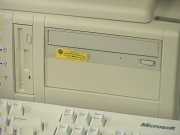
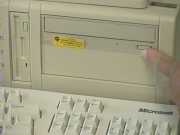
Optical disks for PC's store 660MB per disk. They have an access time of about 300ms (little slower than floppy).
 |
 |
 |
 |
The laser beam is shone onto the surface of the disk. Data is stored as a sequence of surface variations called lands (flat surface) and pits (bumps or holes). The light is scattered by the pits and reflected by the lands. These two variations encode the binary 0's and 1's.
A light sensitive diode picks up the reflected laser light from the surface of the disk, and converts the light to digital data.
Data is stored on a single spiral track. The rotational speed of the CD is altered so that the data on the track is always read at the same speed. This is called Constant Linear Velocity.
WORM (write once
read many)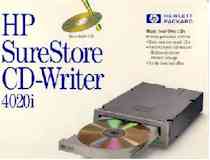
Fig 5.7: HP SureStore CD-Writer: © HP
Single
Speed/Double Speed/Quad Speed and Hex Speed CDROM| Speed | Transfer Rate |
| x1 | 150KB/s |
| x2 | 300KB/s |
| x4 | 600KB/s |
| x8 | 1200KB/s |
CDROM
InterfacesThe type of CDROM must have a matching controller type. For example, It is not possible to connect a SCSI CDROM using an IDE interface.
CD-IAccess to the information is controlled via a simple point and click menu interface, which people find easy to use and navigate. This explains it use in public type kiosks and sales presentations.

Fig 5.8: Philips CD-I Player: © Philips
Photo CDA Photo CD Master Disc storages images up to five different levels of resolution, from small thumbnail sizes of 128x192 pixels to 2048x3072 pixels. This is 16 times larger than standard TV resolutions, and four times the resolution currently being considered for HDTV (High Definition TV).
Users can take their negatives to a Kodak licensed photo processing shop and have their pictures transferred onto Photo CD. Most CDROM drives sold in personal computers are Photo CD compatible. The entire Photo CD does not need to be filled at once, photos can be added onto the Photo CD as required.
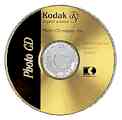
Fig 5.8: Kodak Photo CD Master Disc: © Kodak

Fig 5.9: All 100 images on a Photo CD shown as
thumbnails: © Kodak
CD+G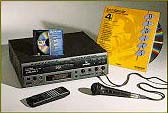

Fig 5.10: Pioneer Karaoke System: © Pioneer
Digital Video
Data (DVD) CDROM| 1980 | Sony and Philips create a standard for Compact Disc Digital Audio |
| 1982 | Sony introduces the first CD player, and the first CD arrives... Billy Joel's 52nd Street |
| 1984 | Sony introduces the portable CD player and the first car CD player |
| 1985 | Sony and Philips create a standard for Compact Disc Read Only Memory CDROM |
| 1989 | Sony and Philips create a standard for Compact Disc Interactive (CD-I) |
| 1990 | Sony and Philips introduce CDROM-XA and CD-R (Recordable CD) |
| 1994 | CDROM firmly established as a medium for personal computers |
| 1995 | CD-Erasable and CD-Plus (enhanced music) are announced |
Differences between DVD and CDROM
ISO-9660Level 2 ISO-9660 allows longer filenames and deeper directory structures (32 levels instead of 8), but isn't usable on some systems, notably MS-DOS.
Rock RidgeBecause it's still an ISO-9660 filesystem, the files can still be read by machines that don't support Rock Ridge; they just won't see the long forms of the names. Rock Ridge is supported by UNIX systems and the Mac. DOS and Windows currently don't support it.
HFSAt present, the only systems that can read HFS CD-ROMS are Macs, Amigas (with AmiCDROM, available from ftp://ftp.cdrom.com/pub/aminet/disk/cdrom/), and the Apple IIgs, and SGI machines running Irix (they appear as AppleDouble format).
Joliet
Home | Other Courses | Notes
| Tests | Videos
© Copyright Brian Brown, 1992-2001. All rights reserved.