
|
|
|
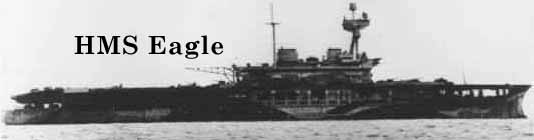
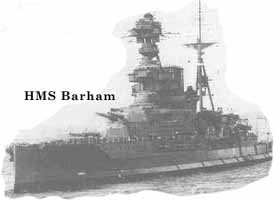
The Royal NavyThe Mediterranean had for 200 years been a seaway of great importance to the British. They controlled it thoroughly from their bases at Gibraltar in the west, Alexandria in the east and Malta in the narrow chokepoint where the island of Sicily is only two hundred miles from the shores of North Africa. At the eastern end of the Mediterannean lay the Suez Canal, the 'Clapham Junction' of Imperial communications and the gateway to the oilfields of Persia, the manpower of India and the rubber of the Far East. Admiral Cunningham commanded the Mediterranean Fleet from his main base at Alexandria. When Italy entered the war, Cunningham had five battleships, the Warspite, Royal Sovereign, Barham, Ramilles and Malaya. Of these ships, two had problems with their boilers, one with her condensers and one carried guns outranged by the guns on Italian battleships. Cunningham also had an aircraft-carrier, the Eagle, seven cruisers, twenty destroyers and twelve submarines. Of the cruisers one had serious mechanical problems and the aircraft-carrier Eagle was obsolete, small and with an unarmoured flight deck.
Cunningham's position was precarious indeed as he struggled to protect the Suez Canal and keep the Mediterranean sealanes open. The Italian invasion of Greece only added to his problems and the new demand for merchant shipping and escorts which the effort to supply Greece entailed stretched his resources to the limit. With such a plethoera of duties to attend to, Cunningham couldn't afford the luxury of striking the pose of a 'fleet in being'. This most sedentary of naval strategies argued that the very existence of a fleet which had to be covered used up more of an enemy's resources than actually going out and fighting him. Such a position was possible for the Italians but not for the British. Britain had a seaborne Empire to protect and a vast seaborne trade upon which all her efforts, in peace or war, rested. The British fleet had no choice but to be active. And so Cunningham faced the dilemma of how to neutralise the Italian fleet. The chance of a Jutland style clash of battleships was very unlikely, and unwelcome too given the Italian superiority in ships. Air attack by land-based bombers was possible but the RAF was desperately short of effective bombers in 1940. A surprise approach by British warships to an Italian anchorage and then a bombardment of the ships therein was too risky given Italian air superiority over their homeland. The only remaining possibility was a torpedo attack on the Italian fleet in harbour and this is what Cunningham chose, or was forced by lack of an alternative, to do. In this endeavour he had one or two advantages. Firstly, the Fleet Air Arm possessed in the Fairey Swordfish an extremely strong, rugged torpedo plane. Although obsolescent by the outbreak of war and too slow to be pitted against an air defence of modern fighters, the Swordfish was adequate for a strike on the Italian mainland at night. Secondly, based on the island of Malta only 200 miles from Taranto were a flight of Glen Martin bombers. Named the Martin Maryland by the RAF, and affectionately known as the 'Bob Martin' by its pilots, these planes were very fast and in the reconnaissance role were usually able to outrun any Italian fighters they might encounter. As such Cunningham had regular and accurate information as regards the status of the Italian fleet in Taranto. The original plan of attack envisaged the use of two carriers - the Illustrious and Eagle, but several near misses by Italian bombs while on recent convoy escort duty had ruptured the aviation fuel delivery system within the Eagle and the damage was severe enough to preclude her from the Taranto operation. Some of her planes were transferred to Illustrious and the attack went ahead with only one carrier. The attack was called Operation Judgement. |
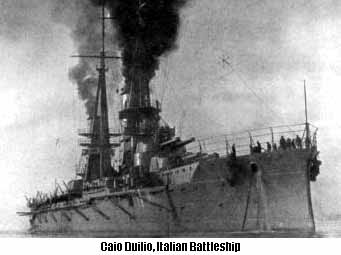
The Royal Italian NavyIn 1940 the Italian Navy was centred around a core of six battleships. The pride of the Italian fleet were the two just completed battleships, Littorio and Vittorio Veneto. When combat ready they displaced 45,000 tons and carried 14,000 tons of armour. They carried nine 15 inch guns mounted in three triple turrets, two fore and one aft. Designed purely for operations in the Mediterranean where they would never be far from Italian bases, they had a very short range. The other four battleships were older warships that had undergone extensive redesign and refits in the years before the outbreak of war. They comprised two classes: the Doria class and the Cavour class. The Conti di Cavour and the Giulio Cesare of the Cavour class had been launched in 1911, but extensively rebuilt and refitted in 1937. At the outbreak of war they were capable of a top speed of 27 knots and carried 12 inch guns. They had also been fitted with an anti-torpedo bulge below the waterline designed by the Italian naval engineer Pugliese. There were also two ships in the Doria class; the Andrea Doria and the Caio Duilio. Launched in the year before World War I opened, they had been rebuilt in 1939. They had a top speed of 26 knots and carried ten 13 inch guns and 53 lesser guns ranging from 5 inch to anti-aircraft cannon. Supporting the battleships were six heavy and twelve other cruisers. The Trento and the Trieste weighed 13,000 tons, could make 36 knots and carried 8 inch guns. The Pola, Zara, Fiume and Gorizia, weighed 14,000 tons and could move their 8 inch guns through the sea at 34 knots. In addition to the heavy warships the Italians possessed large numbers of destroyers, torpedo boats, 106 submarines and bases almost perfectly positioned astride the sealanes through the Mediteranean. Taranto especially was strategically located and in 1940 was one of the most heavily defended anchorages in the world.
|