
| It was a hopeless affair, utterly devoid of any chance of success;
some might say suicidal. Pathos flowed from it like the Liffey to the sea.
There was Patrick Pearse, poet headmaster and would be warrior, calling
the Irish to a war to the knife with a government that was being voluntarily
served by hundreds of thousands of Ireland's sons, fathers and husbands
in a greater struggle across the sea. There was Roger Casement, Knight
Commander of the Order of St. Michael, washed ashore on Banna Strands exhausted,
sodden, salt-encrusted, hoping to avert the shedding of blood his treason
had helped inspire; the arresting arms of the police only a few hours away.
There were the British leaders in Dublin so arrogantly convinced of their
lack of danger that the C-in-C Ireland went home to London for the holiday
and most of his officers went to the races 12 miles outside Dublin.
The rebels entertained (how seriously will never be known) hopes of one of three successful results. Firstly, the Irish people following the trigger of the rising would en masse attack their British oppressors and drive them into the sea. Secondly, the British might suddenly realise, after almost a millenium of supression, that the Irish didn't want them and it wasn't worth the price in blood and treasure to stay there. Thirdly, the Germans might rush to Ireland's aid. Of course none of these things happened. In reality there were only two possible endings. One, the rising would be put down savagely. Two, it would be put down with some restraint on the part of the authorities. The only thing that was certain was it would be put down. The forces of rebellion were so pitifully small and the forces of repression so great there could be no other outcome. Monday
The rebels successfully seized areas both north and south of the River Liffey. Pearse and Connolly and about 150 men including Joseph Plunkett and his aide Michael Collins took over the General Post Office in Sackville (now O'Connell) Street, ejected the staff, barricaded the doors and prepared for the inevitable British reply. Above the roof of the GPO they defiantly 'flung out a flag of war', actually two; the Irish tricolour and a green banner bearing a golden harp and the words 'Irish republic' written in Irish letters. Five other main areas were taken. The South Dublin Union, a group of workhouse buildings, was held by Eamonn Ceannt, the Four Courts were seized by Ned Daly and his 1st Battalion, Jacob's Factory by men under the command of Thomas MacDonagh, St. Stephen's Green by Michael Mallin and Countess Markiewitz's unit and Boland's Mill by Eamonn De Valera. The latter position was of great mportance as it covered the road from Kingstown, the port through which any British reinforcements would surely pass. Some men rose in Meath and there was fighting in both Wexford and Galway but apart from a few widely separated and unco-ordinated skirmishes the rest of the country stayed quiet. Those who rose outside Dublin were too few and too widely scattered to offer any save emotional support to the men in the capital. Dublin quickly became the focus of the rebellion and of British attempts to suppress it. 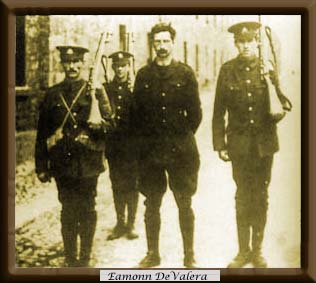 One of the first successful rebel actions in defence of what they had seized occured in Sackville Street barely an hour after the GPO was taken. A troop of British lancers, forgetting how vulnerable cavalry had become in the face of modern rifles and probably naively thinking that a simple show of force would be enough to bring the 'restless natives' to their senses, charged down the street towards the post office. Accurate rifle fire soon disabused them of that notion. Four lancers and many horses were killed, more wounded. Taken by surprise the British authorities responded quickly and forcefully. Dublin Castle called in units from the nearby Curragh army base and urgently appealed to London for extra troops. The C-in-C Land Forces in Britain was Field Marshal Sir John French. Ex-commander of the BEF in France and onetime cavalry commander in the Boer War, French was an Irishman and a determined Unionist. He ordered four divisions to be ready to transfer to Ireland. These forces totalled over 50,000 men. There was not much more fighting on Monday as the British marshalled their forces and the rebels tried to fortify their positions. By that evening they had establish effective control of the city centre but they were hampered by a lack of signalling equipment which forced them to use runners to maintain contact between their strongpoints. As the fighting intensified in the coming days communications between the different units broke down. Tuesday
It was on Tuesday that the atrocities began. A British officer, a certain Captain Bowen-Colthurst executed four men without trial; men entirely innocent who had simply been unlucky enough to have crossed Colthurst's path. One of them Francis 'Skeffy' Skeffington was a well known Dublin character. Colthurst never answered for his crimes before a court of law. He was certainly insane, but this begs the question as to why the British Army allowed a mad officer to remain on active service and in command of troops. More atrocities were to follow but they had little of the premeditaion of Colthurst's crimes. The newly arrived British reinforcements were mostly young, raw recruits and they faced fire for the first time not on a battlefield but in a modern city. Their confusion was understandable and compounded by the fact that few of the rebels wore uniform. It did not become long for any adult male to be seen as a possible enemy. Also when soldiers are used in the role of policemen, their discipline tends to deteriorate, a fact not unknown in the Ireland of more modern times. Wednesday
Thursday
Friday
Saturday
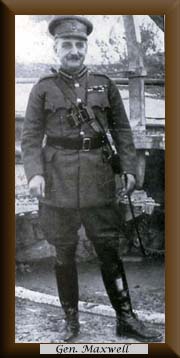 When the captured rebels were marched off to captivity they were jeered and pelted with trash by the traumatized, hungry citizens off Dublin. Maxwell noted this disapproval with which the ordinary people of Ireland seemed to view the failed rising and felt that in the face of such hostility to the rebels he need not take public opinion into account when he dealt with the ringleaders. This proved to be a great miscalculation. Maxwell was swift, ruthless and brutal in his punishment. After brief court martials, in one of which Pearse deeply impressed his British military judges with his eloquent patriotism, the leaders were condemned to death. There was no process of appeal. Quickly and quietly, in Kilmainham Gaol, the executions tok place; Pearse,Tom Clarke and Thomas MacDonagh on May 3rd; Ned Daly, Joseph Plunkett, Michael O'Hanrahan and Willie Pearse the following day; John MacBride was shot on May 5th; Con Colbert, Eamonn Ceannt, Michael Mallin and Sean Heuston on May 8th; Thomas Kent, who had fought in Cork, on the 9th; James Connolly and Sean Mac Diarmada on May 12th. Connolly was so ill from his wounds that he was unable to stand for his execution. It didn't matter to the British; they tied him to a chair and shot him sitting down. Of all the rebel leaders captured, only De Valera escaped the executioner on account of his holding US citizenship. Thousands of rank and file supporters of the IRB were interned and sent to prison camps in England. Maxwell had gone too far. He had indeed put the rebellion down quickly but his repressive methods shocked world opinion and sickened the Irish people. The same people who had jeered the rebels on their capture now revered them as martyrs for the cause of Irish liberty. Pearse and all his semi-mystical ideas of blood sacrifice was right in the end. What his small band of rebels had been unable to do in life they were to accomplish in death. The road to Irish freedom had still a long way to go but barely had the smoke cleared from the firing squads in Kilmainham Gaol than a new stronger flame of Irish resistance was born. It was this flame that would finally see the backs of the British. |