| If
one excludes the Channel islands, Ireland was the first overseas possession of the English crown. More than eight centuries before it
had been taken by the sword and more or less held by the sword since then.
At first the English penetration had been no more than the insatiable desire
of armoured knights for more land that characterised the feudal system,
but as time wore on the English solidified their hold over the whole island
and showed no sign of going home. The Irish never accepted this English
then British domination and rose again and again in violent opposition
to their foreign rulers. Sometimes the English could find safety and security
only within the confines of the Dublin Pale and the rest of the island
slipped from their control; but they never lost Dublin and the castle there
became the symbol and heart of English power in Ireland. With the reformation
a religious aspect was added to the racial animosities of English and Irish.
The latter were staunchly Catholic and in the 17th century when Protestant
England endured civil war, regicide, the birth of a short-lived Commonwealth, the
return of a king and the deposing of his successor, the Irish invariably
supported those in England who shared or sympathized with Ireland’s ancient
faith. The Irish were heavily penalized for this support and after a long
series of draconian legislation by the English government became a dispossessed
people in their own land, ruled over by the ‘Protestant Ascendancy’ -
a ruling class of English and Anglo-Irish landlords.
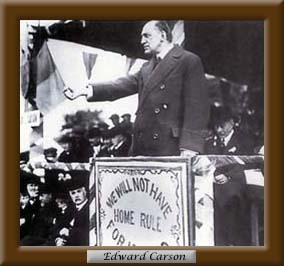
A great rebellion at the end of the 18th century was put down, the powerful reform movements of Daniel O’Connell and later Charles Parnell rose and faded, the Great Famine stalked the land in the 1840’s and many of Ireland’s sons and daughters fled their homeland in the melancholy ‘coffin ships' taking both their Irishness and their hatred of England to new homes in the United States. Finally it dawned on the English body politic that something had to be done about Ireland and the more enlightened members of the British government came up with the solution of Home Rule or devolution or limited autonomy as we would now call it. The Home Rule bills, however, were bitterly opposed by many in Britain and their passage through parliament was not easy. Although the process was started by Gladstone, it was only in the later years of the first decade of the twentieth century that Home Rule for Ireland became a distinct possibility. On being called to form his first ministry, Gladstone had declared that his mission would be the solving of the Irish problem, but even his prodigious political talents failed. In his third ministry he seemed tantalizingly close to success and even managed to secure the acquiescence of Charles Parnell to the passage of a Home Rule Bill. The scandal-tainted fall of Parnell and the veto power of the Tory dominated House of Lords brought the scheme to naught, however, and it was not until the election of Campbell-Bannerman's Liberals (later led by Herbert Asquith) in 1906 that the next chance for Irish autonomy arose. Determined and able to curb the anachronistic power of the Lords, once more the Liberals put forward their proposals for reform of the relationship between Britain and Ireland. This time, most people were sure, the Bill would pass and this certainty brought forth a bitter opposition from both within and without Asquith’s party. It was probably the most divisive issue in 20th century British politics. What made the issue so highly emotive was not simply the desire of some sections of the British establishment to maintain an imperial hold on Ireland (though this existed in no small measure), or even the disbelief which Ireland’s desire to break away often engendered in Britons, but something much more tangible, much more visible and much more capable of causing real harm to the structures of British power than any rising of Irish peasants ever could. It was the presence in Ireland of a geographically concentrated minority of Protestants who called themselves Ulstermen, Loyalists, Unionists or more colourfully, Orangemen. The descendants of Scots and English colonists ‘planted’ in Ireland
more than two centuries before in a vain attempt to curb the persistent
rebelliousness of the native Irish Catholics, they had cohered into a militantly
Protestant community. They comprised a majority in the six north-eastern
counties of Ireland which they called Ulster and, as so often with colonists
who know in their hearts they are invaders and look on the people they
had displaced with a mixture of contempt and fear, looked
to an outside powerfor protection, in this case the British Crown. They were fiercely loyal to that crown.
To the Irish, of course, such royal musings were further evidence of
Britain’s role as Ireland’s oppressor. British troops had never had any
qualms about shooting Catholic Irishmen. The threat from the Ulster Volunteers
was a serious one though and the Irish countered it with an organization
of their own, the Irish Volunteers. It was very different from it’s northern
counterpart. It was, first of all, very much bigger; perhaps 200,000 men
were members at one point. It was less well financed, less well organized
and it’s leaders tended to be professors and poets rather than the ex-colonels
and generals of the Ulster Volunteers. What its men lacked in training,
equipment and experience, they more than made up for in enthusiasm. Another
military force opposed to British rule existed. It was the Citizen Army
and had arisen as a workers' defence unit after a series of bitter strikes.
It was led by James Connolly, an Edinburgh-born ex-soldier and Marxist
trade unionist. The Citizen Army had an ex-British Army officer as
their instructor. He was Jack White, Captain in the Gordon Highlanders
and the son of Sir George White, the general who had defended Ladysmith
from the Boers in the South African War. Both the Irish Volunteers and
the Citizen's Army, however, were desperately short of weapons.
Now though, the pro-Home Rule camp were armed like their northern opponents and if the Ulstermen chose to resist Home Rule by force, civil war would inevitably follow. Unforseen events then arose to seemingly defuse the explosive situation in Ireland. In August of 1914, Britain went to war against Germany and in the first heady days of delirious popular support for the war, Home Rule was postponed for the duration of hostilities. Both the antagonists in Ireland seemed to accept this. John Redmond, the leader of the Irish Nationalist Party in the British parliament pledged his, his party's and his countrymen's support. It was no idle pledge. Over 500,000 southern Irishmen, many of them members of the Irish Volunteers, fought for the British in World War I and Redmond himself lost a son on the battlefields of Flanders. The Ulster Volunteers enlisted en masse and were constituted into the 36th (Ulster) Division. Wearing the Red Hand of Ulster as their divisional badge, they were slaughtered on the first day of the Battle of the Somme. Sir Edward Grey, the British foreign minister commented that the only bright spot in Britain's early wartime situation was the peacefulness of Ireland. On the face of things it seemed so. As a result of so many men joining the army, unemployment fell and Irish farmers enjoyed something of a boom as all the food they could produce was quickly purchased for the war effort. Most people also felt the postponement of Home Rule was, in the circumstances of wartime, not entirely unreasonable. Beneath the surface, however, the ancient soul of Irish resistance was stirring and one group in particular were determined to exploit Britain's temporary weakness and go all out for independence before the end of the war. That this would necessitate an armed uprising made little difference and was positively welcomed by some. |