| As the World War raged across the battlefields of Flanders and France
and hundreds of thousand of young men were mown down by machine guns and
torn apart by heavy artillery, men began to plot in Ireland. The Irish
Nationalist Party, who in theory controlled the Irish Volunteers were wedded
to constitutional methods of achieving Ireland’s freedom and it is no
surprise that other more radical groups existed on the fringes of Irish
nationalism. The Irish Republican Brotherhood (IRB) and Sinn Fein were
the most important of these. Usually translated into English as ‘Ourselves
Alone’, most of the Irishmen I have known say that this is a rather poor
rendering of the original Irish meaning. Of course the phrase could mean
independence for Ireland, alone, free from British control. It had another
meaning though. Often in the past England’s enemies had tried to exploit
Irish discontent for their own purposes and the Irish themselves had often sought help from England's enemies.
Ireland’s location on the western fringe of Europe and perennial English control of the sea, however,
had gone a long way to nullifying such help. The Irish knew that in
the end they could only ever rely on themselves. They were indeed themselves
alone. Such a belief did not stop them trying and in the months before
the rising they looked to Germany for assistance. The Irish were desperately
short of rifles, had no machineguns of any kind or trained officers.
When Britain had gone to war with Germany in 1914, John Redmond's pledge
to aid Britain had split the Irish volunteers. The vast majority had supported
Redmond but around 11,000 had refused. These 'refusers' were to be the nucleus
of an armed uprising. Within the IRB there existed a super-secret cell
that included Patrick Pearse, Tom Clark, Sean Mac Diarmida, Eamonn Ceant
and others and they became the driving force behind the planning of a rising,
determined it would occur before the end of war. The official leader of
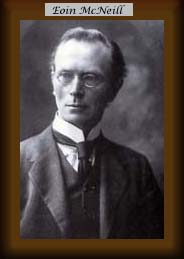
the Irish Volunteers, a history professor by the name of Eoin McNeill,
remained in the dark as to the secret group and their plans.
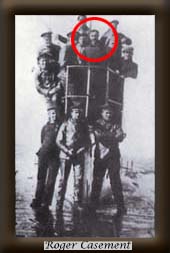
Traditionally, Irish nationalisn had looked to the Irish diaspora in the US as a source of arms and financial aid and the Clan na Gael organisation in America was firm in it's desire to help. Financial aid was never a problem but the provision of enough weapons to equip an uprising, especially in wartime, was beyond their power. As always when England's danger became Ireland's opportunity, it was to England's enemy that those planning a rising turned. The plans the IRB men eventually came up with were nothing if not ambitious and were dangerously dependent on German assisstance. Firstly arms were asked for; thousands of rifles, millions of rounds of ammunition, machineguns and machinegunners. German officers were needed for a force so poorly trained in military matters. Diversionary Zeppelin raids on British cities were requested and a submarine was wanted to patrol Dublin Bay and interfere with the sea route for British reinforcements. The man who chose to go to Germany in search of such things was a strange rebel indeed. Sir Roger Casement was a member of the Protestant Ascendancy and ex-member of the British Diplomatic Corps. As a young consul in Africa he had exposed the horrific exploitation of the natives on the rubber plantations of the Congo Free State. He later laid bare similar abuses after an investigation of the South American rubber trade. As a result of his endeavours, he was, for a while, feted by liberal society in London. He was a darkly handsome man, almost certainly homosexual, and drawn to the cause of Irish freedom by his heart much more than his head. He was to lose both for his pains. Travelling via the US, he arrived in Germany on a mission to acquire guns, German military advisers and persuade Irish POW’s of the Germans to join an Irish Brigade that would be sent home to fight the British in Ireland. After a rather trying period in Germany, in which his military hosts made no secret of their contempt for his treachery, he managed to obtain some weapons, a ship to transport them back to Ireland and a U-Boat to return himself and his two companions. The Germans could spare him no officers and his efforts at persuading Irish POW’s to join him resulted in almost total failure. Most of these prisoners were ‘old sweats’ of the British Regular Army or men who had joined up at the outset of war for idealistic reasons. Their reaction to his overtures was mostly hostile, sometimes even violent. The few who did join him were more interested in the promise of better rations than any desire to take on the might of the British Empire. Unfortunately for Casement, the British Admiralty’s intelligence had broken German ciphers and knew almost everything about Casement’s mission. When finally the guns, loaded in the Norwegian trawler Aud, and Casement in his U-Boat set off for Ireland the British were waiting for them.
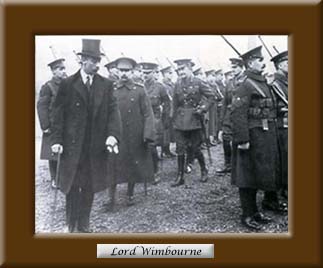
The difficulty of smuggling the guns through the countryside and the danger of the British intercepting them once they were ashore led the leaders of the rising to ask for their delivery to be made as near to the start of the rising as possible. The rising was originally planned for Saturday 22nd April and as such the captain of the Aud was ordered to deposit his cargo on the west coast of Ireland three days before. The plan, however, was changed. Easter Monday, April 24th was a bank holiday and most of the British officers in Dublin would be conveniently away attending the Fairyhouse races on that day. The rising was postponed by two days. A message was got through to Germany informing Casement of the postponement and requesting the guns be delivered two days after the previously arranged time, but it came too late. The Aud had already sailed and as she carried no radio it was impossible to inform her of the change in plans. Although the British knew of the Aud's mission she miraculously evaded British patrols (once actually being boarded and searched by British sailors) and safely reached her rendevouz. There was no one to meet her. Her captain waited as long as prudence would allow and then put to sea again. Off the coast of Kerry she was detected by British warships and escorted to Queenstown harbour. On entering the harbour the German naval crew changed into their German Navy uniforms, ran up the German ensign and scuttled the ship. The badly needed arms went to the bottom of the sea. Casement was as ill-starred as the Aud. He had realised that the rising had no hope of success and had hoped to arrive in Ireland in time to have the action cancelled. Landed by dinghy in heavy seas, the boat capsized and he and his two companions struggled ashore cold, wet and dispirited on Banna Strands. Casement was almost immediately arrested and sent off to London. Eoin McNeill, meanwhile, had finally learned of the IRB plot and the projected rising. He tried desperately to countermand the orders that had gone out from the IRB to units of the volunteers all over Ireland. He issued a proclamation to that effect in the newspapers and had boys on bicycles rushing here and there with his orders to stand down. He was too late and the rising went ahead anyway. The compartmentalization of British Intelligence had led to the British authorities in Dublin initially not being informed of the voyage of the Aud. They were informed of its capture,however, and could read in their newspapers of McNeill's attempt to call off the rising. As such they felt that the danger had passed and confidently assumed that the overwhelming superiority of their forces would be the surest guarantee of quiet. Surely not even passionate, patriotic Irish rebels would dare to undertake a task so obviously suicidal. Of the two highest British officials in Ireland one, chief secretary Augustine Birrell, was in London and his assistant Sir Matthew Nathan was convinced there would be no rising. Lord Wimbourne, the king's representative as Lord Lieutenant of Ireland, was not so sure and demanded that the rebel leaders be immediately arrested. Nathan persuaded him that such a thing would not be necessary. As dawn broke on Easter Monday most British officers had no idea of what had been going on and left, as planned, for the races.
|