| McGRINGO's SCORPIONS |
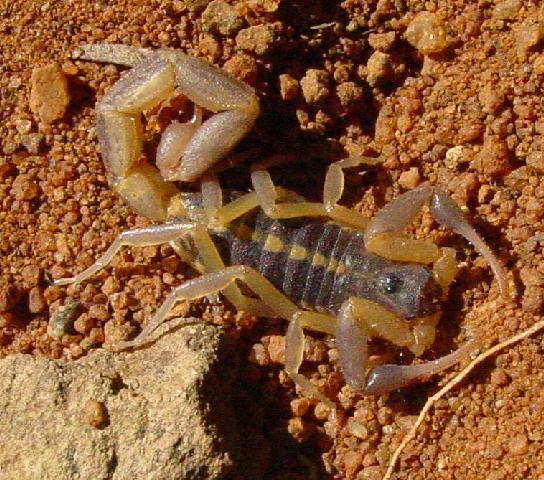
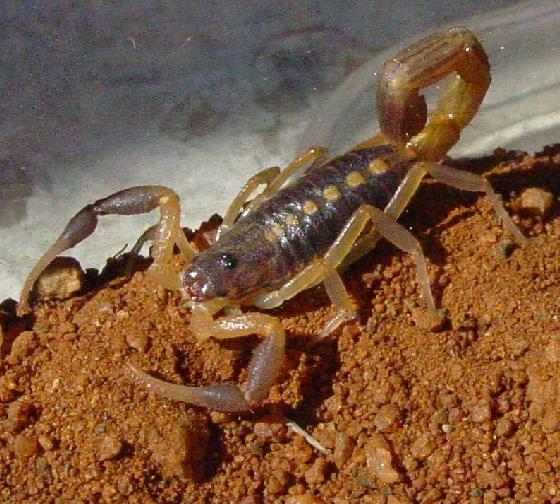
| Found: The one pictured was found on top of a koppie under stones on a sandy path, fairly loose soil. The are very widespread little scorpions, found under stones in grassland ranging from savannah to bushveld. Date: June 2003 Length: Approx. 4cm Description: Greyish body, marked with a distinctive light orange dorsal line "broken" by the anterior edge of each mesosomal segment. The last metasomal segment and the telson are grey, the rest of the metasoma is pale yellow. Legs are pale yellow and pedipalps are pale yellow and grey (see pic) while the chelae have grey "hands" and pale yellow "fingers. Subaculear tubercle present. Comments: Found by chance - I was actually up on the koppie looking for Hadogenes specimens and just stopped on the dirt path for a drink ad a bite to eat. U.triangulifer is very widespread - as a kid, I used to find them often on rocky outcrops in the veld in Jo'burg - a good 350km away - and distribution maps suggest they cover most of Gauteng and Mpumalanga provinces. |
| MORE STINGERS |
 |
 |
 |
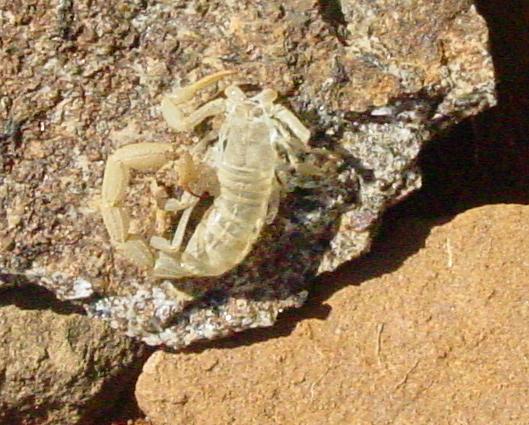 |
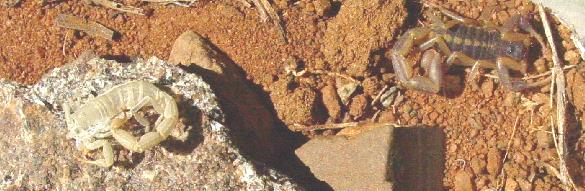
| The male U. triangulifer and its recently shed skin, called the [name] The picture right shows the significant size difference between the live scorpion and its old skin. [Click on the above pics to enlarge] |
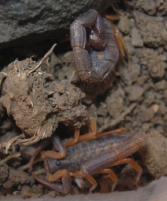
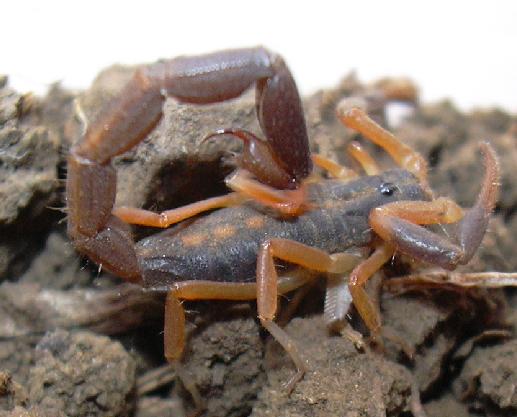
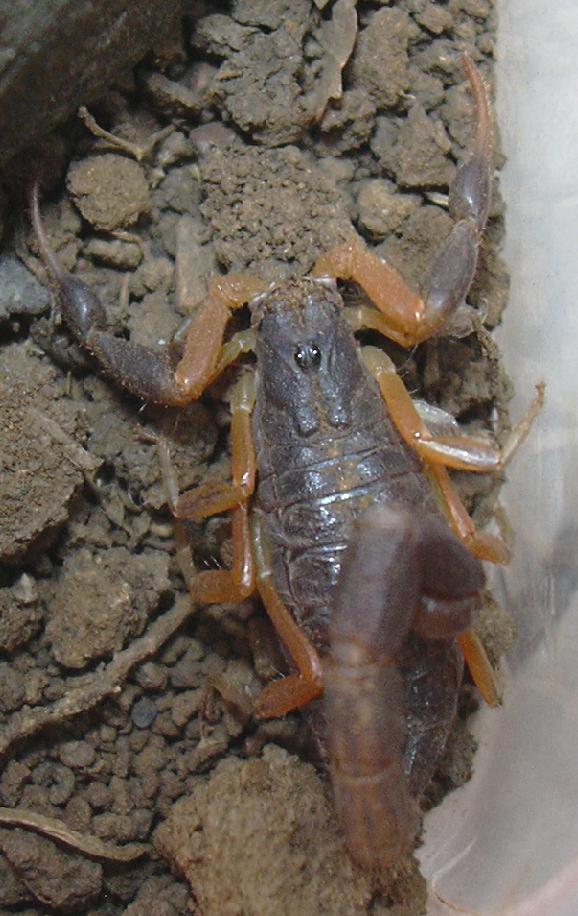
| Found: Under stones in the rocky veld by th roadside. Date: November 2003 Length: Approx. 4cm Description: dark grey/black bodies, a broken orange dorsal line running down the back. Orange legs, banded orange and black pedipalps. In the male (bottom), the first 3 segments of the tail have orange streaks. Subaculear tubercle present. Comments: I found this pair together. At first I thought these were just smaller versions of the black and red Uroplectes sp. featured on the previous page. However, the legs are entirely orange (not banded) and the architecture of the tail is very different - more slender and less ridged. Also, the fact that they were found as a pair indicated that these were adults - confirmed when I discovered the female (top) was gravid. This means the adult size is significantly (1cm) smaller than the Long Tom Pass scorpions. When I compared them to the U. triangulifer above, based on tails and carapaces, they appear structurally identical, hence my guess that they are are a colour variation on that species. CLICK ON PICS TO ENLARGE |
 |
 |
 |
| COMING SOON! A comparison of the three Uroplectes triangulifer species featured on this site. |
| Uroplectes triangulifer (colour variation) |
| Uroplectes triangulifer (common form) |
 |
|