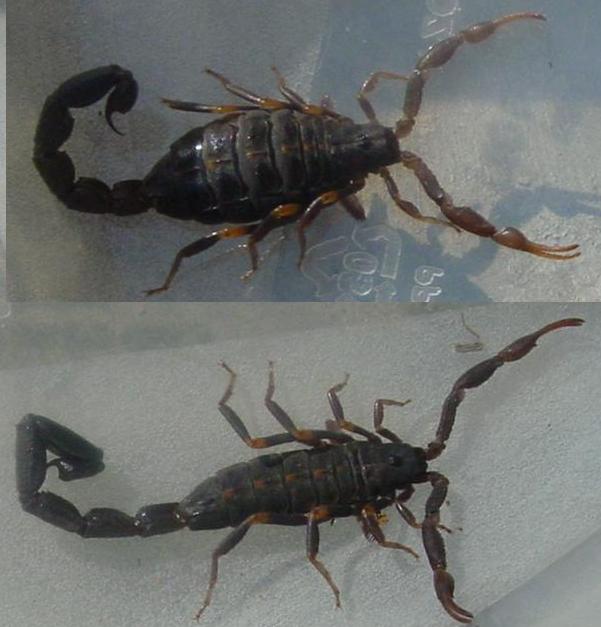
| Right - Typical sexual dimorphism between female (top) and male (bottom), found as a pair under the same stone. [Click to enlarge] |
 |
 |
| McGRINGO's SCORPIONS |
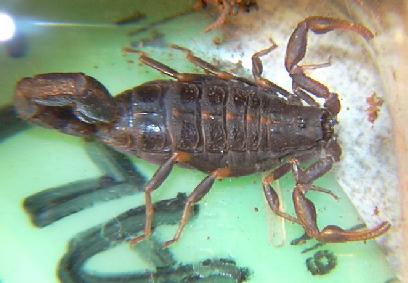
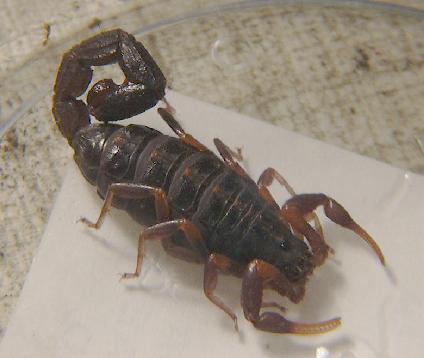
| Uroplectes sp. Note: Based on the photo's - NEVER a failproof way to ID scorpions - it has been suggested that this may be a colour variation on U. triangulifer, possibly U. triangulifer tristis. Found: Grassy veld, under large smoth rocks, rich, tight soil. More commonly, under rocks resting on strips of exposed bedrock in the veld. Date: 2 February 2003 Length: Approx. 3,9cm (see pic) Description: Olive-black body and legs, with orange bands on the posterior half (i.e. towards the claw) of the 3rd segment of each leg and on the 3rd last segment of each pedipalp (including the chela as the last segment). Orange longitudinal dorsal line, "broken" by the anterior edge of each mesosomal segment. The last metasomal segment and the telson are solid black, darker than the rest of the scorpion. Comments: This was a stroke of luck - I was driving at dusk and the terrain caught my eye, so I pulled over and tackled the rocks at the side of the road. This little beauty was clinging to the underside of a rock I rolled over. Unfortunately, poor visibilty meant I had to give up any further searching after about 10 minutes, so I can't comment on population density. |
| A PAIN IN THE ASS! |
| The so-called "stinging" scorpions can be found here (Family Buthidae). Yeah, I know, ALL scorpions can sting you. The fact is, some hardly ever do - the "rock" scorpions are probably the most docile - and others, like the burrowers and creepers, only do when provoked. Actually, when not subduing prey, even the stinging scorpions usually only sting when provoked... too bad they seem to have short fuses! And then of course, there's the poison. While the other scorpion families have fairly mild venom, these little suckers are bad news. Not that one should get paranoid - there are only 2 species in Southern Africa which have caused fatalities (Parabuthus granulatus and P. transvaalicus). Generally, however, it's best not to risk handling "stinging" scorpions without protection, e.g. gloves or forceps. The latter is recommended as gloves thick enough to provide protection lack the sensitivity required for handling smaller individuals. Grabbing the telson (i.e. the sting) is not recommended, as these guys are very fast and surprisingly strong - a sweaty fingertip may be slippery enough for the scorpion to twist and sting you. So don't be a hero - be careful! Some large species of Parabuthus stridulate by scratching their telsons on specially adapted, i.e.granulated or reinforced segments of their metasoma or mesosoma and at least one species will spray venom up to a metre if really annoyed! Cool... but deadly. |
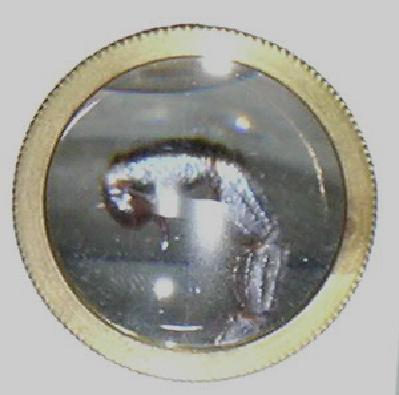
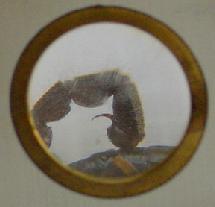
| Above - Close ups of the tail - with a jerry-rigged lens! The blown out flash pic on the right has the single redeeming point of showing up the granulated ridges. |
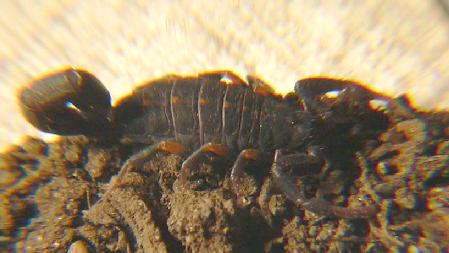
| Uroplectes sp. sub-adult Found: Shortly after capturing an adult under a stone resting on another rock, in the middle of the Cheloctonus intermedius colony, I turned up this sub-adult under a layer of loose shingle, covering another very large flat rock. Have since found them mainly under loose stones on bedrock. Date: 24 February 2003 Length: Approx. 3cm (see bottom left) Description: As above Comments: Apparently commonly distributed. Have been found living in the same area as the common colour form of U. triangulifer. |
 |
 |
 |
 |