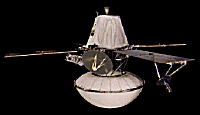
Viking Mission to Mars
NASA's Viking Mission to Mars was composed of two spacecraft, Viking 1 and Viking 2, each consisting of an orbiter and a lander. The primary mission objectives were to obtain high resolution images of the Martian
surface, characterize the
structure and composition of the atmosphere and surface, and search for evidence
of life. Viking 1 was launched on August 20, 1975 and arrived at Mars on June
19, 1976. The first month of orbit was devoted to imaging the surface to find
appropriate landing sites for the Viking Landers. On July 20, 1976 the Viking 1
Lander separated from the Orbiter and touched down at Chryse Planitia (22.48°
N, 49.97° W planetographic, 1.5 km below the datum (6.1 mbar) elevation).
Viking 2 was launched September 9, 1975 and entered Mars orbit on August 7,
1976. The Viking 2 Lander touched down at Utopia Planitia (47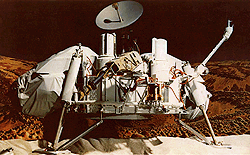 .97°
N, 225.74° W, 3 km below the datum elevation) on September 3, 1976. The
Orbiters imaged the entire surface of Mars at a resolution of 150 to 300 meters,
and selected areas at 8 meters. The lowest periapsis altitude for both Orbiters
was 300 km. The Viking 2 Orbiter was powered down on July 25, 1978 after 706
orbits, and the Viking 1 Orbiter on August 17, 1980, after over 1400 orbits.
.97°
N, 225.74° W, 3 km below the datum elevation) on September 3, 1976. The
Orbiters imaged the entire surface of Mars at a resolution of 150 to 300 meters,
and selected areas at 8 meters. The lowest periapsis altitude for both Orbiters
was 300 km. The Viking 2 Orbiter was powered down on July 25, 1978 after 706
orbits, and the Viking 1 Orbiter on August 17, 1980, after over 1400 orbits.
The
results from the Viking experiments give our most complete view of Mars to date.
Volcanoes, lava plains, immense canyons, cratered areas, wind-formed features,
and evidence of surface water are apparent in the Orbiter images. The planet
appears to be divisible into two main regions, northern low plains and southern
cratered highlands. Superimposed on these regions are the Tharsis and Elysium
bulges, which are high-standing volcanic areas, and Valles Marineris, a system
of giant canyons near the equator. The surface material at both landing sites
can best be characterized as iron-rich clay. Measured temperatures at the
landing sites ranged from 150 to 250 K, with a variation over a given day of 35
to 50 K. Seasonal dust storms, pressure changes, and transport of atmospheric
gases between the polar caps were observed. The biology experiment produced no
evidence of life at either landing site.


