Description
The Mars
Pathfinder was the second of NASA's low-cost planetary Discovery missions to be
launched. The mission consists of a stationary lander and a surface rover. The
mission had the primary objective of demonstrating the feasibility of low-cost
landings on and exploration of the Martian surface. This objective was met by
tests of communications between the rover and lander, and the lander and Earth,
tests of the imaging devices and sensors, and tests of the maneuverability and
systems of the rover on the surface. The scientific objectives include
atmospheric entry science, long-range and close-up surface imaging, rock and
soil composition and material properties experiments, and meteorology, with the
general objective being to characterize the Martian environment for further
exploration. (Mars Pathfinder was formerly known as the Mars Environmental
Survey (MESUR) Pathfinder.)
Mars Pathfinder was launched on a Delta 7925 (a
Delta II Lite launch vehicle with nine strap-on solid-rocket boosters and a Star
48 (PAM-D) third stage) at 6:58:00 UT (1:58 a.m. EST) on 4 December 1996. The
spacecraft entered the Martian atmosphere on 4 July 1997 directly from its
approach hyperbola at about 7300 m/s without going into orbit around the planet.
The cruise stage was jettisoned 30 minutes before atmospheric entry. The lander
took atmospheric measurements as it descended. The entry vehicle's heat shield
slowed the craft to 400 m/s in about 160 seconds. A 12.5 meter parachute was
deployed at this time, slowing the craft to about 70 m/s. The heat shield was
released 20 seconds after parachute deployment, and the bridle, a 20 meter long
braided Kevlar tether, deployed below the spacecraft. The lander separated from
the backshell and slid down to the bottom of the bridle over about 25 seconds.
At an altitude of about 1.6 km, the radar altimeter acquired the ground, and
about 10 seconds before landing four air bags inflated in about 0.3 seconds
forming a 5.2 meter diameter protective 'ball' around the lander. Four seconds
later at an altitude of 98 m the three solid rockets, mounted in the backshell,
fired to slow the descent, and about 2 seconds later the bridle was cut 21.5 m
above the ground, releasing the airbag-encased lander. The lander dropped to the
ground in 3.8 seconds and impacted at 16:56:55 UT (12:56:55 p.m. EDT) on 4 July
1997 at a velocity of 18 m/s - approximately 14 m/s vertical and 12 m/s
horizontal - and bounced about 12 meters (40 feet) into the air, bouncing at
least another 15 times and rolling before coming to rest approximately 2.5
minutes after impact and about 1 km from the initial impact site.
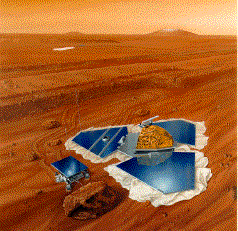
After landing, the airbags deflated and were
retracted. Pathfinder opened its three metallic triangular solar panels (petals)
87 minutes after landing. The lander first transmitted the engineering and
atmospheric science data collected during entry and landing, the first signal
being received at Earth at 18:34 UT (2:34 p.m. EDT). The imaging system obtained
views of the rover and immediate surroundings and a panoramic view of the
landing area and transmitted it to Earth at 23:30 UT. After some maneuvers to
clear an airbag out of the way, ramps were deployed and the rover, stowed
against one of the petals, rolled onto the surface on 6 July at about 05:40 UT
(1:40 a.m. EDT).
The bulk of the lander's task was to support the
rover by imaging rover operations and relaying data from the rover to Earth. The
lander was also equipped with a meteorology station. Over 2.5 meters of solar
cells on the lander petals, in combination with rechargeable batteries, powered
the lander. The lander on-board computer is based on 32-bit architecture with 4
million bytes of static random access memory and 64 million bytes of mass memory
for storing images. The main lander components are held in a tetrahedral shaped
unit in the center of the three petals, with three low-gain antennas extending
from three corners of the box and a camera extending up from the center on a 0.8
meter high pop-up mast. Images were taken and experiments performed by the
lander and rover until 27 September 1997 when communications were lost for
unknown reasons.
The landing site in the Ares Vallis region of Mars
is at 19.33 N, 33.55 W. The lander has been named the Sagan Memorial Station.
The Ares Vallis region of Mars is a large outwash plain near Chryse Planitia.
This region is one of the largest outflow channels on Mars, the result of a huge
flood (possibly an amount of water equivalent to the volume of all five Great
Lakes) over a short period of time flowing into the martian northern lowlands.
The Mars Pathfinder mission cost approximately $265 million including launch and operations. Development and construction of the lander cost $150 million and the rover about $25 million.


