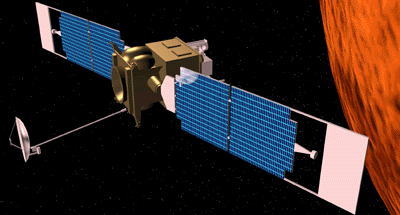
The Mars Global Surveyor (MGS) mission is designed as a rapid, low-cost recovery of the Mars Observer mission objectives. The science objectives involve high resolution imaging of the surface, studies of the topography and gravity, the role of water and dust on the surface and in the atmosphere of Mars, the weather and climate of Mars, the composition of the surface and atmosphere, and the existence and evolution of the Martian magnetic field.
The spacecraft began its Mars orbit insertion burn at 01:17 UT 12 September 1997 (9:17 p.m. EDT September 11) after a 10 month cruise phase. The time for the radio signal to travel from Mars to Earth is about 14 minutes, so the Earth received time for these events was 14 minutes later, or 9:31 p.m. EDT for the beginning of the orbit insertion burn. At 9:29 p.m. the spacecraft went behind Mars and contact was lost at Earth at 9:43 p.m., closest approach to Mars on this pass was at 9:30 p.m. The burn was completed at 9:39 p.m. and contact was re-established at Earth at 9:57 p.m. Mars Global Surveyor started in an elliptical (54,021 x 258 km altitude) 45 hour orbit.
Over the sixteen months after orbit insertion, aerobraking and thrusters will slowly convert the original elliptical capture orbit into a nearly circular 2 hour polar orbit with an average altitude of 378 km, allowing complete coverage of the planet every 7 days. The primary mapping mission will begin about March, 1999. (Primary mapping was originally scheduled to begin in March, 1998 but a malfunction of one of the solar panel supports delayed the aerobraking schedule for one year.) The spacecraft will be in a "sun-synchronous" orbit so that each image will be taken with the sun at the same mid-afternoon azimuth. Data will be acquired for one Martian year (approx. 2 Earth years). The spacecraft will also be used as a data relay for later U.S. and international missions over the following two years. Mars Global Surveyor is the first spacecraft to be launched in a decade-long exploration of Mars by NASA. Launches will be occurring every 26 months, in 1998, 2001, 2003 and 2005, involving orbiters, landers, rovers, and probes to Mars. Orbiters launched in 1998 and 2003 will contain other instruments to recover the planned Mars Observer objectives.
