About Mali

Excerpted from Wikipedia.
The Republic of Mali (Republique du Mali) is a landlocked nation in West Africa. It is the second largest country among West African nations. It borders Algeria on the north, Niger on the east, Burkina Faso and the Cote d'Ivoire on the south, Guinea on the south-west, and Senegal and Mauritania on the west. Its straight borders on the north stretch into the centre of the Sahara desert, while the country's south, where the majority of inhabitants live, features the Niger and Senegal rivers. Formerly French Sudan, the country is named after the Empire of Mali.
History
The Mande peoples settled the Sahel (including present-day Mali), and formed a succession of Sahelian kingdoms, including the Ghana Empire, the Mali Empire, and the Songhai Empire. Timbuktu was a key city in these empires as an outpost for trans-Saharan trade and a center for scholarship. The Songhai Empire declined under a Moroccan invasion in 1591.
Mali was invaded by France starting in 1880, which annexed it as an overseas department of France. The colony, which at times also included neighbouring countries, was known as French Sudan or the Sudanese Republic. In early 1959, the union of Mali and Senegal became the Mali Federation, which gained independence from France on June 20, 1960. Senegal withdrew from the Mali Federation after a few months. The Republic of Mali, under Modibo Keita, withdrew from the French Community on September 22, 1960.
Mali was ruled by a series of dictators from independence until 1991. Anti-government protests in 1991 led to a coup, a transitional government, and a new constitution. In 1992, Alpha Oumar Konare won Mali's first democratic, multi-party presidential election. Upon his reelection in 1997, President Konare pushed through political and economic reforms and fought corruption. In 2002 he was succeeded in democratic elections by Amadou Toumani Toure, a retired General, who had been the leader of the military aspect of 1991 democratic uprising.
Geography
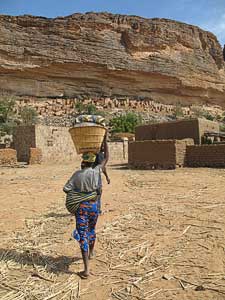
Mali is landlocked and has a subtropical to arid climate. It is mostly flat, rising to rolling northern plains covered by sand, with savanna around the Niger River in the south. The hills of the Air Massif and Djado Plateau lie in the northeast. Most of the country lies in the Sahara Desert, which produces a hot, dust-laden harmattan haze common during dry seasons and leads to recurring droughts. The nation has considerable natural resources, with gold, uranium, phosphates, kaolin, salt and limestone being most widely exploited.
Economy
Mali is among the poorest countries in the world, with 65% of its land area desert or semidesert. Economic activity is largely confined to the riverine area irrigated by the Niger River. About 10% of the population is nomadic and some 80% of the labor force is engaged in farming and fishing. Industrial activity is concentrated on processing farm commodities. Mali is heavily dependent on foreign aid and vulnerable to fluctuations in world prices for cotton, its main export. In 1997, the government continued its successful implementation of an IMF-recommended structural adjustment program that is helping the economy grow, diversify, and attract foreign investment. Mali's adherence to economic reform, and the 50% devaluation of the African franc in January 1994, has pushed up economic growth. Several multinational corporations increased gold mining operations in 1996-1998, and the government anticipates that Mali will become a major Sub-Saharan gold exporter in the next few years.
Demographics
Mali's population consists of diverse Sub-Saharan ethnic groups, sharing similar historic, cultural, and religious traditions. Exceptions are the Tuaregs and Maurs, desert nomads, related to the North African Berbers. The Tuaregs traditionally have opposed the central government. Starting in June 1990,in the North by Tuaregs seeking greater autonomy led to clashes with the military. In April 1992, the government and most opposing factions signed a pact to end the fighting and restore stability in the north. Its major aims are to allow greater autonomy to the north and increase government resource allocation to what has been a traditionally impoverished region. The peace agreement was celebrated in 1996 in Timbuktu during an official and highly publicized ceremony called "Flamme de la Paix" (peace flame).
Culture
Approximately 90% of the Malians follow Sunni Islam, but not always to the exclusion of traditional religious beliefs and practices. The Muslims have their own educational systems, leading in some cases to the equivalent of baccalaureate and doctoral studies. An increasingly large number of Muslims make the pilgrimage to Mecca and study in Arab countries. Christians comprise about 5% of the population. Under French colonial rule the introduction of missionaries into predominantly Islamic areas was discouraged.
Literacy in French, the official language, is low and is concentrated in the urban areas. The government has expanded literacy considerably since 1960 by stressing education at the primary and lower secondary levels. A national university was established in Bamako in the 1990s.