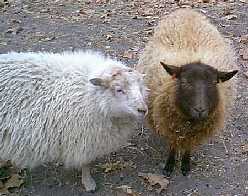

Shetland sheep are an ancient breed, said to have been brought to the Shetland Islands by Vikings in the 8th Century.
One of the most distinguishing characteristics of Shetlands is their short fluke shaped tail that does not need to be docked. The breed is very diverse in wool types, colors and dispositions. They are one of the smallest sheep breeds, generally weighing between 75 to 120 lbs. as adults. Shetlands are considered "unimproved" hardy sheep that do not require the amount of feed that "improved" breeds need and usually lamb unassisted.
Ewes are normally hornless. Horns are uncommon in ewes, but there are a couple bloodlines which will throw horned ewes which have 4-7 inch horns as adults.
The traditional names for colors are still used to register Shetland sheep. There are 11 main colors and 30 markings that have names. Many of the markings are rare in the US.
The main colors are:
You can find a list of the Markings on the North American Shetland Sheep Association website.
For more reading about Colonel Dailley, check: Maple Ridge Sheep Farm and African Lion Safari
For more about the Flett flock go to: Puddleduck Farm
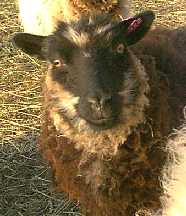
In 1980, thirty-two shetlands were imported to Alberta, Canada by "Colonel" Dailley. There were 4 rams and 28 ewes. Most of the Shetlands now in the US are descendants of those Shetlands. Previous to the Dailley import, a small flock of Shetlands were actually imported in 1948 to Saskatchewan, Canada by the Flett family. Much more recently, for new blood, there has been the availability of semen of select rams from the United Kingdom for those enrolled in the voluntary scrapie program.
Shetland wool was once used for a traditional wedding shawl that could be pulled through the bride's ring. 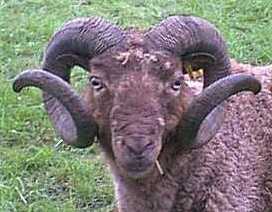 Rams have large horns which curve out about the sides the head. Ram lambs are capable of producing lambs but many breeders will not use a lamb ram for breeding so that they can see how the overall animal and especially horns will turn out within the next year. Rarely are rams born without the ability to grow horns and typically they are not kept as breeding rams.