|
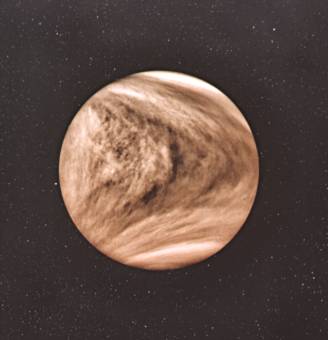
Venus is the second planet from the
Sun. Apart from the Sun and the Moon, Venus is the brightest
object in the sky. The planet is called the morning star when it appears in the east at sunrise, and the evening star when it is in the west at sunset. In ancient times the evening star was called Hesperus
and the morning star Phosphorus or Lucifer. Due to the distances of the orbits of Venus and the Earth from the Sun, Venus is never visible more than three hours before sunrise or three hours after
sunset.When viewed through a telescope, the planet exhibits phases like the Moon. Full Venus appears the smallest because it is on the far side
of the Sun from Earth. Maximum brilliance (a stellar magnitude of -4.4, or 15 times the brightness of the brightest star) is seen in the crescent phase. The phases and positions of Venus in the sky repeat
with the "synodic" period of 1.6 years. Transit across the face of the Sun are rare, occurring in pairs at intervals of a little more than a century. The next two will be in 2004 and 2012.The swirling clouds
of sulphuric acid are most probably due to a run-away greenhouse effect because of its distance from the Sun, in turn causing a surface temperature of 462 degrees Celsius (hot enough to melt lead). |