|
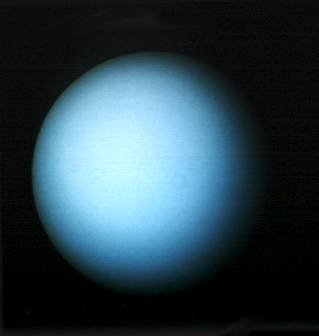
Uranus is a major planet in the solar system, seventh planet from the Sun. Uranus revolves outside the orbit of Saturn and inside the orbit of Neptune. The average distance from Uranus to the Sun is 2.87 billion km. Uranus has an inner rocky core that is surrounded by a vast ocean of water mixed with
rocky material. From the core, this ocean extends upward until it meets an atmosphere of hydrogen, helium, and methane. Uranus has 10 known rings and 21 confirmed moons. The mass of Uranus is 14.5 times
greater than the mass of Earth, and its volume is 67 times greater than that of Earth. The force of
gravity at the surface of Uranus is 1.17 times the force of gravity on Earth. Because of its great size and mass, scientists classify Uranus as one of the giant or Jovian (like Jupiter) planets, along with Jupiter, Saturn, and Neptune. Uranus was the first planet that people discovered
by using a telescope. Sir William Herschel, a German-born British musician and astronomer, discovered the planet in 1781. Herschel accidentally discovered it while measuring shifts in the positions of stars
in the constellation Gemini. He observed that Uranus is a moving object, so he first reported his discovery to the British Royal Society as a comet. However, people had observed and plotted Uranus on star
charts dating back to 1690 (believing it was a star). Astronomers used these earlier observations to identify the object as a planet and to establish its orbit. Herschel originally named the planet Georgium
Sidus (Star of George) in honour of King George III of Great Britain. Later, astronomers named the planet after Uranus, a figure who embodied the heavens and was the father of Saturn and the grandfather of
Jupiter in Greek and Roman mythology. |