@
" Kaiseki "

@Makoto Hatori

The relationship between tableware and the food presented on it has long been a topic for discussion, with an emphasis either on the food dish or the accompanying tableware.

In Japan it is taken as implicit that in talking about one you inevitably talk about the other. So in this article I am referring indirectly to tableware even though my apparent focus is on Japanese dishes and the mentality behind them!

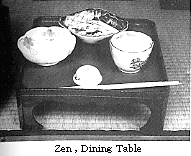
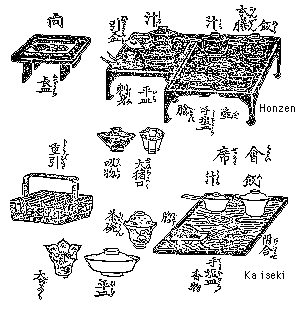
Until about a hundred years ago, in the Meiji era (1868`1912), when society was organised in highly explicit social classes, the upper class ate their dishes, using zen which is a tiny low table for individual use. A wide variety of tableware was required to make the zen table more attractive and to make it reflect the appropriate seasonal atmosphere. The Japanese-style zen table design and the typical pattern of ordering dishes as commonly understood in the West can only be found today in special traditional Japanese restaurants or hotels.

Kaiseki dishes best represent the core of traditional Japanese food culture. These are simple dishes served before tea is served in the tea ceremony. It is essential to appreciate the spirit of kaiseki to fully understand the form of the zen table. The core of kaiseki dishes resides in their proper respect for food materials and nature's role in producing them, which in turn is shown in the simple form of the kaiseki dish.

The name kaiseki comes from the tradition of Buddhist priests who stow warm stones (stone = seki) in their inside breast pocket (breast = kai).

There is also the concept of wabi or austere refinement. The feeling of wabi and sabi (quiet simplicity) come from simple and poor food served to fill an empty stomach. To be precise, this type of kaiseki is called cha-kaiseki (tea kaiseki). Food variety was naturally limited as Buddist priests did not eat meat.

On the other hand, there is another type of kaiseki, which is different - good and high-quality dishes served at special parties. These are also called kaiseki dishes. In addition, there are the more formal full-course dishes called honzen (proper zen) dishes. In the spectrum of dishes. These are at the end opposite to cha-kaiseki.

It is said that the traditional Japanese dishes should be consumed not only by taste but also their visual appearance as presented to the eyes. Party kaiseki dishes or honzen dishes please people by utilising a wide variety of food materials, finely cooked and presented on decorated dishes, and shining tableware. Kaiseki or honzen dishes are served luxuriously decorated at ceremonial celebrations. We should note that there are two meanings to zen which are separate, the zen for table and the zen which Western readers are more familiar with, or the Buddhist way. Decorated celebratory dishes are far from the spirit of the tea ceremony which relates to the Buddhist way.

Our "eyes" in party kaiseki or honzen can only capture surface or material luxury. But the metaphor of "eyes" should be understood in a more spiritual sense. The food that merely satisfies desire for life and appetite contradicts the spirituality of sado (the way of the tea ceremony) whose essence is going beyond one's own self. For Zen priests, eating is not just for satisfying the appetite. For them, the whole life, and the whole ascetic practice are represented in eating. This is why they keep quiet while eating. In addition, cooking is also an ascetic practice. Indeed, everything related to one's appetite is ascetic practice. When eating, they just eat, and they just keep seated and when they are seated that is commonly and widely known as zazen (Zen sitting). And the excretion that comes afterwards is also an ascetic practice. Hunger is thus a way to spiritual enlightment.

The simplicity of cha-kaiseki comes from the core of the Zen spirit. Being simple does not mean being shabby. The mental simplicity in Zen and the tea ceremony is related to the artistic sense of wabi and sabi. The simple food materials used in cha-kaiseki are cooked with care, and without losing their essential own natural taste. This is different from just enjoying raw food materials as being natural. What is at stake is the respect for nature, which is emphasised by the style of cha-kaiseki - small amounts of food seen in pots and plates. The tableware here is not new, not shabby, but not luxurious merely to show off to guests. The pots and plates used in cha-kaiseki are sometimes used for the tea ceremony. For instance, a sake (rice wine) pot is used as a flower vase, with some seasonal flowers and put on the floor. The act of putting the tableware into a different context, different from its original use, is called mitate. A pot in cha-kaiseki, used for serving food, may be used as a snack plate in which seasonal cakes are put. These cakes also represent the four seasons. Thus everything related to cha-kaiseki and the tea ceremony represents respect for nature and identification with nature. If the guest is surprised and pleased, it is not because of the material luxury but because of the spirituality and the artistic sense of their host. Thus everything leads us to the sense of beauty in the poverty or simplicity pursued in Zen.

This spirit of cha-kaiseki was the backbone of original Japanese food culture and the background to the spirit of people who lived in an era of poverty. Up until about 120 to 130 years ago, rice farmers could not eat the rice they had produced, and they had to eat other grains. Most Japanese including low-class warriors (samurai) ate a cup of soup plus one dish, with some grain (rarely rice) as their sole diet. On the other hand, the dishes commonly consumed in Japan nowadays are more like popularised party food. It is essential to recall the spirituality that existed in cha-kaiseki when seeking to examine and appreciate our food culture here in Japan.

CPA News, The Newsletter of the Craft Potters Association of Great Britain,
Number76, p.6 (March/April 2001)

All Copyrights Reserved (c) 2002-2005, Makoto Hatori
@
Hosted by www.Geocities.ws

1