BEIJING INTRODUCTION
Beijing, the capital of the People's Republic of China, is the nation's
political and
cultural centre.Some 690,000 years ago, Peking Man lived at Zhoukoudian, 48 kilometres southwest
of Beijing.
A small town appeared on the present site of southwestern Beijing in 1045 B. C.
It was named Ji and then changed to Yan. At the beginning of the 10th century,
it was the second capital of the Liao Dynasty. From then on, the city had been
the capital of the Jin, Yuan, Ming and Qing dynasties until 1911.
In the early twenties, Beijing became the cradle of China's new democratic
revolution. The May Fourth Movement against imperialism and feudalism began here
in 1919.
On October Ist, 1949, Chairman Mao proclaimed to the whole world the founding of
the People's Republic of China.
Beijing is situated at 40 degrees north latitude and 116 degrees east longitude.
It is 43 metres above sea level and 183 kilometres from the sea. Beijing covers
an area of 16,800 square kilometres, 38% of it is flat land and 62% mountains.
Beijing has a continental climate. Annual rainfall averages nearly 700
millimetres, most of it comes in July and August. Winter is dry and cold and has
little snow, The frost-free period is 185 days. The best time to visit Beijing
is May, September and October, when people enjoy bright sunny sky.
Beijing has
a population of 10.855 million, about 5 million live in the city proper
and the rest on the outskirts. It is divided into 12 districts and 6
counties.
A long history has left numerous famous historical sites which possess
great aesthetic and cultural values. The Great Wall, a huge project begun
more than 2,000 years ago, meanders through mountains and valleys for
hundreds of kilometers in the region of Beijing. On the Shijing Mountain,there
are more than 340 volumes of 15,000 stone tablets carved with Buddhist
scriptures. The big Yongle Bell, cast at one go with over 230,000
characters on it , weighs 46.5 tons and shows the exquisite casting
technology of ancient China. The Forbidden City, the largest ancient
architectural complex extant today, is splendid crystallization of ancient
Chinese architectural art. Walking in the city, one may find many places
worth a second visit. These include mansions, gardens , gate towers ,
temples, former residences of celebrities and places where many historical
events took place. Every day, hundreds of thousands of people, domestic
and foreign, come to Beijing to visit its grand palaces and graceful
gardens and to enjoy its marvelous art.
top!
Beijing also attracts world attention with its growing prosperity,and its
closer links with world affairs. Through more than 40 years of construction,Beijing
has changed from a consumer-city to a major city with various industries.
Beijing ranks second among the top 50 cities in China in terms of comprehensive
power, and is the first among the 40 best cities in China in terms of investment
environment.
With China's reform and opening up, Beijing is improving urban construction on
an unprecedented scale. Its speed of development is astonishing,and it brings
about changes day after day. Around this graceful ancient capital, a large
number of key national projects, massive infrastructure buildings and modern
residential houses have sprung up. Wasteland and low, dilapidated houses are
gradually disappearing,replaced by newly-built residential quarters of different
styles and surrounded by greenbelts. Wide and smooth highways, magnificent
overpasses and expressways link Beijing with its neighboring provinces and
cities, and eye-catching green trees and gardens have made Beijing resemble a
huge scroll of painting pleasing to both the eye and the mind.
To preserve the space and historic buildings around the Forbidden City,
nearby buildings must remain single-storey structures, and buildings within the
Second Ring Road must be no more than 30 metres in height.
As China's cultural center, Beijing , with a galaxy of talent and a rich
culture, has over 70 institutions of higher learning such as the famous Beijing
University, Qinghua University, More than 500 scientific research institutions,
over 300 publishing houses, as well as hundreds of newspapers and periodicals.
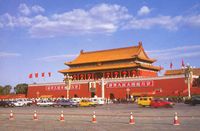
Tian'anmen Square, located in the city center, is a symbol of both Beijing and
China. The solemn flag-raising ceremony has become a sacred daily celebration.
Standing in the world's largest city square and looking far east and west up and
down the Chang'an Avenue, one can see a centuries-old architectural complex
standing side by side with newly-built modern-style buildings, pigeons
fluttering in the blue sky, large kites flying lazily above, torrents of
bicycles flooding by and tows of cars whisking along. Tian'anmen Square embodies
Beijing's history and reality, arousing the awareness the while the essence of
old Beijing remains splendid, the miracles created by new Beijing add to the
city's brilliance.
top!
|
A Brief Chronology of Beijing
|
|
| 700,000 B.C. | Peking Man |
| 1045 B.C. | Ji city founded in Beijing |
| 226 B.C. | Emperor Qin Shihuang occupied Ji |
| 581-618 | Called Zhuojun |
| 618-907 | Called Youzhou |
| 916-1125 | Called Nanjing, capital of Liao |
| 1153 | Called Zhongdu, capital of Kin |
| 1215 | Occupied by Genghis Khan and called Yanjing |
| 1272 | Called Dadu, capital of Yuan |
| 1368 | Called Beiping under the Ming empire |
| 1403 | Renamed Beijing |
| 1406 | Forbidden City--construction began |
| 1421 | Became the Ming Capital |
| 1564 | Expanded further south to form the present-day city size |
| 1644 | Became the Qing Capital |
| 1860 | British-French Allied Forces invaded the city and burned down Yuanmingyuan Gardens |
| 1900 | Eignt-Power Allied Forces invaded the city to suppress Boxer Movement |
| 1911 | Sun Yat-sen's revolution put an end to the rule of the Qing |
| 1912 | Founding of the Republic of China (then renamed Beiping) |
| 1937 | Japan invaded Beijing |
| 1945 | Surrender of Japan |
| 1949 | Founding of the People's Republic of China, resumed the name Beijin |
top!
Beijing's Gates
Nine
inside, seven outside, four in the Imperial City is a phrase used by Beijing
residents since Ming Dynasty as an aid to remembering the number of gates in the
walls of their city.
Nine Inside
Gate of Exalted Literature, South-Facing Gate or Front Gate, Gate of Universal
Prowess, Mound-Forming Gate or Gate of Just Rule, Western Gate or Gate of
Harmony & Righteousness, Gate of Virtuous Triumph, Gate of Peace and
Stability, Eastern Gate or Gate of Upholding & Benevolence, Gate Facing the
Sun or Gate of Uniformity & Affinity.
Seven Outside
Eastern Informal Gate, Broad Canal Gate, Left Gate of Peacefulness, Gate of
Eternal Stability, Right Gate of Peacefulness, Gate of Universal Peace, Western
Informal Gate.
Four in the Imperial City
Gate of Heavenly Peace, Gate of Earthly Peace, Gate of Eastern Peace, Gate of
Western Peace.
On a tour of Beijing, the visitor learns about the different functions of old
Beijing's nine city gates, the meaning of the saying "East for the wealthy,
west for the noble, north for the poor, and south for the lowly."
Each of the 20 gates had its own functions and has left many touching stories.
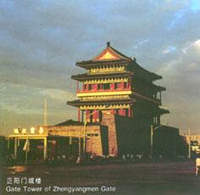
Zhengyangmen was the pass the Emperor used for travel to the Temple of Heaven
for worshipping ceremonies. Only the imperial sedans and carriages were allowed
to use the gate, while funeral ceremonies and carriages were forbidden to pass
here.
The most popular carts passing Chongwenmen were those carrying liquor as
distilleries were then located in the south and east of the city.
Chaoyangmen was the gate of grain since it linked transportation between the
Forbidden City and Tongzhou (present-day Tongxian). Tongzhou (Tongxian) which
was the beginning of the Grand Canal linking Beijing and Hangzhou in Zhejiang
Province. Tribute grain from the south was shipped to the capital on the canal.
Warehouses were built close to Chaoyangmen. Today's Nanmencang, Beimencang,
Xintaicang and Lumicang were used to store rice in the past.
Xizhimen was the water gate named for its position as the gateway to Jade Spring
Mountain which was the source of the imperial drinking water.
Gates were also connected with walls which were used to defend Beijing. On top
of the wall, special facilities in the shape of sawtooth were built to shield
arrows and other weapons. Other facilities included blockades that prevented
soldiers from falling down the wall. Building the walls was a costly project. It
was once reported that more than 40 million bricks and great quantities of earth,
lime and timber were used to wall the city.
Nowadays, Beijing's city walls have all been demolished. Only a few gate towers
are left. The Old Beijing Mini Landscape Park presents a complete picture of the
20 city gates and walls, although in a scaled down version.
The great architect Kuei Xiang of the Ming Dynasty adopted Chinese astrology
when he built the city. In the theory, the number Nine represented the divine
Heaven, the number Five the Dragon and the Earth in the middle of the Universe.
Under such a theory, Kuei Xiang constructed nine gates, five fortresses and a
platform in the shape of the Chinese character Earch in the middle of the palace.
The design symbolized the Emperor's divinity of both the Nine and the Five.
From the modern point of view, Beijing's arrangement of the axis thoroughfare
and four lakes of Nanhai, Zhonghai, Beihai and Houhai is shaped like two dragons
raising their heads rivaling for a pearl. We see the dragon and alarming pearl
motif often repeated in ancient Chinese ceramics and elsewhere in the artifacts
of Chinese antiquity. It is a deeply symbolic as well as artistically fanciful
and articulated design.

top!