Beijing Special
| Morning | Hutongs | Siheyuan |

As the
first day light is cast on the old city the citizens of Beijing have begun
their day. Old men carrying bird cages, swinging them backward and forward,
and old women, with wooden swords in hand, all make their way to nearby
parks, while young couples prepare breakfast for their only child before
they go to work.
The morning in Beijing is very colourful and you may find it surprising.
Why not get up a little earlier and take a walk in nearby streets or parks
where you will witness unfamiliar sights that many tourists miss
altogether?
Exercises in Parks
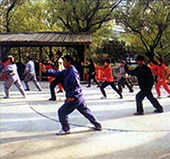
Beijing parks in
the morning are places for exercise by people young and old. Here you can
see people doing Taiji Boxing, Taiji Sword, Qigong or even disco dancing.
Some practise by themselves, and others follow an instructor in groups.
Taiji Boxing, also known as Shadow Boxing, and Taiji Sword are ancient
Chinese martial arts, but are now mainly practised for exercise. They
combine slow movements, deep breathing with strong and forceful postures.
The exercises are good for your health if you practise daily for years.
Qigong is another kind of silent exercise passed on from ancient times,
but has become very popular among people in recent years. The Chinese
believe that the entire cosmos can be divided into yin (negative) and yang
(positive), so everything has its belongings. When yin and yang are balanced, the world is in
peace, and when the human body has yin and yang
balanced it is in good health. Qigong helps make the yin and yang balanced.
By concentrating one's attention at the centre of one's abdomen and taking
deep breaths, one makes certain
movements according to the rules of different types of Qigong. Qi is an
invisible element, as believed by the Chinese, which is contained in air,
food, water and every living thing on the earth. By doing Qigong exercises,
one absorbs the Qi element from the universe to build up one's body in
order to have a long life.
Disco dancing has become part of the morning exercises in Beijing. A
modern dance naturally enjoyed by young people, disco dancing has become a
favorite for middle-aged and old people simply because of its strenuous
movements. This fact has led to the bizarre situation of disco dancing
having become a common sight as one of the morning exercises loved by old
people in Beijing.
Bird-lovers
In the morning, you can see old men carrying bird-cages in the streets,
on their bikes, by river banks or in parks. When they get together with
their mates they hang their bird cages on the branches of trees and chat
about their birds or other common interests. Some old men, especially in
summer, will spread out a chess board to play Chinese chess, while others
may do exercises or roll two heavy iron balls in the palm of one's
hand¡ªan
exercise for preventing rheumatism and loss of memory. Lovers of Peking
Opera train their voices by singing opera songs to the accompaniment of a
fiddle player.
Bird-loving has been a tradition in Beijing ever since the Ming and Qing
dynasties. Under the Qing, in particular, sons of Manchu families did not
have to work and one of their hobbies was to play with birds. This rich
family hobby has spread to ordinary people, especially the old, who have
their time for it.
Ballroom Dancing in the Street
You may be
astonished to see people doing ballroom dancing in open spaces by the
streets, even in midwinter. This Western type of dance was introduced into
China in the 1930s and was only enjoyed by rich people. After 1949, the
Waltz, which was known as "social dancing", became popular among
high officials and students. Every university was actually given the task
of eliminating "dance illiteracy" among the students at that
time. This was criticized as a bourgeois style of life and banned for a
dozen years during the "cultural revolution". It was revived
after China started on the path to economic reform. In the beginning,
people went to dance halls, but gradually people found it too expensive to
dance in these luxury halls, so they started to look for somewhere cheaper
instead. The open space by the streets is naturally a good choice (and free!). The dancers are mainly middle-aged people who regard the ballroom
dance as an exercise, but not as strenuous as disco dance. They may dance
for an hour before going to work. Normally there is an organizer who
brings a tape recorder to play the music and all the participants have to
pay a little money towards the battery. If you get up early and are
interested in joining in, you will certainly receive a warm welcome.
Morning Vegetable Markets
In the past, all the vegetable markets were state-run,
but since the economic reform in agriculture farmers have started to sell
the vegetables they grow on their land in the city to earn more money.
City neighbourhood committees provide places for the farmer to run morning
vegetable markets. The prices here are lower than in shops and the
vegetables are fresher. You may even able to bargain for a better price if
you have the patience. You can buy almost everything in the morning
vegetable markets, from vegetables to eggs, fish, meat and even clothes
and daily necessities. Though crowded, it is worth visiting and buying
some local products to take home.
top!
One of the
unique features of Beijing is its numerous Hutongs which means small lanes.
The life of ordinary people in these lanes contributes greatly to the
charm of this ancient capital. In these small lanes, you'll find many
siheyuan, or quadrangles which are the living quarters of ordinary Beijingers. No one knows exactly how many lanes there are in Beijing which
has been China's capital for five dynasties. But one thing is certain, if
we connected all these lanes, their total length would be longer than the
famous Great Wall, which is more than 6,000 kilometer' long.
Why are Beijing's lanes called Hutong: According to historical records, a
small scall scale
city first appeared in the Beijing area about 3,000 years ago. It was not
until the Jin dynasty in the 12 century that Beijing became the capital
city for the first time. At that time, there were no Hutongs in Beijing,
just streets and roads. The word "Hutong" is said to originate
from the Mongolian language which is one of China's minority language. It
means a passage between rows of Siheyuan courtyard house, the traditional
residence of Beijingers, each consisting of rectangle courtyard surrounded
by one-storeyed tile-roofed houses, usually one to six meters wide,
hutongs are where life was going on for the last 700 years since they
first appeared in the Yuan Dynasty (1271-1368).
In the early 13 century, a Mongolian tribe from the north became very
strong. Led by Genghis Khan, the Mongolians occupied Beijing, then the
capital of the Jin. In 1260, Kubla Khan, the grandson of Genghis Khan
established Yuan Dynasty. Kubla
Khan set Beijing as the capital city. Unfortunately, the old city was
destroyed during the war. So they had to rebuild it. In old China, all the
structures and roads were required to be symmetrical. So the city was well
designed. First, they had to find a centre, and then built a regular
square city. After construction was completed, they asked all the
residents who lived in the old city to move to the new one. In this
newly-built city, you can find streets and Hutongs. At that time, there
was a clear definition for a street or a lane. A 36-metre-wide road was
called a big street. An 18-metre-wide one was called a small street. And a
9-metre-wide lane was called a Hutong.
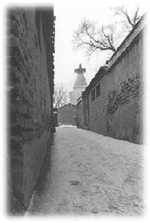
Most of the Hutongs which remain today were formed in the Ming and Qing
dynasties. But you can still find some from the Yuan dynasty. For instance, the
Zhuanta Hutong in Xisi on the west side of the city is a typical example. In the
Yuan dramas this Hutong was often mentioned. The area was also the home of
famous playwright Guan Hanqing, China's Shakespeare of the Yuan Dynasty.
Over the last 7 centuries with the growth of the city, more and more Hutongs
appeared, but they were not the same as the old ones. During the Qing Dynasty in
the 17th century, the Manchu people who used to live in North China ruled. After
they overthrew the Ming Dynasty, they divided Manchu people into eight banners.
Over the last 7 centuries with the growth of the city, more and more Hutongs appeared,
but they were not the same as the old ones. During the Qing Dynasty in the 17th
century, the Manchu people who used to live in North China ruled. After they
overthrew the Ming Dynasty, they divided Manchu people into eight banners. Each
of them was distinguished by a different colour. With the growth of the
population the city had to expand. So the Manchu people with all the banners,
lived in the inner city. Han people, whether high ranking or ordinary people
were driven to the outer city. There they built their houses randomly. And a lot
of Hutongs appeared.
Since then, Beijing has quite many Hutongs with different shapes, Lengths or
directions. The shortest one is just 10 meters' long, and the narrowest Hutong
is only about 40 centimeters' wide. some Hutongs have more than 20 turns. And
slanting Hutongs also appeared due to the terrain. The majority of hutongs run
straight from east to west, some from north to south. That has resulted from the
need for houses to face south so as to take in more sunshine and resist cold
wind from the north.
Even though the city wasn't symmetrical, it promoted the development of the
economy. In the
inner city, all the places were designed for their functions. For instance, the
Forbidden City was the court, and behind it was the market. The left side of the
center was the place to worship ancestors, while the right side was for
worshipping all kinds of gods. Later in the outer city free markets appeared due
to the needs of the local people. Such as markets for furs, jewels, silk, hats
and shoes, grain and so on. Gradually, some of these became shopping centers
like Qianmen ( or the front gate ), Dongdan and Xisipailou (Xisi Archway).
However, transportation was not as convenient as today, so street peddlers
emerged. They wandered from lane to lane selling various goods or providing all
kinds of services. People could judge their goods from their singing or the
sounds of their special instruments. At sunset, the peddlers selling food were
among the first to come. The food they sold include Youzhagao, which is
deep-fried twisted dough sticks, baked pan-cakes,
seasoned millet mush, armen tea and so on. A little bit later, peddlers who sold
vegetables of daily necessities would appear. A barber never shouts, his
instrument is a big pair of scissors and an ironing stick. But now it's unusual
to hear such melodious cries of sounds.
Beijing's hutongs are not only an appellation for the lanes but also a kind of
architecture. It's the living environment of ordinary Beijingers. It reflects
the vicissitude of society. Most of the Hutongs look almost the same with grey
walls and bricks. Hutongs are a happy kind of place. There are often 4 to 10
families with an average of 20 people sharing the rooms of one courtyard compels.
The main attraction of Hutong life is a friendly and interpersonal communication.
Children living in one courtyard play together and grow up like one family. For
the eldly, the charm comes from each other's company.
Well, is Beijing denying 700 years of its history by destroying many of its
hutongs? Recently, a
new style of apartment building has been built in Beijing. Even though, it has
four stories, it is built in the same way of Siheyuan and it has a very
traditional name: Ju'er Hutong or the Chrysanthemum Lane. People who live there
enjoy the convenience of modern facilities while maintaining good relations with
their neighbours.
top!
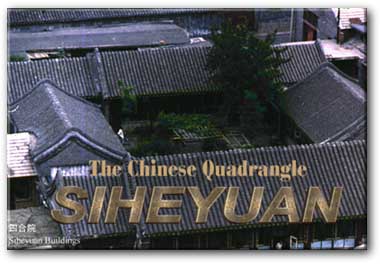
Dwelling compounds or quadrangles (Siheyuan) in Beijing are one important aspect
of the city's architectural heritage.
Beijing's dwelling compounds are generally rectangular, with the four sides
squarely facing the cardinal points. Almost every dwelling compound is
surrounded by high walls, with an open courtyard in the centre. The buildings on
four sides are usually one storey high.
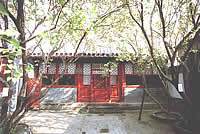
Stepping over the high wooden base of the front gate of a large compound, you
will find a brick screen located a few feet inside. In front of the screen is
the outer courtyard, which is flanked by structures to the east and west. In
former days, these were the kitchen and servants' living quarters. A red-painted
gate leads through the north wall of the outer court into the inner courtyard.
The main building faces south to get the maximum possible sunshine in winter,
and the eaves provide a pleasant shade in summer when the sun is high. The
building is divided into three or five rooms: living or community rooms in the
centre with smaller bedroom or studies at each end. The buildings facing east
and west on each side of the court were constructed to accommodate married
children and their families. Some dwelling compounds consist of several
courtyards. With no steel or concrete, the entire dwelling was built of bricks
and wood. The compounds are quiet, beautiful and compact. Beijing residents like
to live in them and even foreigners find them attractive.
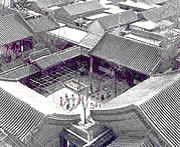
Nowadays, these peaceful quadrangles are hard to find
in Beijing. The reasons are as follows:
Since 1949, a large-scale construction programme has been carried out in
the city, causing the demolition of some dwelling compounds.
During the initial post-liberation period, government offices occupied
some quadrangles. Later they were demolished to build office buildings.
During the "Cultural Revolution" (1966-1976), air-raid shelters
were dug everywhere in Beijing, resulting in the destruction of some
dwelling compounds.
In recent years many residential buildings have been constructed to ease
the housing shortage and provide better accommodation for the people. Some
were built on the sites of demolished dwelling compounds. Outer compounds
have been changed or distorted beyond recognition because the residents
have added kitchens in the courtyards.
Today, Beijing still has about 400,000 residential quadrangles, mainly
distributed over the East, West, Xuanwu and Chongwen districts of the
city. Those in the East and West districts are in the best shape. The
departments concerned with the preservation of cultural relics in Beijing
have earmarked a number of good-quality dwelling compounds for protection.
In addition, the urban construction departments have worked out a plan to
limit high buildings in the city proper to protect the dwelling compounds.