
Beijing Specialities
Cuisine
| Table Manners | Beijing Roast Duck | Drinks |
| Chopsticks | Various local cooking | The Four cuisines |
| Snacks | Ethnic restaurants |
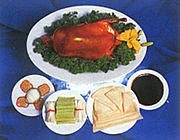
Table Manners
The main difference between Chinese and Western eating habits is that
unlike the West, where everyone has their own plate of food, in China the
dishes are placed on the table and everybody shares. If you are being
treated by a Chinese host, be prepared for a ton of food. Chinese are very
proud of their culture of food and will do their best to give you a taste
of many different types of cuisine. Among friends, they will just order
enough for the people there. If they are taking somebody out for dinner
and the relationship is polite to semi-polite, then they will usually
order one more dish than the number of guests (e.g. four people, five
dishes). If it is a business dinner or a very formal occasion, there is
likely to be a huge amount of food that will be impossible to finish.
A typical meal starts with some cold dishes, like boiled peanuts and
smashed cucumber with garlic. These are followed by the main courses, hot
meat and vegetable dishes. Finally a soup is brought out, which is
followed by the starchy "staple" food, which is usually rice or
noodles or sometimes dumplings. Many Chinese eat rice (or noodles or
whatever) last, but if you like to have your rice together with other
dishes, you should say so early on.
top!
Beijing Roast Duck
Beijing Roast Duck dates back to the Ming Dynasty, about 600 years ago.
The two famous Beijing Roast Duck restaurants in Beijing are Bianyifang
(Shop of Convenience and Pleasure) and Quanjude (Complete Collection of
Virtues), both having a history of 400 years. The original Bianyifang was
in the Rice Market Hutong while the original Quanjude was in the Meat
Market, both in the southern part of the city. Now they both have many
branches. Two main branches of the Bianyifang are located at Qianmen
(Front Gate) Street and at Chongwenmen, while two of the largest branches
of Quanjude are at Hepingmen (Peace Gate) and Wangfujing.
Almost every part of the duck (except the feathers) can be made into
hot or cold dishes, (for example, the wings, webs, tongue, heart and liver).
This is called the "Complete Duck Feast". The duck head is cut
in half and served on a small plate with the tongue. The head is usually
for the guest of honour, but if you cannot face it you do not have to eat
it. The bones of the duck are made into soup which is served near the end
of the feast.
Drinks
At the dinner table, drinks are essential whether you are alcoholic or not-it is
a tradition during Chinese dinner. Unlike Westerners, the Chinese do not drink
unless there is food to accompany it. Restaurants provide various kinds of
drinks-soft drinks, beer, wine, Chinese liquor, and Western spirits like Whisky,
Brandy and even XO Martini.
Liquor used to be the most popular drink at the table. China makes many brands
of liquor, and the best ones are Maotai, Wuliangye, Fenjiu, Yanghe Daqu,
Erguotou, etc. Some are very strong, as much as 65 degrees proof. When friends
get together to have dinner, they usually drink till drunk. "Ganbei"
is a word you hear everywhere in restaurants, which means "a toast" or
"cheers", but literally it means "bottoms up". There is a
saying among the people: ¡°If we are really good friends, we must finish a cup
of liquor at one mouthful.¡± A host regards offering a drink a courtesy to his
friend. So it is not strange if you asked to drink liquor and drink one cup
after another. If you are not a great drinker, it is better to announce before
the feast begins that you don't drink alcohol or you are "allergic" to
alcohol.
Now Beijing people have mostly shifted from liquor to wine or beer. Soft drinks
are more popular among ladies. If you are a new friend, Beijingers won't force
you to drink. There is another saying around the table: "As you please."
To satisfy the alcohol drinkers but to avoid getting drunk, there are
low-alcohol liquors which are getting more popular. The best-known are Kongfu
Jiajiu (Confucius Family Wine), Kongfu Yanjiu (Confucius Feast Wine),
Beijingchun (Beijing Pure Wine),etc. which are below 40 degrees proof.
In addition to Western soft drinks like CocaCola, Sprite, Seven-up and Fanta,
there are plenty of Chinese soft drinks. The ones that I would recommend are
lichee-flavoured carbonated drinks, Yezizhi (coconut drinks), Guocha (haw-tea
drinks), Xingrenlu (almond drinks). It is almost a convention to serve tea at
the dinner table. You may have green tea, black tea, jasmine tea or
chrysanthemum tea which is a bit sweet. English tea and coffee are rarely served.
Chopsticks

You really have to master the art of using chopsticks if you visit China. In
every restaurant, you will be provided with chopsticks instead of forks and
knives. Don't be frightened, they are easy to use. Use your thumb and the fourth
finger to grip one stick and your forefinger and middle finger to grip and
control the other stick. (See the illustration) After practising a while, you
will be able to pick up pieces of food. If you are able to pick up a bean with
chopsticks, this means that you have ¡°graduated¡±? If you cannot use them,
you can always ask for fork and knife in a tourist restaurant.
top!
Court Cuisine
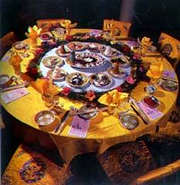
Court Cuisine originates from the imperial kitchen which cooked food for the
emperor and his family. After the fall of the Qing Dynasty, some chefs from the
imperial kitchen opened restaurants in the capital to introduce the special food
once only eaten by the imperial family.
Fangshan (Imperial-style) Restaurant sits on the island in Beihai Park in a
traditional courtyard facing the lake. Apart from delicious dishes meticulously
prepared with rare and expensive foodstuffs such as birds nests and sharks fins,
the restaurant is also known for its pastries, including pea-flour cakes, kidney
bean-flour rolls, miniature corn buns and sesame seed buns with chopped meat
filling.
A newly-opened branch of restaurant of Fangshan style, Yushan Restaurant, is
located a few hundred yards to the west of the north gate of the Temple of
Heaven in the southern part of the city.
Tingliguan (Hall for Listening to the Orioles) Restaurant, in the Summer Palace,
serves more than 300 dishes and pastries from the Qing and Ming imperial recipes.
The "All-fish Feast" is a speciality of the restaurant. The fish is
caught from the Kunming Lake and cooked in a unique way. When the fish is served
on the table, its mouth is still opening and closing and its gills flapping.
Diners should not be frightened; it is falsely alive. The secret lies in keeping
the nerve certre of the fish intact.
Tan Family Food
Famed as a home-style cooking, the Tan Family food is liked by both
southerners and northerners who eat different staple foods. The most popular
dishes include the Steamed Chicken with Mushrooms and Duck with Crab Meat.
Mongolian Hot-pot
Mongolian Hot-pot The hot-pot is a traditional brass pot with a wide outer rim
around a chimney and a charcoal-burner underneath. Water is heated to boiling
point in the rim, and the diners dip thin slices of raw meat in the water, where
the meat cooks quickly. The cooked slices are then dipped in to a sauce. The
meat can be anything, from lamb, veal, pork, chick, fish to prawn. There are
vegetables, bean noodles, mushrooms and bean curt to be boiled in the rim as
well. The sauce is prepared personally by the diner by selecting from a few
dozen kinds to suit his/her own taste. You may want it hot, sweet, or salty.
People usually do not eat rice when they have Mongolian Hot-pot. The traditional
food to accompany the hot-pot is buns or noodles.
Nowadays, some restaurants provide each diner a small hot-pot with solid-alcohol
fuel. They no longer look like the traditional ones but are more hygienic. Some
people still prefer the traditional ones because they think it gives a greater
atmosphere of "gathering together".
Barbecued Meat
Barbecued Meat is a Manchu food which has become very popular in Beijing.
Meat, mainly beef or mutton, is cut into thin strips or slices, and then soaked
in a mixture of soy sauce, crushed ginger, wine, shrimp paste, sesame seed
paste, rice vinegar and chopped coriander. The meat is then barbecued over a
highly-heated grill before it is served.
The most famous restaurants of barbecued meat are Kaorouji (Barbecued Meat
Quarter) which was opened in 1848 and is located on the bank of Shishahai Lake
north of Beihai Park, and Kaorouyuan (Barbecued Meat Garden) which is also over
a century old and is near Xuanwumen in the southwestern part of the city.
Nowadays, there are many barbecued meat restaurants in the streets, but most of
them are Korean ones.
top!
The Four Cuisines
Many foreigners have eaten at Chinese restaurants before they come to visit
China. Since most Chinese restaurants abroad are Sichuan or Cantonese, they may
have the impression that Chinese restaurants only serve hot spicy food or Dim
sum. Some even think that Chaw mein is the typical Chinese food.
Chinese food varies from place to place mainly according to geographical
difference. Some dishes are hot, some sweet, some salty and others sour. In
general, Chinese food is divided into four main cuisines: Shandong, Cantonese,
Huaiyang and Sichuan. Of each cuisine, there are several different types. For
instance, the Shandong cuisine includes Beijing food (known as Mandarin food )
and Shandong food; the Cantonese cuisine consists of Cantonese and Chaozhou food;
the Huaiyang cuisine refers to Anhui, Jiangsu, Shanghai and Zhejiang food; the
Sichuan cuisine represents Sichuan, Yunnan and Hunan food.
Do you have to travel to these regions to taste the different specialities of
Chinese cuisine? No. Without leaving Beijing, you can sample various delicacies
in restaurants of different cuisines. Eating in Beijing, you will find the city
is as famous for it "food culture" as it is for its ancient sights.
Shandong Cuisine
Shandong cuisine is probably the main feature in home cooking in Beijing. Since
the province is on the coastline, the food includes mainly fish and seafood
dishes, like sea cucumber, prawns, crab, eel and the well-known dish "Fried
Scorpions", which has already been mentioned.
Since Shandong is in northern China where wheat is the main crop, steamed bread,
noodles, and many other foods made of wheat flour are often served in Shandong
restaurants.
Cantonese Cuisine
Cantonese cuisine is known for its fresh and delicate flavours. The Cantonese do
not eat "dead" things. All the freshwater fish or seafood is kept in
glass water tanks in the restaurant, and diners can point out what they want and
it will be killed immediately, cooked and served in ten minutes. The only "dead"
things used in its cuisine are dried seafood such as shark's fin and abalone.
Cantonese snacks are one of the best known, and Dim Sum is popularly served in
many restaurants, especially in the morning. Diners are first served tea and may
pick various kinds of snacks from small trolleys which are wheeled to each table.
Waiters tick off the ones you have picked, and the bill is paid when you have
finished eating.
Sichuan Cuisine
Sichuan cuisine is famous for its spicy, hot food. This is probably the result
of the province's wet weather, in which people have to keep their body
"dry" and hot food helps to increase their internal "heat" .
In addition to chili, Sichuan food uses "Sichuan pepper" in almost
every dish, which makes your tongue feel hot and numb. Even in snacks, hot sauce
is very common. So if you are not keen on hot food or it doesn't agree with you,
you'd better ask the waiter to make it less spicy.
Sichuan hot-pot is very popular, especially in winter. A thick layer of
chili-oil is floating on top of the water in the pot, so the meat cooked in the
pot is covered with a hot coating of it when it is scooped out of the pot. The
flavour is quite unique and it's hot enough to make you break out in a sweat, so
have a nice cool drink at hand, too.
Huaiyang Cuisine
Huaiyang cuisine is specialised, with its rather light and sweet food. Since it
originated from the area in the Huaihe and Yangtze river basins, river fish,
crab, eel, shellfish, turtle, poultry and pork are the main ingredients. The
best known dishes are "Squirrel Fish" in sweet and sour sauce and the
"Beggar's Chicken" which is wrapped in clay and cooked on an open fire.
Snacks are mainly made of rice-flour since rice is the staple food in the region,
and most of them are sweet. So diners with a sweet tooth may like Huaiyang
cuisine.
Snacks
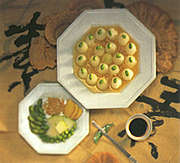
Beijing snacks have their own specialilties, and combine varieties from all over
the country. A rough calculation shows that there are at least 200 varieties of
snacks in Beijing.
The best known snacks in Beijing are:
Soya-bean milk (Douzhi); Fried rings (Jiaoquan); Pea-flour cake (Wandou huang);
Seasoned millet mush (Miancha); Steamed rice cake with sweet filling (Aiwowo);
Jellied bean curd (Doufunao); bean-flour cake (Doumiangao).
Food made from wheat flour is served in most Beijing-style restaurants, such as
dumplings (Jiaozi), steamed bread (Mantou) and noodles. In some restaurants, you
will see the chef demonstrating his skill in turning a lump of wheat dough into
very fine noodles all by hand.
You may have snacks in most restaurants, especially those which open in the
morning for breakfast. In the evening, there are two food streets bristling with
small stalls selling various kinds of snacks. One is at Donghuamen (East Flowery
Gate), an east-west street crossing Wangfujing and about a hundred yard west of
the Palace Hotel. The other is at Longfusi Market Street near Dongsi. If you are
tired of big meals in the hotels, you could go there to have some light snacks.
top!
Ethnic Restaurants
There are many ethic-minority restaurants in Beijing, and those who like to
taste ethnic cuisine can try them out. They are mainly Dai, Mongolian, Xinjiang
and Tibetan restaurants.
The Dai food is worth trying. The food served in the Dai restaurants is unique.
You will be served with rice wine (very weak, but tasting sweet and fragrant) in
a bamboo cup and the wine is poured from a long bamboo tube. The chicken, meat,
fish, rice, and almost every dish are cooked or at least served in bamboo
containers. Even the tables and the chair are made of bamboo, as well as the
walls and ceiling.
Dai dance and singing are performed on a bamboo stage in the restaurant by
beautiful Dai girls and handsome boys, all in their national dresses. You will
be invited to join in their dance. At the end of the performance, the girls will
come and place a lovely small embroidered bag with a silk string around your
neck. The bag is a sachet full of scented grass.
Foreign Restaurants
Eating Chinese food everyday may make you feel homesick. Well, other Oriental
and Western restaurants can also be found in hotels and in the streets.

top!