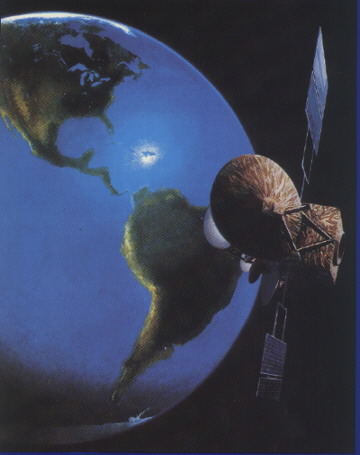
Satellite Communication
Why do we need satellites?
From the early days of communication systems the aim of personal communication systems was to provide maximum access to an individual anytime anywhere. Cellular phones have seen a long haul of evolution period. Starting from the first days of analog push-to-talk phones with a central transmitter base station which are sill used by the forces, mobile phones have seen consistent development, and we have WAP enabled phones today.
Wireless communication evolved as one of the most powerful communication systems, but line of sight distances was the crippling fact it faced. This hurdle was what prompted scientists to think of having a repeater in the sky. A communication satellite is a repeater in the sky that just receives a signal amplifies it and retransmits to receivers at distant places from the transformers. Due to the high altitude the footprint of the satellite (the area of the earth that satellite can see) is high and this increases as the altitude increases. But it has been identified that increasing the altitude beyond 36,000 Km does not increase efficiency considerably. So communication satellites usually orbit the earth at a height of 36,000 Km that is known as the geo-synchronous orbit since an object moving in this orbit moves at the same velocity as the earth and hence would seem to be at rest to a receiver on earth. A Communication satellite's footprint covers almost half the earth and a combination of three such satellites capable of communicating with each other can link any two points on the earth except the poles. Another advantage of the geo-stationary satellite over low earth orbit satellites is that, the former remains in the line of sight at all times where as the latter goes out of sight at times since it moves at a speed higher than that of revolution of earth and covers a number of revolutions around the earth by the time the earth completes one rotation. Another disadvantage of using the low earth orbit is the need for complex tracking equipment to track the satellites as it moves across the sky.
Satellite technology has evolved considerably since the first launches and now we have satellites to provide us even direct Internet connectivity. We have VSATS where satellites work as hubs for a network. The technology development in the field of communication satellites has seen no bounds and it promises to improve considerably in the coming future. Advanced communication satellite is an example of what scientists have in stock for the days to come.
Some topics of interest in satellite technology:acknowledgements
| Home | Personal | Profession | Academic | Interests | Nostalgia