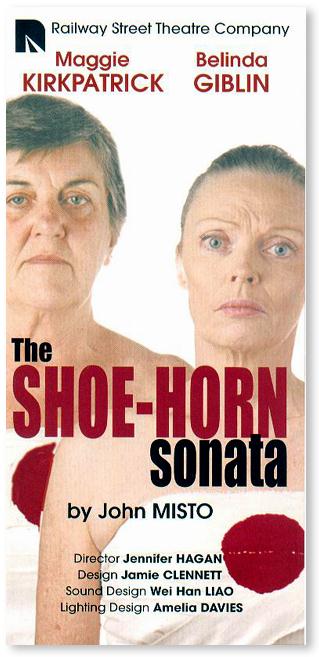
 THE SHOE-HORN SONATA THE SHOE-HORN SONATA
NEW SOUTH WALES TOUR
2005
Tuesday 15th -
Saturday 26th February
GLEN STREET
THEATRE,
FRENCHES FOREST
www.glenstreet.com.au
Tuesday 1st - Saturday
12th March
Q THEATRE, PENRITH
www.railwaystreet.com.au
Tuesday 15th - Saturday
19th March
IPAC, WOLLONGONG
www.ipac.com.au
Wednesday 23rd March
BATHURST ENTERTAINMENT
CENTRE
Wed 30th March -
Saturday 2nd April
JETTY THEATRE, COFFS
HARBOUR
Tuesday 5th - Saturday
9th April
PARRAMATTA RIVERSIDE
THEATRES
www.riversideparramatta.com.au
 Maggie will, for the fourth time
and exactly ten years after debuting in the role,
play the character Bridie Cartwright in the 2005
New South Wales Tour of the acclaimed The
Shoe-Horn Sonata. Maggie will, for the fourth time
and exactly ten years after debuting in the role,
play the character Bridie Cartwright in the 2005
New South Wales Tour of the acclaimed The
Shoe-Horn Sonata.
Previously, Maggie
toured (for the first time) with the production
in 1995, with Melissa Jaffer playing the
part of Sheila. Read a review of this, from 'The
Australian', here. The following year, 1996, Maggie, alongside Susannah York
as Sheila, brought the play to London, playing at
the King's Head Theatre in the city.
In 2004 Maggie, and Belinda Giblin, as
Sheila, took The Shoe-Horn Sonata on a
short season in Penrith, near Sydney, and
followed that with a short tour of New South
Wales. Click here for a great article on this
production.
Maggie and Belinda are
reprising their respective roles for the 2005
tour of New South Wales. Expect further rave
reviews!
 PARRAMATTA ADVERTISER PARRAMATTA ADVERTISER
Wednesday 23rd March 2005
Tribute to POWs
Popular Australian
actresses Maggie Kirkpatrick and Belinda Giblin
will soon make their first appearance at the
Riverside Theatres in The Shoe-Horn Sonata.
The play based on a true
story about the ideals of friendship and survival
throughout World War II. Playwright John Misto
was inspired to write the play after reading the
book White Coolies.
He said he did not have
enough power to build a memorial to these women,
but could write a play instead.
White Coolies was
written by Betty Jeffrey, a member of the
Australian Army Nursing Service, who with her 23
colleagues survived four years as prisoners of
war in Sumatra and Malaya.
Misto wrote The
Shoe-Horn Sonata based on the experiences of
these nurses.
It tells the story of
two women, Bridie and Sheila, who ended up in a
Japanese camp together when their ships were sunk
when they were escaping from Singapore in
1942.
A shoe-horn is intrinsic
to their story of separation, loyalty and
love.
The Shoe-Horn Sonata
will be at the Riverside Theatres from April 5 to
April 9, for bookings call 8839 3399.
 NORTH SHORE
TIMES NORTH SHORE
TIMES
March 2005
Dark secret from a
grim time
Playing a nurse taken
prisoner by the Japanese during World War II on
stage is a role close to the heart of actress
Maggie Kirkpatrick, who aspires to maintain the
memory of those who served and died.
On the one hand Maggie
Kirkpatrick loves her role in The Shoe Horn
Sonata because it pays homage to the previous
generation - and on the other because she has
found it of enormous meaning to the next.
Maggie is currently on
stage with Belinda Giblin at Glen Street Theatre
in John Misto's award-winning two-hander which
celebrates the friendship, survival and courage
of two women imprisoned by the Japanese after the
fall of Singapore in 1942.
Bridie (played by
Maggie) was an Australian Army nurse and Sheila
(played by Belinda) was then a teenager. Fifty
years after their wartime ordeal they meet again
when asked to take part in a documentary.
Maggie's own father,
Lieutenant Jim Downs, was killed in action in
North Africa in August 1941 after the siege of
Tobruk - only months after Maggie's January
birth.
She takes up the tale:
"Although Bridie and Sheila were in prison
for three and a half years they have not met
since - and the play reveals why - a very
traumatic secret.
"One of the reasons
I love playing women of this generation is
because I really feel the need to pay homage to
people who survived both the Great Depression and
then World War II.
"I have an immense
pride in my parents' generations and it's been
wonderful to see how young people, especially
school audiences who are studying the play for
their HSC, are deeply affected.
"Another
inspiration is the commitment of playwright John
Misto, who first wrote the play for the 50th
Anniversary of VJ (victory over Japan) Day in
1995 and who donated his prize money from that
year's Australia Remembers National Play
competition and the 1996 premier's Literary Award
to the building of a memorial in Canberra to
Australian nurses killed in war.
"I had the
privelege of playing Bridie in that opening
production; the following year in London; and
last year on a NSW tour."
Words: Carol Payne
North Shore Times
March 2005
Thanks to Decker for the
article.
|