 Civilian
casualties Civilian
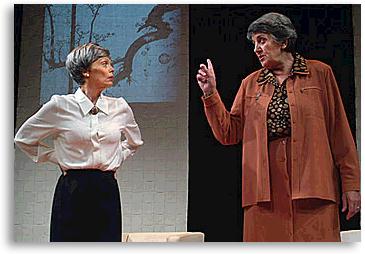
casualties Prisoner star Maggie Kirkpatrick stars
in another prison drama - this time of female
POWs during World War II.
THE
SHOE-HORN SONATA
Where: Q
Theatre, corner Railway and Belmore streets,
Penrith
When:
Until March 13
How much:
$35/$25
Bookings:
4721 8832
In 1967, when
playwright John Misto was a schoolboy, he was
caught reading a risque novel, the banned Peyton
Place, during religion class.
Yet instead of
giving him the strap, Misto's teacher gave him
another, worthier book to read and write a report
on: White Coolies by Betty Jeffrey, an Australian
nurse who served in Malaya and Singapore during
World War II.
The young Misto
was fascinated by Jeffrey's account of her
capture and imprisonment by the Japanese during
the war. For the next 30 years, he sought a way
to tell the story of the hundreds of female
civilians and military nurses who had endured the
same fate.
The result was
The Shoe-Horn Sonata, first produced by the
Ensemble Theatre in 1995. The play went on to win
several prizes, including a NSW Premier's
Literary Award. (Misto donated the entire $20,000
of one of these prizes to the Royal College of
Nursing.)
"The play
is about the stories we don't tell about
war," says Misto. "The people who
usually bear the brunt of war are the civilians,
and the people who are non-combatants, who find
themselves caught up in war."
The piece is an
account of the friendship between two women
imprisoned for almost four years in Belalau camp,
in what is now Indonesia: Bridie, an Australian
nurse (Maggie Kirkpatrick), and Sheila, an
English schoolgirl (Belinda Giblin). They meet at
a reunion for survivors 50 years later, where a
documentary is being filmed about their
experiences.
Misto was also
motivated by a sense of justice to write the
play, because he felt these women had been
largely forgotten by history.
"We always
tell our war stories in terms of battle, not in
terms of the people who were caught up in
it," says Misto. "These women were the
princesses of an empire which crashed around
them. Some of them couldn't make a bed, and they
[were] thrown overnight up against a ruthless
invader."
The script is
based on the testimony of about a dozen women
around Australia. Through his characters, Misto
details the starvation, beatings, disease and
ritual humiliation the women suffered at the
hands of the Japanese.
Despite the
distressing detail, Misto never intended his play
to be anti-Japanese. He says that for every story
of Japanese cruelty, he included an example of
the Allies' cruelty, such as the projection of
photographs of post-bomb Hiroshima onto the set
of the play.
The focus, like
all the best war stories, is on survival, the
strength of the human spirit and the courage of
everyday people: people who came out alive, but
damaged, and struggled to carry on life once
released.
"You
wouldn't expect women in genteel homes to have
seen the horrors of life that they saw,"
says Misto. "I thought I'd try and tell, in
a coherent way, all the little stories - Bridie
and Sheila sharing a caramel, chewing the bone to
forget their hunger, pressing a pillow to their
stomach ... the heart-breaking things that we
don't think about with war."
Despite the
women's suffering, Misto says, "They're not
bitter against the Japanese, but they're bitter
about being locked out of history".
Misto
illustrates this point by recounting the story of
a year 12 English teacher who taught his play,
which has been on the HSC syllabus for six years.
"[She]
said to her class: 'Find everything you can about
prisoners of the Japanese.' The kids came in with
mountains of material and she said, 'Now what
have you got on the women and children?' and they
said, 'Oh no, there weren't any.' She said, 'Now
we're ready to start the play.'"
Misto says both
male and female POWs were encouraged to keep
quiet about their experiences once home. Military
POWs have since been formally honoured by the
Australian government, but the female civilians
were largely forgotten.
The government
negotiated with the Japanese after the war for
compensation payments for the prisoners.
According to Misto, the figure they arrived at
worked out to be about sixpence for every day
spent in captivity. For women whose health had
been largely ruined by imprisonment, it was
hardly enough.
Misto makes no
apologies for the dark nature of his material.
"In
theatre, I think we should be talking about
everything," he says. "Once upon a
time, theatre was the venue where you dealt with
difficult stuff."
By
Jacqueline Maley
March 5,
2004
Sydney
Morning Herald
Source:
www.smh.com.au
|