 Richard
Zachariah: I'm talking to a marvellous woman
who launched her acting career at the age of
three, against the surprising backdrop of an
Aussie pub. Now 50 something years later, Maggie
Kirkpatrick is an Australian icon, perhaps best
known for her role as 'The Freak' in the
Australian drama series Prisoner, but the
road to success hasn't always been smooth for
Maggie. Over the years it has been punctuated by
a series of personal setbacks. So, how did it all
begin...? Richard
Zachariah: I'm talking to a marvellous woman
who launched her acting career at the age of
three, against the surprising backdrop of an
Aussie pub. Now 50 something years later, Maggie
Kirkpatrick is an Australian icon, perhaps best
known for her role as 'The Freak' in the
Australian drama series Prisoner, but the
road to success hasn't always been smooth for
Maggie. Over the years it has been punctuated by
a series of personal setbacks. So, how did it all
begin...? Maggie:
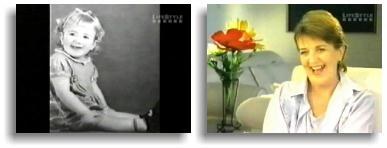
I guess I was just born a show off, it seems to
be. It was the same all the way through school. I
was always the class clown. Not brilliant
academically, in fact I only did well in things
that interested me, which was English and
history. Never, ever, did I pass maths, ever, not
ever, but English and history I shone. But always
the distractor, would always find some way to get
out of work in the classroom and distract the
teacher, or be sent out of the classroom. Showing
off.
 Richard:
So Miss Kirkpatrick left school without an
academic record? Richard:
So Miss Kirkpatrick left school without an
academic record?
Maggie: Yes.
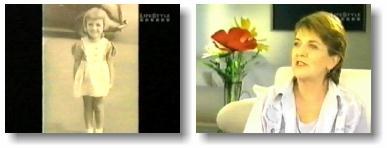
Margaret Anderson left school at the age of 14
and 10 months, because I couldn't stand it. And
yet I remember, so clearly, the day I went to the
headmistress with papers to be signed, and she
said, "Oh my dear, it's girls like you we
need in this school!". I said, "you
should've told me that three years ago". She
had made me feel quite unwelcome, I felt.
Richard: 50 years
on from three, and you're still performing. Why?
Maggie: Well I
don't know how to do anything else. I've passed
the point of no return, well and truly. I don't
think anyone wants to retrain an old thespian of
57. Yes, I'm still doing it Richard, it's a love
hate relationship, it really is. It doesn't get
any easier. My expectations of myself become
greater, and other people's expectations of me
also become greater. Where once upon a time an
opening night, for me, was a fun thing, an
opening night for me now is total trauma, it's
hideous. But yet I love it.
 Richard:
You've always said that, haven't you? Richard:
You've always said that, haven't you?
Maggie: Yes.
Richard: That
you'd like to do something else, but there's
nothing else that you can do.
Maggie: Not
really. Years ago all I wanted to do was be a
nurse. But then that was in the '50s when, if I
had gone ahead with that, I would have had a
profession for life, as people did growing up in
the '50s. We were very fortunate. I don't think
we thought we were fortunate at the time, we all
seemed to rebel against it and think it was a
grey period. In essence, we had such employment
here and if I had chosen to be a nurse, or a
teacher, or a lawyer, or a doctor, I would have
had that career for life. Heaven knows, I'd have
been a dried up old hospital matron by now
probably. I always wanted to do something like
that and I guess the bleeding heart is there.
Richard: Or you
could have been a prison warden!
Maggie: Ha! ...
Never!
 Richard:
Which brings up... We have to talk about that
early on, 'The Freak'. Richard:
Which brings up... We have to talk about that
early on, 'The Freak'.
Maggie: Sure.
Sure. A most important part of my life. Opened a
lot of doors for me. I shall never deny it. I
just wish that the world-at-large remembered that
I do do other things. But then that's just the
power of television, you see.
Richard: When was
it? Let's put it back in context.
Maggie: 1982. It
was four and a half years out of 37. So it really
is a little drop, isn't it?
Richard: But it
became... why did it become such a cult?
Maggie: Oh god
knows! People's need to love-to-hate. There's the
whole success of the series isn't there? I guess
the voyeurism of women behind bars, or whatever.
I had no idea that it would be the huge success
that it became, or that my character would be. I
signed a three month contract.
Richard: Why did
you think particularly your character became
so... You must have done it well.
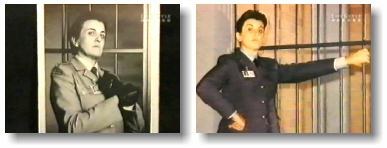 Maggie:
I like to think that I did. It was awfully
hard work. Not so hard finding that character,
because let's face it, put an ugly uniform on me
and slick my hair back and there's the
physicality of it. What I tried to do with that
character was find areas... I mean, nobody is all
that bad, not even Joan Ferguson. And I
know that there are prison officers like her, but
there are also prison officers like the Meg
Morris character. There are the caring, nurturing
prison officers, I believe. Ferguson, my brief
was to play a sadistic, corrupt bull-dyke screw,
in the words of the creator. But I also had to
show some vulnerable sides to her, and thankfully
the writers enabled me to do that. And then there
was the political correctness, or incorrectness,
of playing a lesbian. A lot of people didn't care
for the way I portrayed her. They thought it was
stereotypical. I didn't think so atall, because
the writers introduced a love interest, and when
that love interest broke up I refused to use
hackneyed words, or stupid words that the male
writers seemed to think I should use. I said
'look, the breaking up of a relationship is the
same, no matter whether it's a man and a woman,
two men, or two women. The pain is the same,' So
I felt very true to that aspect of this sad
creature's life. I think she was a pathetic
creature, let's face it. A born loser in personal
life, and, ultimately, a loser within the system
that she adored so much, for some inexplicable
reason. Maggie:
I like to think that I did. It was awfully
hard work. Not so hard finding that character,
because let's face it, put an ugly uniform on me
and slick my hair back and there's the
physicality of it. What I tried to do with that
character was find areas... I mean, nobody is all
that bad, not even Joan Ferguson. And I
know that there are prison officers like her, but
there are also prison officers like the Meg
Morris character. There are the caring, nurturing
prison officers, I believe. Ferguson, my brief
was to play a sadistic, corrupt bull-dyke screw,
in the words of the creator. But I also had to
show some vulnerable sides to her, and thankfully
the writers enabled me to do that. And then there
was the political correctness, or incorrectness,
of playing a lesbian. A lot of people didn't care
for the way I portrayed her. They thought it was
stereotypical. I didn't think so atall, because
the writers introduced a love interest, and when
that love interest broke up I refused to use
hackneyed words, or stupid words that the male
writers seemed to think I should use. I said
'look, the breaking up of a relationship is the
same, no matter whether it's a man and a woman,
two men, or two women. The pain is the same,' So
I felt very true to that aspect of this sad
creature's life. I think she was a pathetic
creature, let's face it. A born loser in personal
life, and, ultimately, a loser within the system
that she adored so much, for some inexplicable
reason.
 Richard:
And then you became this icon in the gay
community. Richard:
And then you became this icon in the gay
community.
Maggie: Seemingly.
Richard: And then
at the Tilbury Hotel, I think, in Sydney, you
came out as a heterosexual!
Maggie:
(Laughing) Wasn't that amazing? You see, you
can't win in this life. Yes, I was attacked by
the gay press for standing up there, talking
about ex-husbands, ex-lovers, grandchildren,
cooking, gardening. I mean, it was just
appalling, the reaction rom that particular
little rag. That was not the reaction from very
influential, senior members of the Sydney gay and
lesbian community, they were appalled by that.
There was talk of my taking action against them,
and then I though, 'No, why give them any
publicity?' Who's ever heard of them anyway, in
the world of journalism? It did get a bit sticky
when a quote was printed in one of the tabloid
daily press, and the quote was that I had
"passed myself off as a lesbian in order to
gain an audience". Now that is really
impuning my integrity as an actor. It hurt me
until I realised just how petty and stupid.
Simply two people, in the entire Sydney
community.
Richard: What did
they actually say?
Maggie: Oh they
castigated me for being straight. How dare she?
How dare she be straight? Nobody in the Sydney
gay and lesbian community was ever under any
other impression, other than I was this straight
old Sheila, with the grandchildren, who ran
around like a fool every Mardi Gras period
raising hundreds of thousands of dollars.
Richard: There'a
an irony there, isn't there? After having raised
money for the AIDS community.
Maggie: Yes. My
relationship with that community has been a love
affair for years. I met some of my best friends,
the bravest people, truly bravest and most
dignified people I've ever had the good fortune
to meet. Sadly gone now but there's still an army
of people battling this dreadful disease called
AIDS, and living with HIV, and doing very well.
But years ago when I became involved with them it
was not such the case. There was a lot of fear,
there was a lot of prejudice, a great deal of
prejudice. And enormous ignorance, and, of
course, from ignorance comes fear and prejudice.
I just felt that perhaps given the notoriety, or
the public face, I had that I could be of some
assistance.
Richard: You have
said that in this business people expect you to
be all sorts of certain things, and you tried to
live that out. Now you don't really give a damn!
Maggie: No, I
guess not. Maybe it's late age maturity. I don't
know.
Richard: It can't
be the truth. Being a performer you do...
Maggie: I give a
damn about what people think of my performance,
naturally, because that's bread and butter to me,
and I always do my work to the best of my
abilities. Sometimes a project will extend me a
little further than I had ever thought I could
go, other times it's a little more calmer. But
just in terms of my personal life, I used to feel
I had to be a hell-raiser, I had to be grand, I
had to be whatever, I don't know. I think it was
just a personality default that I lived with all
my life, and now I guess, what you see is what
you get! I'm more comfortable with me, much more
comfortable as I am.
Richard: Why?
Maggie: I never
was, I just never was. I never felt secure about
my role as a woman, as a mother, as an actor,
certainly as a partner or a wife. I never seemed
to be very good at any of those things.
Richard: You were
married and then divorced.
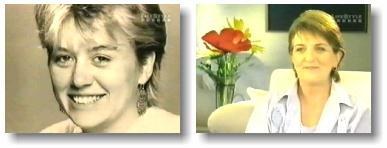 Maggie:
Yes. I was married to Caitlin's father. We
were married for 15 years, 12 good ones. But I
think my greatest achievement is my daughter,
really. Somewhere I went right. My friends have
said to me, 'Where did you go right?' She brings
me great joy, and we're terrific friends. We have
a tremendous amount of reliance on each other
even though she has her own life and her own
family, we're joined at the hip, I think. Maggie:
Yes. I was married to Caitlin's father. We
were married for 15 years, 12 good ones. But I
think my greatest achievement is my daughter,
really. Somewhere I went right. My friends have
said to me, 'Where did you go right?' She brings
me great joy, and we're terrific friends. We have
a tremendous amount of reliance on each other
even though she has her own life and her own
family, we're joined at the hip, I think.
Richard: Are you
still ambitious to be a great star?
Maggie: No, just
a great actress. I feel that there are lots and
lots and lots of things for me to do. It's just
finding the opportunity to do them. The sad part
about being over a certain age, I'm not alone in
this, you hear actors of my age complaining about
this all the time. Yo ureach a certain point in
your career, where you've honed your skills and
you feel as though you've got something to offer,
and the work's not there. Certainly not in
television, where almost everybody has to be,
seemingly, under 25. With a token oldie here and
there. But work of any substance is few and far
between. In the theatre, then the scope is not as
great, there's just not the population here to
accommodate all the fabulous, mature actors that
we have in al the wonderful works that have been
written.
 Richard:
Let's talk about some of those very good
Australian plays you've been in. Richard:
Let's talk about some of those very good
Australian plays you've been in.
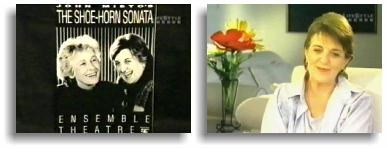
Maggie: At the
moment Shoehorn Sonata is probably top of
the pops for me. Written by John Mistow. That was
a wonderful experience for me, and for Melissa
Janfarr. To play two women who had survived a
Japanese prisoner of war camp, and they are
brought together for the first time in 50 years.
That, to me, was a truly great piece of story
telling. It was thoughtful. It was challenging
beyond belief, I was playing a 79-year-old. To be
able to conjure up the memories of a woman of
that generation, and to impart that story to
people was wonderful. It was old fashioned story
telling at its best. Patrick White's work I've
had small cameos, feature roles in. That's always
tough going. I've not played any of his major
ladies.
Richard: Why was
it tough going? Does he understand women?
Maggie: Not
terribly much. Except that I was very lucky with
the women that I was able to play because they
were kind of eccentric sides of Patrick, quite
eccentric sides of Patrick. And that was poetic
stuff. I've done Alan Seymour, One Day Of The
Year, another great character. I'm very lucky
to be of a generation that's very close to that
generation, that's my mum's generation. Those
wonderful people, born during the First World
War, came through the '20s to the depression, and
then lo and behold, another World War! I adore
those women and I try so hard to present
them faithfully, honestly, and try to show the
heart and the strength that they brought to this
country. I'm talking about women like my mum, who
is 80. She's one of those women. A war widow at
23, left with a six month old baby to get on with
her life. great people.
Richard: Is there
anything different about Australians to the
English?
Maggie: Oh god,
yes! I do believe we are very different. We're
certainly not as anally retentive as the British.
It's been lovely growing up, since the '60s, and
becoming passionately aware of Australia, and
loving it as I do.
Richard: Is there
a favourite play?
Maggie: Usually
my favourite play is the one I'm doing at the
time. A rich tapestry of female characters,
absolutely. And all terribly, quintessentially
Australian. By all those wonderful men. That's
the real thing they all have in common, it might
not tell you a lot about ourselves but I think in
their way's, and their generations, they have
told us a lot about the women of this country.
Richard: Yo usay
Patrick White didn't really understand women.
Maggie: He was a
bit British. But eventually fiercely Australian,
as we all know. An absolute Republican,
renouncing all that family history of his. It was
great to have met him on several occasions. I did
two plays and a film that he wrote, the las tplay
being A Ham Funeral, and by then Patrick
was fairly frail. He came to the first morning of
rehearsal, and the role I played in that was just
one scene - two old bag ladies rummaging in the
rubbish bin - we had our first morning's reading
and Patrick presented me with a funny little hat
that had been worn by the actress who played the
character in the first production, all those
years ago in South Australia. When it came to do
the reading Patrick read opposite me and I said,
'You've got to put the hat on to do this,
Patrick'. So there he sat, this little old man
with a funny little old lady's hat on, reading a
fairly eccentric old bag lady, opposite me. I
wish somebody had had a tape recorder. It was a
glorious moment in my personal history, it really
was. he also came on the set of a night shoot, at
three or four in the morning, to hear me deliver
one line. He said, 'I've been waiting to hear
that line.'
Richard: Do you
remember the line?
Maggie: I do
indeed. I had to say to the late Doris Fitten, 'I
met a divine communist once, he was a plumber. He
came to blow me pipes, and stayed to
indoctrinate.' And Patrick sat up till four in
the morning, waiting to see that one line done,
and then roared with laughter, upset the sound
system, and we had to do it again!
Richard: It's
really the humour that tells us about ourselves.
That's what distinguishes us.
Maggie: Yes, very
much so. Our sense of irony, our taking the
mickey out of each other, which we do terribly
well. I hope we don't ever lose that. I think all
that comes from the Irish.
Richard: It
hasn't always been humour and fun, beer and
skittles, has it?
Maggie: Oh god
no. Whose life has been?
Richard: Stuart
Wagstaff said about you. That you were a
fun-loving, raunchy lady but there was an
underlying sadness.
Maggie: Oh I
wouldn't say sadness. Probably an underlying
guilt, for mistakes made, but not to any great
neurotic extent. I refuse to wallow in the
mistakes of my past because it's too tough.
Richard: What are
some of the mistakes?
Maggie: Loving
the wrong people. Drinking too much. Thinking
that I was Lady Bountiful
Richard: You did
make a lot of money.
Maggie: And spent
it too, on a lot of people.
Richard: You have
a reputation of being extremely generous. Which
is not a bad reputation.
Maggie: To the
detriment of my own life, though. That is just
foolish.
Richard: How did
it cost you?
Maggie: Cost me
emotionally. It cost me financially. I found
myself into bankruptcy. It kept a few unsavoury
people well dressed and out of jail.
Richard: How much
money did you have?
Maggie: Oh I
don't know. We're not talking millions here. But
for a jobbing actor a lot of money was wasted.
Richard: How
much? Did you lose a home?
Maggie: No. No,
no, no, I didn't lose a home. I lost a lot of
self respect and that's worse than losing a
house. It caused me to think very lowly of
myself. I must have thought lowly of myself
anyway, to indulge people the way I did. It
seemed as if I was trying to buy friendships, and
buy love, and buy sex. I don't care anymore about
that sort of thing. As I said to you, 'What
you see is what you get'. Did I feel that I had
to play a "television star"? I don't
know, Richard.
Richard: You were
getting international publicity. Hard to accept
that fame?
Maggie: Perhaps
it just went all to my head, and my cheque book.
Or my Amex card, who knows? I think in the self
searching, I don't navel-gaze a lot, but I think
it was low self esteem on my part. Suddenly
you've shot into the public eye. It's like, -
'Why do these people want to know what I had for
breakfast?, Oh, they're going to give a nice rock
for that photo-shoot! Oh, I'm dining here, I'm
dining there, I'm getting best tables in
restaurants!' - maybe this little girl who
started singing in the bar of her grandma's pub
had never really come to terms with who she was
at that point in her life.
Richard: How did
you get from then to now? This programme is
called Life Changes, people are interested
in how people, not only cope with success, but
with failure.
Maggie: Failure
is really hard to cope with too. When I say
failure, it was not the failure of one specific
job, it was just the work flow drying up.
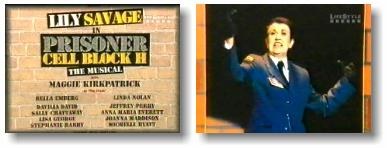 Richard:
Is that a terrible sound, the sound of the
phone not ringing? Richard:
Is that a terrible sound, the sound of the
phone not ringing?
Maggie: Oh, it's
hideous. it's hideous. And it all came as I
approached 50, so it was not an easy period. Not
an easy time, '91, '92. I went off to England and
did appearances in clubs all over the UK. That
was ridiculous, that's enough to drive a girl
into a whiskey bottle.
Richard: What was
that like? They remembered you?
Maggie: Oh,
mobbed. Ridiculous. But down the track I
went back again in '95, and that was great fun.
That was the West End, that wasn't little bingo
halls in the North of England. It was the Queen's
Theatre in the West End. Schlocky show, but what
fun, what fun? And at least I was there.
Richard: So
getting from then till now. It's basically a
process of letting things go?
Maggie: Letting
things go, and letting things happen. I sweat
over the bills, of course. That's a constant in
one's life, but it's okay. I've still got a
passion about my work, I have passion about my
life. I think when we lose our passion, then curl
up your toes. I'm passionate about my garden,
about the plants, the birds around me, and
especially my grandchildren.
 Richard:
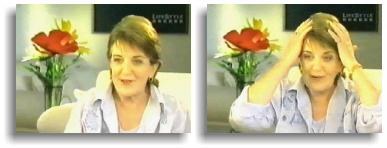
What about men? Are you over men? Richard:
What about men? Are you over men?
Maggie: I'm
pretty circumspect about that. Hey, look, if he's
out there and he's absolutely independent, and
can put up with me and mine.
Richard: There
are qualifications?
Maggie: There are
huge qualifications. I don't think he's out
there, I just don't think he is. They say that
there is for all of us, but if he isn't it
doesn't really matter. I have great friends. I
like my own company and that's why I don't
think I could really tie up with anybody
anymore. I've become too set in my ways, as they
say.
 Richard:
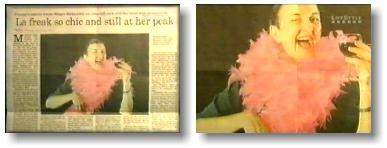
What about reviews? I've just read a review
about a play in Perth. It was kind, but it wasn't
overwhelming. Richard:
What about reviews? I've just read a review
about a play in Perth. It was kind, but it wasn't
overwhelming.
Maggie: No. Was
that for A Passionate Woman that I
recently did? So lukewarm, and yet the reviews
for my one-woman-show, aside from that person we
won't mention, I couldn't have bought them they
were so fabulous. One of them in 'The Australian'
made me almost cry. It was as if I had spent my
life getting to that point of appreciation. And
it was appreciation, it wasn't just going on and
on about how fabulous Maggie Kirkpatrick is. It
was true appreciation, of me, and my contribution
to the theatre, and it was so lovely. And then
you do something as difficult as that wonderful
English play that I did over there, and it's
almost a ho-hum!
Richard: I think
it was Katharine Hepburn who, when she was asked
what were the good things about getting old, she
said, 'nothing'!
Maggie: That's
disappointing. I would have thought that such as
positive role model for women and for actresses
would have had something a little more uplifting
to say. I'm sad about that.
Richard: But you
don't feel as though you're getting old?
Maggie: Oh, lord
no, no. My bones tell me from time to time, but
up here, and in here, no. In fact I have to pull
myself short from time to time, and think, 'Come
on, you're not 18 anymore,' I don't know how I'm
supposed to feel as I'm getting older.
Richard: What I
like most about this interview is that you've
come through. You're now at the optimistic period
of your life.
Maggie: Yes.
Let's hope it lasts.
Richard: I think
it's a nice time to say goodbye, and thank you.
Maggie: Thank
you, Richard.
Originally
broadcast on Australian TV in 1998.
Return to top of page
|