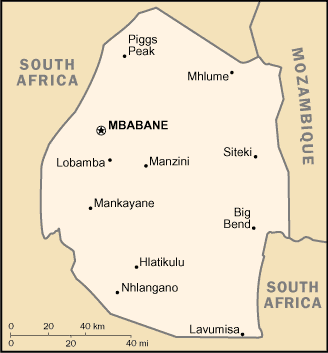
Swaziland is situated close to the Tropic of Capricorn, so the climate ranges from sub-tropical to temperate. Generally, June to September is cold but sunny and dry. From October to May, the temperature rises, but it is also the rainy season, especially February where floods are likely.
Having said that, Swaziland has four well-defined regions, each with their own climate. The Highveld, where the capital city is situated, is high up in the mountains. It is much cooler than the rest of the country; rain and mist are a part of life. In winter, temperatures can drop to zero degrees celsius at night. Winter mornings tend to have frost and it snows occasionally. I even remember waking up to a blizzard once. (This in a country that does not have central heating!) On average, temperatures range from about 10 degrees celsius to about 25 degrees celsius.
As you move through the middleveld, lowveld and Lubombo region, the country gets progressively warmer. The Lubombo region, in particular Big Bend, tends to be extremely hot in the summer, about 30 degrees celsius and does not get very cool in the evenings.
The population of Swaziland was placed by the Central Statistics Office in 1997 to be just under a million at 912, 878, with 60% of that being under the age of 21.
Swaziland's biggest exports are sugar and wood pulp. About 80% of Swazis are subsistence farmers. Unfortunately, because Swaziland is landlocked, it is heavily dependent on South Africa for trade, imports and exports. Swaziland receives customs duties from Southern African Customs Union and worker remittances from South Africa.
Siswati is the language of the Swazi but English is widely used for teaching, in business situations and for commerce. The Siswati vocabulary is not extensive so often words from English are used to supplement the language. For some basic Siswati phrases, click here.
The Swazis have a very strong cultural heritage and they are proud of their traditions. Traditions have been maintained throughout the years. The best way to see this in action is to visit any of the traditional events that occur during the year. The two most popular are the Reed Dance in September and the Incwala (celebration of the first fuits) normally held towards the end of the year.
Swaziland has one university, the University of Swaziland. It has two campuses, one in Kwaluseni and the other in Luyengo. Oops, sorry, the Nursing Institute is now part of the University of Swaziland.