ART
HISTORY
RELIGIOUS BELIEFS
LOCATION
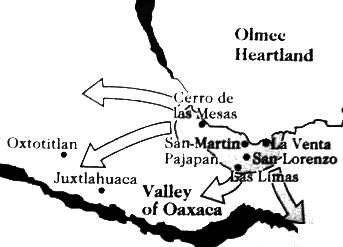
The most ancient Mexican civilization is that called 'Olmec'. For many years, archaeologists had known about small jade sculptures and other objects in a distinct and powerful style that emphasized human infants with snarling, jaguar-like features. Most of these could be traced to the sweltering Gulf Coast plain, the region of southern Veracruz and neighboring Tabasco, just west of the Maya area. Actually, nothing is known of the real people who produced Olmec art, neither the name that they called themselves by nor from where they came. Old poems in Nahuatl, recorded after the Conquest, speak of a legendary land called Tamoanchan, on the eastern sea, settled long before the founding of Teotihuacan:
In a certain era
which no one can reckon
which no one can remember
there was a government for a long time.
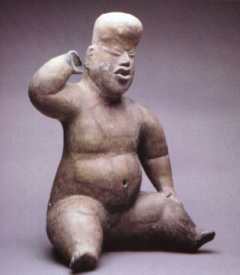
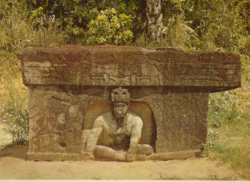
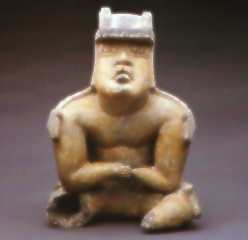
The hallmark of Olmec civilization is the art style. Its most unusual aspect is the iconography on which it is based, through which we glimpse a religion of the strangest sort. The Olmec evidently believed that at some distant time in the past, a woman had cohabited with a jaguar, this union giving rise to a race of were-jaguars, combining the lineaments of felines and men. these monsters are usually shown in Olmec art as some-what infantile throughout life, with the puffy features of small, fat babies, snarling mouths, toothless gums or long, curved fangs, and even claws. Given its odd content, Olmec art is nevertheless 'realistic' and shows a great mastery of form. On the great basalt monuments of the Olmec heartland and in other sculptures, scenes which include what are apparently portraits of real persons are present; many of these are bearded, some with aquiline features. Olmec bas-reliefs are notable in the use of empty space in compositions. The combination of tension in space and the slow rhythm of the lines, which are always curved, produces the overwhelmingly monumental character of the style, no matter how small the object.
Notwithstanding their intellectual and artistic achievements, the Olmec were by no means a peaceful people. Their monuments show that they fought battles with war clubs, and some individuals carry what seems to be a kind of cestus or knuckleduster. Armed groups of Olmec warriors apparently invaded the Mexican plateau during the Middle Formative, for we have an isolated site of pure Olmec character at Chalcatzingo, Morelos, jus south of the Valley of Mexico, where a bas-relief on a boulder shows three Olmec warriors brandishing clubs above an ithyphallic captive.
Text from the Book Mexico (Ancient Peoples and Places by Michael D. Coe.