|
|
Away We Go!
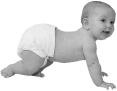
Crawler
Blocking will become some of your primary activities as your baby scoots, crawls, climbs and explores. His communication skills improve rapidly now, too, so pay close attention to what he's trying to tell you.
For babies learning to chew and hold food, this may be a good time for new tastes and textures.
Connects words with gestures, Touches Mom or Dad during mealtime to control feeding, Communicates feelings of anger, happiness and fear, has a sense of humor, plays games like patty-cake and peek-a-boo, shows assertiveness by reaching for objects that are taken, starts problem solving, Masters crawling, can reach out for a toy without losing balance, practices hand skills, using thumb and fingers to hold objects, pulls self up to stand using furniture, throws toys when learning to let go of objects, arches neck when on stomach to look around.
At this age, your child is curious about everything. But she also has a very short attention span, rapidly moving from one activity to the next. Ironically, the things that fascinate your child will not be the expensive items you find in toy stores, but will instead be ordinary objects like wooden spoons, egg cartons and plastic containers.
Your baby will be especially interested in things that differ from what she already knows. To help your child expand her horizons, look for objects that are familiar and add a twist. If your child is bored with the oatmeal box she's been playing with, renew her interest by tying a string to it to make a pull toy. Little things like this will help your child learn to differentiate between the familiar and unfamiliar.
Throughout this phase, your baby will never tire of dropping, rolling, throwing or waving objects to find out how they behave. This may look like random play, but it's your child's way of finding out how the world works.
Like any good scientist, she's observing the properties of objects and developing ideas about shapes (some things roll, some don't), textures (some things are scratchy, some are smooth) and sizes (some things fit inside each other). Gerber Playthings are made especially with these new discoveries in mind. Your child will even begin to understand that some things are edible and others aren't. But, be careful, she'll still put everything in her mouth, to be sure.
As your baby learns to open her fingers at will, she'll delight in dropping and throwing things. If you leave small toys within her reach, she'll fling them around and call loudly for someone to retrieve them. To be safe, you should introduce your child to soft objects such as spongy balls of various sizes, colors, and textures. You can witness your child's development simply by sitting on the floor and rolling a ball toward her. At first, she may clumsily slap at it, but eventually she'll learn to swat it so it rolls back in your direction.
With her improved coordination, your baby can now investigate more thoroughly the objects she encounters. She'll pick them up. Shake them. Bang them. Pass them from hand to hand.
Giving her one of Gerber's colorful rattles is a good way to feed this fascination. She is constantly learning, from you and those things around her. Her continuing observations will help her understand that objects exist even when they're out of sight. This concept is called "object permanence." To help your baby learn object permanence, play peek-a-boo with her. By switching from one variation of this game to another, you'll maintain her interest almost indefinitely.
Nutrition
Toys
Teething
Baby Foods
Bottles
| |

