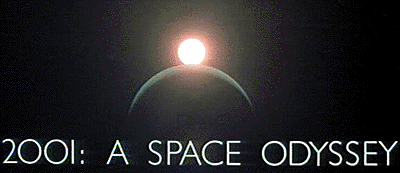
2001: 太空漫遊
2001: 太空漫遊
Genre: Science_Fiction_Fantasy
Based on the short story "The Sentinel" by Arthur C. Clarke
Running Time: 2:19
Release date: 1968
STAFF
Produced, Directed and Screenplay: Stanley Kubrick
Screenplay: Arthur C. Clarke
Director of Photography: Geoffrey Unsworth, John Alcott
CAST
Keir Dullea.....David Bowman
William Sylvester.....Dr. Heywood Floyd
Gary Lockwood.....Frank Poole
and......HAL 9000……Martin Balsam
Other cast members include: Sean Sullivan (Michaels); Frank Miller (Mission Controller); the director's daughter Vivian Kubrick (Dr. Floyd's Daughter); Alan Gifford (Frank Poole's Father); Edwina Carroll and Penny Brahms (Stewardesses); Bill Weston, Edward Bishop, Glen Beck, Ann Gillis, Heather Downham, Mike Lovell, John Ashley, Peter Delmar, David Hines, Darrel Faes, Jimmy Bell, Terry Duggan, Tony Jackson, Joe Refalo, David Charkham, David Fleetwood, John Jordan, Andy Wallace, Simon David, Danny Grover, Scott Mackee, Bob Wilyman, Jonathan Daw, Brian Hawley, Laurence Marchant and Richard Wood.
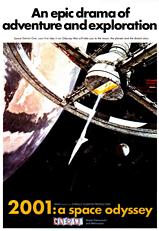
About the film
Original film was 160 minutes which included an intermission, and was rated MPAA G. Filmed in Cinerama, Super Panavision and Metrovision, using Metrocolor and Technicolor, at MGM British Studios, Ltd. Borehamwood, England. Shooting actually began December 1965 and took more than two years; finally being released April 4, 1968.
Critical reaction to the film at the time of its initial release was mixed; most critics found much of it tedious and plotless. The absence of plot is actually beside the point, as Kubrick's approach was to emphasize the visual elements, producing a lyrical, poetic fantasy that continues to raise far more questions than a simple narrative could answer.
Director Stanley Kubrick was also the special photographic effects designer and director. Other people in the special photographic effects unit were: David Osborne, Frederick Martin and John Jack Malick.
The film is based on a short story by science fiction writer Arthur C. Clarke, but the film generated one of the first commercially successful "novelizations," a trend which was to become very popular in the 1970s and 80s.
A sequel to the film, "2010: The Year We Make Contact," was released in 1984.
A computer program has been developed by Scott French that generates output based on the literary style and conventions of the novels of Jacqueline Susann and the name of the program is HAL.
2001 : A Space Odyssey first appeared on screens in spring 1968, nothing quite like it had ever been seen before. And, although the science and technology of motion picture special effects have made huge strides in the intervening years, there hasn't been a film quite like it since.
2001: A Space Odyssey dared to suggest that images might be capable of embodying and evoking real ideas about the nature and origin of human intelligence. In so doing, it revolutionized the movies and carved itself an unassailable niche in motion picture history.
This film's speculations about life, intelligence, and meaning. The most famous of these is arguably the abrupt cut from the man-ape leader's bone-weapon, turning in the air, to the long, white, bonelike space liner approaching the space station -- all of human prehistory and history reduced to a single film-splice. It's a brilliant moment, not only because it compares the bone with the ship as manifestations of how human intelligence devises tools that are also weapons, but also because it suggests that, in the four million years that pass between those two shots, nothing of much importance has happened. People are still throwing things up in the air and getting no closer to figuring out the mysteries of the universe.
The fact is that 2001 : A Space Odyssey epitomizes, and harmonizes, two of the great themes of science fiction : the mechanization of the human and the humanization of the machine. And it seemed to offer a positive vision : it does all mean somthing; there is a power that shapes our ends; and we are destined for new achievements.
It is much remarked on -- and rightly so -- that Hal, a machine, remains the most human and sympathetic character in 2001.When the human beings in the film err, we expect no more of them; when Hal errs, we are profoundly touched by his shattering recognition of his own limitations -- due, of course, to human error.
But the superhuman shares with the subhuman the quality of being not human, and the idea of a superhuman has always been most readily embraced not by those who hold great hope for humanity but by those most disillusioned with it..
|
INTRODUCTION |
 |
序論 |
|
THE STORY (ACT 1 TO 4) |
|
故事劇情 (第一幕至第四幕) |
|
SCREEN PLAY |
|
劇本 |
|
ANNEX |
|
附錄 |
|
ANNOTATION |
|
註解 |
|
APPENDIX |
|
附加資料 |
|
2010: The Year We Make Contact |
|
2010 |
MY FAVORABLE...COURTYARD我最喜愛的...庭園