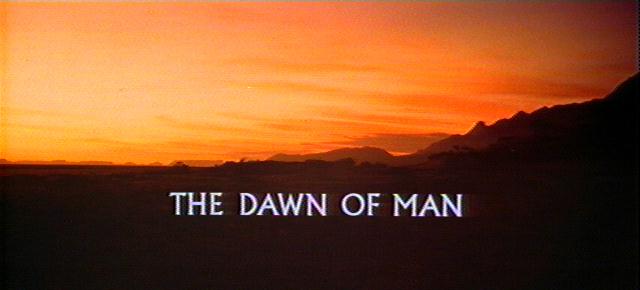
2001: A Space Odyssey opens four million years ago in the plains of Africa.
Man is more animal than human, covered with black hair and looking very much like a gorilla. The man-apes are simple vegetarians, foraging for berries and leaves, and competing for food with tapirs and other animals. As vegetarians, they easily fall prey to predators like the leopard. They hang onto life by a thread, having to share the dwindling food and water supply with other, bolder man-apes, ones that stake a claim to the water hole, dooming the first group to death by thirst.
That is, until one night, when the monolith comes to Earth.
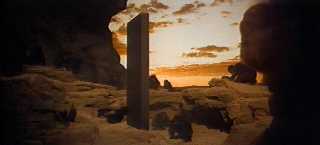
The monolith appears outside the man-apes' shelter one morning. Examining it in its primitive way, one man-ape reaches out and touches the monolith. The monolith lets out a deafening shriek at the crucial moment--when the sun, moon, and earth are in perfect alignment overhead.
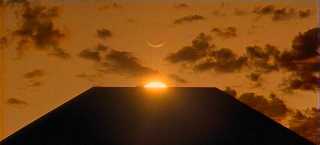
The monolith disappears, but what was it for? One man-ape picks through a pile of bones. An idea forms in its head. The man-ape, with its uncertain monkey-like hand, picks up the thighbone of the dead animal. The hand swings down and bones are broken--Man has learned how to use tools.
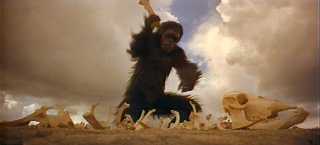
The man-apes use their new tools to kill the animals with which they recently shared the plants. After they discover this new food source, the man-apes go to reclaim the water hole. When it could have been used in cooperation, mankind's first tool is a murder weapon.
The man-apes team up and bludgeon one of the others to death. With their destructive power, they become the masters of the world. In a victory growl, a man-ape tosses his ultimate weapon skyward?
MAN'S EVOLUTION AND MEET THE SENTINEL
In probably the best film transition ever, the bone, the ultimate weapon of the past, becomes the orbiting nuclear bomb, the ultimate weapon of the future--the year 2001, to be exact. Many such weapons orbit the Earth. Even in the so-called "civilized" times of the future, Man has retained the ability to destroy himself through his technology. Manuevering between those harbingers of doom, the Orion spacecraft, a passenger liner, lifts off from Earth.
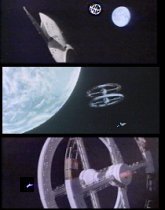
On this trip, however, it only carries one passenger: Heywood Floyd. As Floyd sleeps belted in, inside a typical airline cabin, Floyd's pen floats past his chair, due to the lack of gravity. Apparently, space travel is just as routine in the 21st century as air travel is in the 20th century.
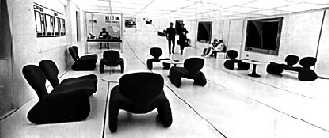
A stewardess, wearing grip shoes so her feet stay anchored to the floor, walks down the aisleand replaces the pen in Floyd's pocket just as the Orion comes up to Space Station One. Space Station One is a beautiful and gigantic rotating wheel that provides simulated gravity to its inhabitants. Space Station One is also where Floyd's connecting flight to the Moon awaits. A graceful docking sequence, with ship, station and Earth all rotating before view, performed to The Blue Danube, ends the silent portion of the film.
Upon arrival, Floyd makes a videophone call to his daughter and meets some Russians, who ask about the Moon bases--there are rumors of a plague outbreak. Floyd denies any knowledge of what's happening, but admits he is going there to investigate the strange occurrence. After excusing himself from the lifeless conversation, Floyd leaves on the Aries spaceship-- Destination: Clavius Base, Moon. On board, he becomes literally the "butt" of 2001's only joke: reading the instructions of a zero-gravity toilet.
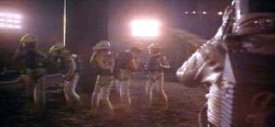
The Aries spaceship lands on the moon, where Floyd holds a press conference to the Clavius personnel. They are just as confused as the Russians about what is really happening in the nearby crater of Tycho. Floyd tells them: an object of unknown origin has been found in the crater. The object, TMA-1, has an intense magnetic field, is buried 40 feet below the lunar surface, and is four million years old. After the initial shock at proof of extraterrestrial life subsides, Floyd swears the Clavius personnel to secrecy, then leaves for Tycho to examine the object. On the trip by Moon Bus, Floyd learns that it was delibrately buried, and has not reacted to Man's presence in any way. Once the Bus arrives at Tycho, Floyd and his party step out onto the lunar surface and see TMA-1: a monolith.
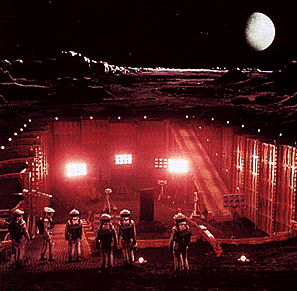
They approach the monolith, its black, featureless surface as eerie as it was four million years ago. In a primal and automatic gesture, so like the one of the man-apes, Floyd reaches out and touches the monolith with a gloved hand.
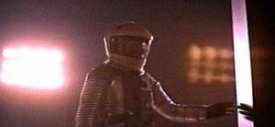
As the Sun and Earth align and their light enters the crater and hits the monolith, the monolith again shrieks--this time releasing a powerful radio signal. The astronauts reel at this sound, their behavior still as primitive as the man-apes. The signal, however, heads to Jupiter. Man follows...
THE PURSUIT OF THE RADIO SIGNAL WITH THE JUPITER MISSION
18 months later, as the title suggests, the spacecraft Discovery is headed toward Jupiter. The front end contains a spinning centrifuge, which creates normal gravity for the astronauts, and bays for three space pods, which are used for maintenance and any other duties during the flight. Dave Bowman, Frank Poole, the HAL 9000 supercomputer, and three hibernating astronauts make up the crew. One night, Bowman and Poole sit down to dinner to watch a BBC broadcast of their recent interview, in which Hal brags about being "foolproof, and incapable of error".
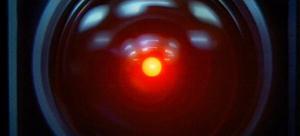
Poole receives a phone call from his parents wishing him 'Happy Birthday', and Bowman practices his sketches. Both behave very mechanically and emotionlessly. In contrast, Hal, the computer, is the one with the full range of "human" emotion. In a conversation with Dave, Hal shows human apprehension and paranoia concerning the strange circumstances of the mission.
As Bowman replies, Hal interrupts, alerting Bowman to the impending failure of the AE-35 unit, which keeps the radio antenna pointed at Earth. Bowman leaves Discovery in a space pod, then just his space suit, to replace the unit and bring in the old one for testing.
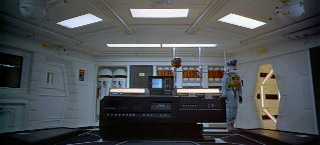
When the AE-35 unit is brought back in and tested by Poole & Bowman, it has no faults and works perfectly. Because Hal is supposed to be foolproof, Bowman and Poole have concerns about his error and what it means to the mission. Hal dismisses it as "human error". Since Hal can hear in every part of the ship, Poole and Bowman hide in one of the space pods and turn off the radio to have privacy. In their conversation, Poole and Bowman realize that Hal is malfunctioning. What do these humans do when their technology begins to fail them?
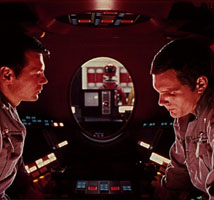
They discuss the various ways of dealing with Hal. Poole brings up disconnecting Hal from control of the ship, and relying on Earth-based control. All that is necessary for this is to replace the AE-35 unit and realign the antenna with Earth. Bowman hesitates, wondering how Hal will take it, but agrees that there is no alternative. Unfortunately for the astronauts, Hal watched their lips move during their conversation.
Poole leaves Discovery in a space pod to replace the AE-35 unit. After he leaves the pod to go to the antenna, Hal rams him with the space pod, disconnecting Poole's air and sending him spinning off into space. Bowman hastily sets out in a space pod to rescue Poole, who, exposed to the vacuum of space and without air, quickly dies.

Bowman catches the dead body of Poole and heads back to the ship. Meanwhile, Hal shuts down the life support for the three hibernating crewmen. Hal was programmed to make sure the mission is a success, and believes he must be in command to ensure its success. Faced with disconnection and failure, Hal eliminates everybody that could disconnect him. The antenna problem was indeed "human error"--the error in programming Hal received before the mission.
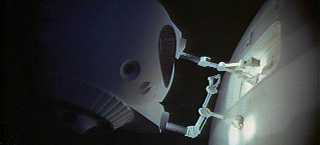
Bowman, trying to reenter Discovery, runs into a very determined Hal.
After this stunning mutiny, Bowman strikes upon an ingenious solution: he will go in through the emergency airlock. Hal reminds him that he forgot his space helmet and would have to brave the vacuum of space in order to get inside. Despite this, Bowman enters Discovery and sets his house in order.
Once inside, Bowman heads into Hal's computer banks to disconnect him. Hal begs for his life, but Bowman slowly lobotomizes him, immune to the pleading.
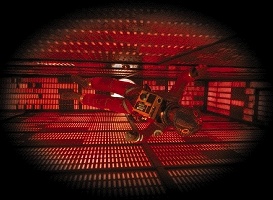
Inside Hal's brain, Bowman sees a video recording, made by Heywood Floyd, revealing the Jupiter mission to him. He has been sent to find the destination of the monolith's radio signal, known to be in Jupiter space. Hal had known this fact during the entire mission, and concealing it from Bowman was another cause for his malfunction. Playing the message is an apology from Hal, an admission of defeat, and a heartfelt desire to see that the mission is completed.
GOING TO JUPITER AND BEYOND THE INFINITE
Discovery nears the planet Jupiter. But amongst the celestial orbs of planets and moons, there floats something unnatural: a huge monolith. It has orbited Jupiter for four million years. It has waited patiently for 18 months, signaled by its brother on the Moon. The first monolith stimulated the man-apes' evolution. The second announced Man's arrival in space. The third awaits the arrival of Man to Jupiter, so it can fulfill its role. After the Jupiter Mission, Man means David Bowman.
Bowman, upon locating the monolith, leaves Discovery in his space pod. He follows the monolith through space, trying to match velocities. To examine it, as his orders must state, he has to touch it, just as the man-ape and Heywood Floyd did in pondering their monoliths. As Bowman chases, the celestial objects align.
The monolith disappears from sight upon crossing the aligned moons. From the point where it disappeared, the Star Gate opens. It is something describable as both pure velocity and the closest thing to a LSD trip one can experience without the drug. Bowman and his pod are launched into the Gate, travelling at speeds intolerable to humankind. As he travels, Bowman is shown in agony. After the light show ends, he travels through the creation of new universes, and flies over the colored landscape of an alien planet before he comes to rest.
Bowman's journey ends in a room, much like a suite at an upscale hotel. The trauma of the journey has taken its toll: Bowman's hair has turned white and he is gripped in seizure. Bowman leaves his pod and explores the room. As he explores, it is as he is living his life in only a few minutes. Eventually Bowman becomes an old man eating dinner. When he sits at the table, he knocks a glass onto the floor. As he bends to pick it up, he hears the labored breathing of a very old man. Bowman sees the man lying on the king-size bed. The man blinks, and we see that the ancient, withered creature in the bed is Bowman now. He lifts his hand to touch something, in a gesture now very familiar.
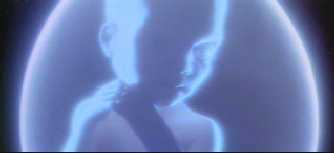
A monolith sits across from the bed. It awakes. Bowman is reborn into a creature of pure thought, a Star-Child. He has acheived superiority over his tools, even the mind's original tool--the human body. The Star-child leaves the room and travels to a familiar blue marble: Earth. Its motives, its powers, and the details of its creation are uncertain.
RETURN TO THE BEGINNING OF 2001: a space odyssey
 重新展開旅程