| Return to: Lands and their Cultures Salzburg even more Salzburg Schatten Travels (main page) |
 |
| ...Salzburg more |

|
| Austria |
| Travels with Me and My Shadow |
|
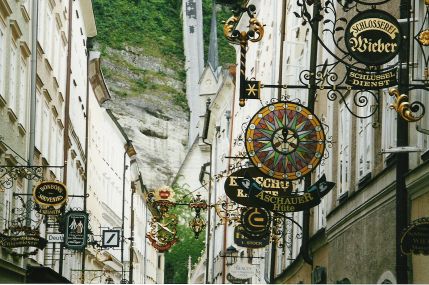
| Getreidegasse |
 |
| Returning back down the Steingasse, fortify yourself before the next adventure and then take the 100 or so stone steps up past a maze of medieval doorways up the mountain to the Kapuziner Kloster, or, make a right at the Linzergasse and walk partway down the street to a passage known as Stefan-Zweig Weg, which winds up to the Kloster and into the mountain. Along this passage are little �capellas,� or cabins, with life-sized baroque figures, each cabin representing one of the Stations of the Cross. This path is named for the Austrian-Jewish writer who lived on this mountain until 1935, when he realized that Hitler would soon be crossing the border. At the top is the aforementioned monastery Kapuziner Kloster (�Kloster� is German for monastery), surrounded by seemingly miles of forest, and numerous pathways which crisscross the whole of this idyllic terrain. Various open-air art exhibits are in the woods, made of natural products and meant to be out in the elements. After a peaceful meandering, find your way out of the woods towards the west and a reward awaits: yet another spectacular view high above Salzburg. The ancient walls here are part of the original city walls, with lookout posts still intact. Across street from the Stefan-Zweig Weg is the Sebastianskirche, a church overlooked by tourists. The small cemetery behind the church is the Sebastiansfriedhof, and here is where prominent Salzburg merchants� families were buried, including Mozart�s wife and father, as well as Paracelsus, the famous physician and philosopher, also known as Theophratus Bombastus von Hohenheim. Yes, one and the same, the Paracelsus that is the medical symbol on most hospitals, displayed in most pharmacies, definitely on all physician graduation diplomas. Archbishop Wolf-Dietrich erected an impressive monument to himself here, as was the habit of the times: the Gabriel Chapel, a mausoleum covered with mosaic that he had built during his own lifetime for his burial! Well, I wonder that this sidetrip would qualify as an exciting tourist activity but the cemeteries are rather unique in Europe. |
| On the other side of the Salzach, the burgher�s side of the river, are most of the churches and the Dom. Following the cemetery theme, visit the Friedhof von St. Peter (St. Peter�s cemetery), adjacent to the Monchsberg cliffs, one of the most intimate and charming cemeteries in Austria, certainly one of the oldest and most beautiful in the world. Nannerl�s crypt is here (Mozart�s sister), the torso of Joseph Haydn�s brother is buried in this communal crypt as well, his head inside an urn in St. Peter�s church. On the main path is the grave of the only American to be buried here, Harry Collins. His claim to fame was that he was in charge of the liberation of Salzburg in 1945, and subsequently married an Austrian woman. The discovery of Nannerl�s crypt will lead you to the catacombs, look up! They are built right into the cliffs, under 90 feet of mountain. Two tiny chapels, dating from the 3rd century when Christianized Romans held secret masses here, are hewn right out of the rock. One of them is in the shape of a cross, or � of it was until a landslide took part of the �T.� These chapels are so tiny that only 50 or so people could squeeze inside. There is an external room where the non-baptized people could stand, as they could not enter the chapel until they were consecrated, which happened once or twice yearly. The catacombs are rugged, consisting of bare rock and dirt floor, and there is an old, barely discernible fresco painted on one of the walls, disintegrating from the damp air. Since the 1600�s there have been mountain groomers �cleaning� the mountain. The rock is conglomerate and absorbs water easily, so every spring the groomers check for new cracks and cement them to prevent seepage of water or snow. |
| On one visit, leaving the catacombs, we heard a choir of voices singing, so we scurried along and found an assembly of men at the nearby St. Peter�s Stiftskeller, a restaurant. This is Europe�s oldest Gasthaus, but does not have guest rooms, it is just a restaurant. The Stiftskeller has many different rooms, from elegant wood-paneled rooms to less formal rooms, plus an outdoor garden. Part of the garden, as well as some of the rooms from the restaurant, are tucked under the mountain, the walls appear to be simply bare mountain. So there we sat in the garden, serenaded by 20 or so harmonious voices in impromptu song, the church bells filling in the silences, Lynda drinking a wine from the Wachau region of Austria and me snacking on local monastery cheese. By now it is late afternoon, she�s been trying for awhile to have lunch, but the annoying custom of the Germans and Austrians to serve meals at specified hours and her inconvenient habit of eating at erratic hours does not match well, though I snack on dog biscuits and the odd portion of pretzel or bread that I snatch from the ground when she�s not looking. Earlier in the day, we stopped at the famous Tomaselli Caf�, the oldest caf� in Salzburg, where Lynda had coffee and thinks she has discovered the best strudel in Salzburg, maybe this is why the cafe is famous? Even I received a treat of dog biscuits from the waiter (maybe this is why the cafe is famous). |
 |
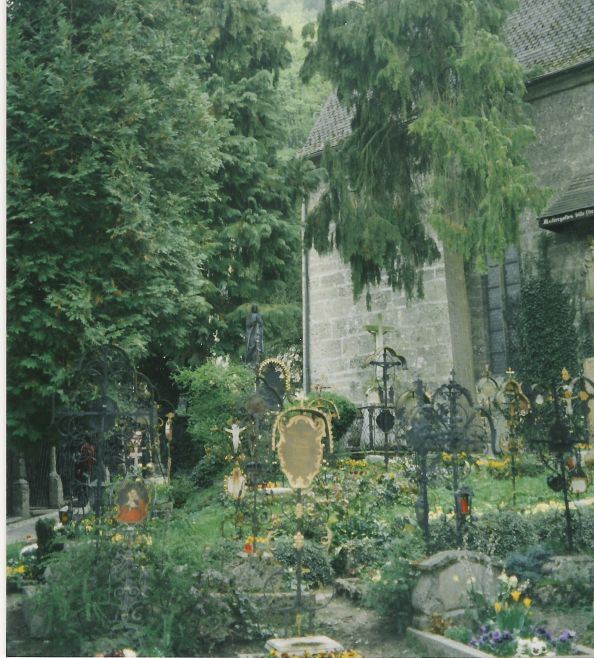 |
| Friedhof von St. Peter |
|
|
 |
 |