Landing at the Salzburg airport is, next to landing in Jackson Hole, Wyoming, is the second most spectacular landing in the world. The plane completely circles the old part of the city, flying quite low above the old Fortress and the cathedral, a view of the expansive green farmlands on one side of the plane, and the forested hills and the green Salzach River on the other side, nudging up to the mountainside until dropping on the runway. Outside the plane, standing on the tarmac, one has a breathtaking view of the Alps, the foothills literally at one�s feet.
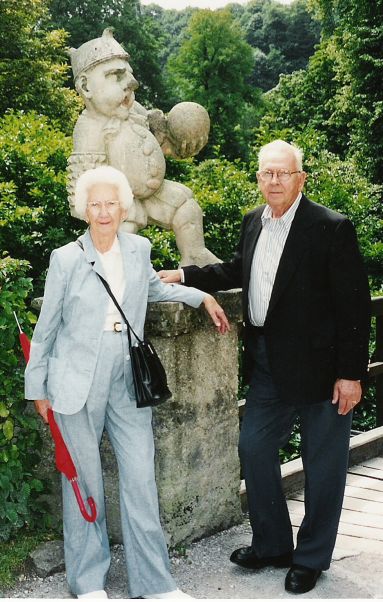
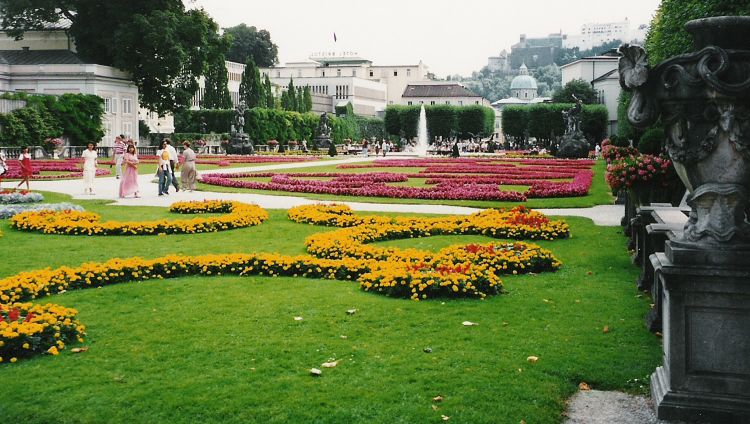
We have been in Salzburg hundreds of times, and each time new discoveries delight us. I suggest a person start their tour through the beautifully landscaped Mirabell Garten, in front of the baroque splendour of Schloss Mirabell, the residence that the Prince-Archbishop Wolf-Dietrich had built for his mistress, Salome Alt, and their 10 children. The gardens have numerous fine statues, transporting one to the world of ancient Greek myths. The palace, which we would revisit time and time again for concerts, has a monumental staircase decorated with sculptures and sleepy, putti cherubs by the famous baroque artist, Georg Raphael Donner. The Marmosaal, known as the Marble Room to the non-German speaking world, has immense height, the walls covered in marble of pale and dark grey, rose, tan colors, gold and mirrors, crowded with immense marble statues, was at one time the hall where the young Mozart, Salzburg�s favorite son (and modern-day profitable marketing item), captivated audiences with his performances.
At one concert, the Chamber Orchestra of Salzburg played selections for strings and piano from Haydn, Vivaldi�s 4 Seasons and of course selections from Mozart. We love to watch the conductors in concerts, and this conductor, Bruno Steinschaden, was quite colorful with expressing his dismay or glee with facial expressions. When he was irritated at a mistake, perhaps one note was off or one note was held too long, he frowned so loudly in silence, and knitted his eyebrows so fiercely, I thought the putti cherubs would cry. All the while he is guiding the next stanza of music. The conductor�s upper body hopped to the high notes, he bowed and sagged to deep resonance, his hand reached out, pleading and probing for depth from his musicians. The violinists and bass player were animated and lively, snapping their heads to the music, or expressing their happy amazement of a critical summed ending with a broad smile to one another. The bass player articulated his joy not only in his face and dancing eyes, but by moving his oversized instrument to the music, his body bowed and leaning to the notes. In this small room it is also impossible for them to hide their subtle grimaces or muscular contractions in their faces if they make a mistake. They collectively make such ethereal music, we subconsciously revere them and place them on little pedestals, yet there they were at the pause, having champagne or juice with us, dressed in their plain black wardrobes, some younger, some older.
|