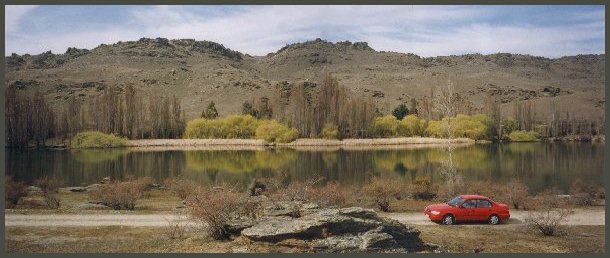
Looking across the lake to Linda and Barry Walker's property, "Lye Bow".
Looking across the lake to Linda and Barry Walker's property, "Lye Bow".
| To New Zealand photos | To July 2000 photos | To July 2001 photos |
Also
refer to www.lyebow.info (for latest information)
A place for all seasons (and our little bit of paradise)
| "Lye Bow" is a property of 8.5 acres facing roughly north-west
onto a 80 acre lake called "Butchers Dam" (after the dam commissioned in
1937 to provide town supply water to Alexandra via a combination of
pipes and open race). The land is approx 6 acres alongside the
dam by about 1.5 acres deep, with willows, bullrushes and open areas
alongside the water, and a small dinghy jetty. The land area is
party enclosed by the original chinese schist rock wall which in places
is 6x3 feet in size. The wall continues in and under the lake to
enclose a further 6 acres once part of the property before the dam was
built. Perch, rainbow and brown trout, kura (fresh water lobster),
ducks and black swans, pukeko, etc inhabit the lake. Almost the
entire area of the boundary has rows of large poplars, some from original
plantings. There are hundreds of other trees of more recent origin,
including many large conifers, oak, walnut, macrocarpa, radiata, and a
host of other varieties. In summer the heat is kept at bay by many
leafy specimens which provide a literal carpet of gold in autumn and let
the sun thru in winter. (In winter you can see across the lake from
the house, in summer its hardly visible from the house).
Having the distinction of being the only residential property on the lake, which is in a landscape protection zone, makes it somewhat unique. As a bonus, the remaining three sides are surrounded by 3,500 acres of Dept Of Conservation reserve on Flat Top Hill, sandwiched between the Clutha river gorge and state-highway 8 (from which our 1 km metalled access road extends). The reserve has some 240 different types of plants and grasses, is covered in its lower adjacent areas in Thyme, and has many schist rock outcrops - unique and awesome. "Lye Bow" is named after the original chinese owner who bought the property from the crown in 1891 and lived here till his death in 1930. He and his six or so chinese employees developed a water race which transverses the back of the property, originating high up on Butchers Creek (which is the main feed to the lake) and extending beyond the dam to connect eventually to Alexandra town. He eventually sold the race to the town to supplement the town water supply. The same employees built the boundary wall and the now 100 year old fruit storehouse which still stands. Lye Bow operated an orchard and market garden, selling his produce in Alexandra. The older residents still remember his horse and cart and the ginger sweets he gave the kids. We now have 10 or so apricot trees, half a dozen pear trees, a row of some 30 cherry plums, the odd new apple and nashi, walnuts, etc. Fruit in season is surplus to requirements! |
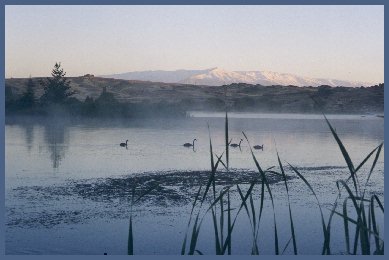
A misty day in early winter, four black swans
|
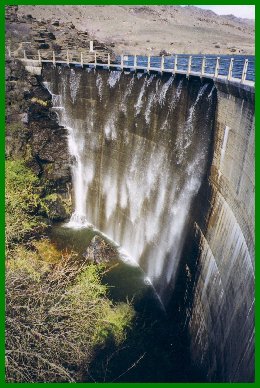
80 meters high, commissioned in 1937, Butchers Dam holds back 60 acres of water area. Seen here at full lake level with a good spill over, irrigation draw-offs in summer can see the water level down as much as four metres (1999). Once used for the Alexandra town water supply, the dam now supports farm irrigation north from the dam, and of course provides Lye Bow with irrigation and filtered house supply. |
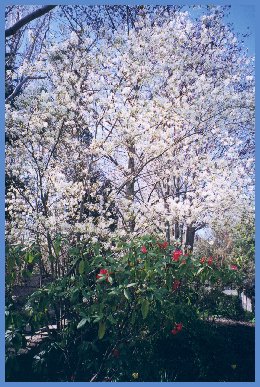
| Spring shows the garden at its best, with perhaps the whites and
pinks of fruit tree blossoms the most spectacular. Rowan trees
with red, orange and white berries abound, and spring brings forth
the 3000+ daffodills, lillies, tulips and other bulbs we have planted.
Rhododendrons start their flowering too.
This photo is of a couple of cherry plum trees and rhodos near the house and behind the sleepout. |
|
|
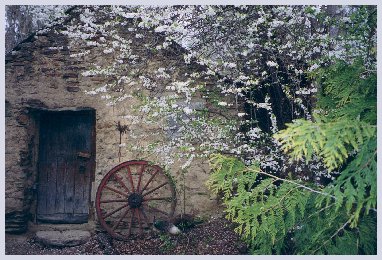
The old stone storehouse once kept pears and apricots cool and
fresh. Built about 1890 by Lye Bow, from schist rock and mud mortar,
it has only one slit window in the main rear store-room to allow a
little light into what is otherwise dark and a fairly constant cool
temperature. The front room may have been a later addition.
The wooden door deserves a photo all of its own! |
| Crab apple trees flank the path from the lawn at the rear of the house heading to the vege garden. White and pink blossom change to orange and red crab apples as the seasons progress, finally making it to the Crab Apple Jelly jar at summer's end! | 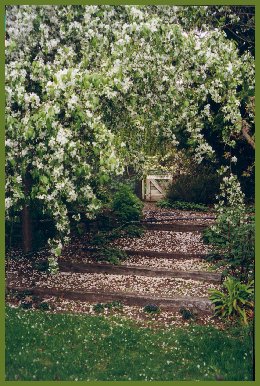
|
|
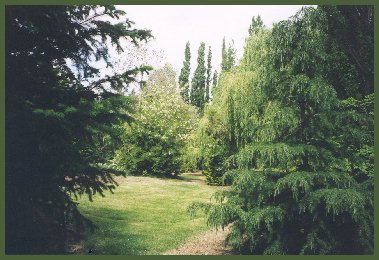
Spring and early summer see lots of green foliage and nice tidy lawns. A lot of the garden area has pockets of lawn surrounded by large trees and smaller conifers and shrubs. There are several hundred trees in all, of many different varieties. |
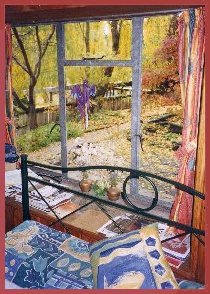
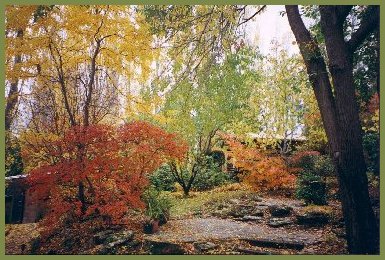
| Autumn in Central Otago is renowned for its splenour and Lye Bow, with over 100 poplar trees alone, joins in with an amazing explosion of colour. Eventually this all falls to the ground to produce a carpet of leaves inches thick, which finally ends up on the garden plots as mulch to protect from the winter chills and eventually compost for the next growing season. | 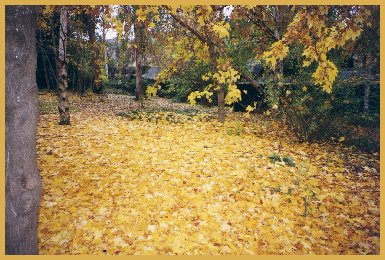
|
|
|
|
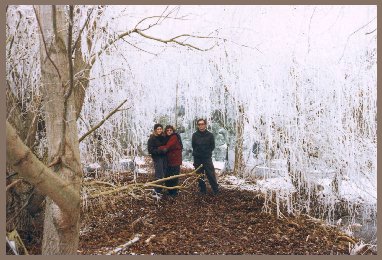
And then comes winter. Snow covers the Old Man Range to the west most of winter. Generally snow settles on Lye Bow at least once a year to a depth of a couple of inches, and stays maybe a week. Misty cold weather may bring a hoar frost such as this 1997 photo, when the place takes on a magical fairyland quality (forget the cold, enjoy the sparkle, go skiing!). |
|
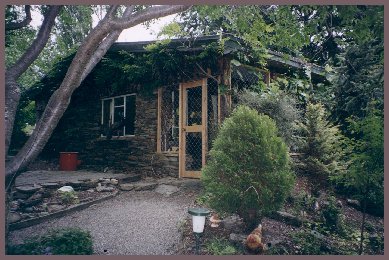
The house is made of "all sorts". This shot from the north shows the front entrance via the front porch/deck. This wall is schist lined. |
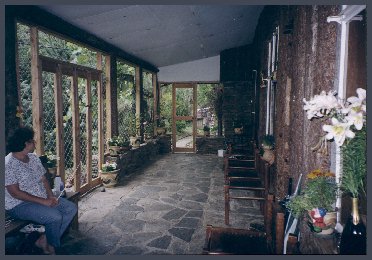
| The porch/deck out front is built in to keep the birds away (hens,
peafowl, pigeons, etc). The floor is shist shale, as are the outer
walls. Vertical larch timber in natural half-rounds line the outer
house walls over weatherboard and in some places mud brick and concrete.
The south wall is still natural mud brick, as is the old laundry - now
the computer room/office. A log cabin complements the accomodation.
The house started out as a two room mud brick building about 1930, with most extensions in place by about 1950. |
|
|
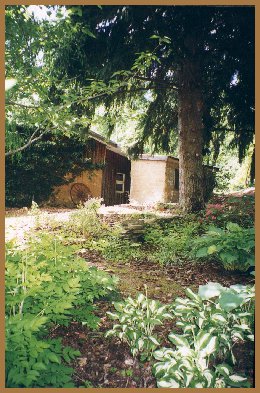
The south side of the house shows the mud brick wall and office.
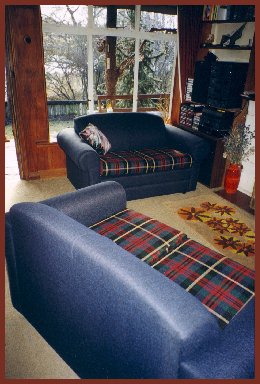
The lounge is original, comfortable, but small. |
|
|
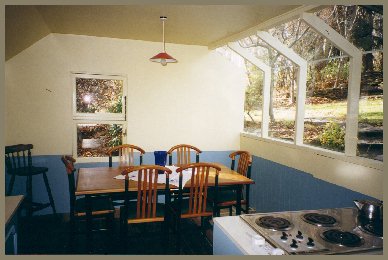
The dining room and kitchen started off as two separate rooms, now they are one. This area of the house has been gutted and relined, rewired, re-almost- everything. It has a hob stove and separate dual wall oven. |
| The view outside the windows is of the back lawn and garden on about window sill level. Always a treat to see. | 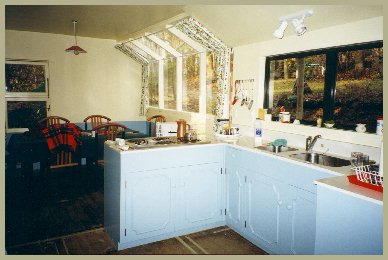
|
|
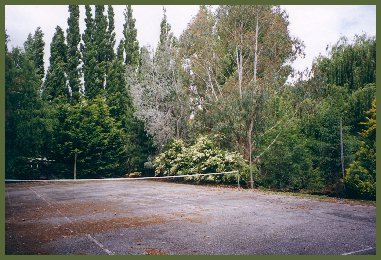
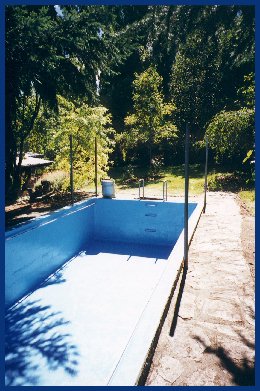
A swimming pool (seen here after the repaint) and tennis court complement the dinghys, canoes and other lake activities (such as fishing!). Central Otago is also renowned for its 4WD and mountain bike actvities. And don't forget the 3,500 acres of surrounding DOC land!
|
So that's Lye Bow, [available for sale or for lease by negotiation for 12-24
months].