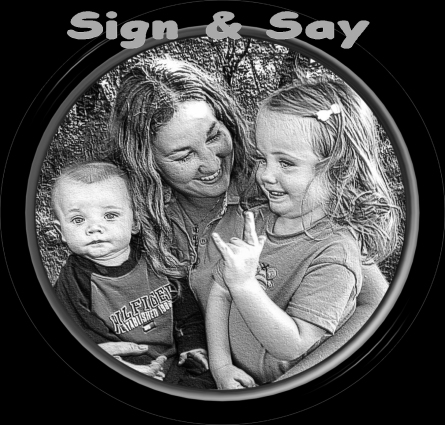
Babies who are deaf: A signed langauge like ASL is the best way for a deaf or hard of hearing child to access a complete and full language in a natural way (by simple exposure). The entire family should learn sign language so communication is used naturally in the home, not just in class. Classes by Deaf instructors are offered in Winnipeg!
Children with a speech delay can benefit from using signs so 2-way communication can happen while they are working on aquiring speech.
Babies who can hear can learn signs for 2 basic reasons:
*for fun
*for early communication (beyond crying and pointing)
_________________________________________________________________________
Sign & Say
focusses on teaching signs to children who can hear.
(Deaf children should be instructed by Deaf instructors, as they need more than just signs, but grammar, role models, cultural exposure and signing peers).
Babies can say it with signs...
All babies communicate, but not all babies are understood. Signs are aquired earlier than words (even though signing "babble" and vocal "babble" is performed at roughly the same time) and this gives your baby the ability to express more than just his/her basic needs. This in turn develops their communication skills, and language learning (including spoken) usually happens earlier and with more ease. Babies feel empowerd since they can control the topic of conversation.
~
Babies naturally use gestures (waving, pointing, head nods, and even pushing and hitting).
We are just exposing them to a vocabulary so they can say a bit more!
Classes and playgroups provide the instruction needed to see how the signs are done properly, a fun and educational atmosphere for songs, stories and rhymes, and a social network for families!
ASL is suited to children because it uses the visual/spatial and hand/motor skills that children are developing. Preschoolers naturally want to explore the world and express themselves with their hands and bodies. ASL provides this kinesthetic experience, plus the second language benefits as well.
There has been significant research into the benefits of signing with children, including its successful use with children who have development delays and special needs. Research indicates that children who have been taught sign language have increased spoken vocabularies and improved cognitive and communication skills throughout childhood.
Combining nursery rhymes with signs helps children with reading literacy and comprehension. It enables them to understand written and spoken language conceptually, and encourages them to use these skills to communicate.
You're never too old to learn a new language.
To learn ASL in its entirety (grammar, etc.), take a class from a native signer (ie: a Deaf person) at either Red River College or the Deaf Centre Manitoba.
Learn a new language...learn a new culture...learn!
American Sign Language (ASL) is said to be the third most used language in North America; if you learn it...you will use it!