 |
|
|
|
|
|
|
|
|
|
|
|
|
|
|
|
|
|
|
|
|
|
|
|
Tools - How Nanotechnology is Conducted: |
|
|
|
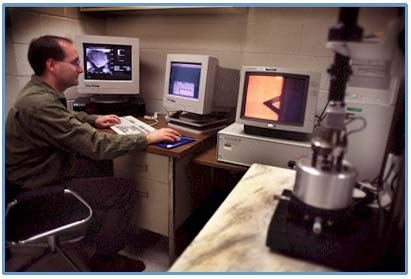
Computers are enhancing the image of the electron and atomic force microscopes onto the monitors, measuring the electrons. |
|
|
Prior to electron and atomic force microscopes, it was impossible to operate effectively at the nanoscale.These microscopes were developed at the IBM laboratory in Zurich during the 1980's. With these microscopes and various types of scanning probes it is possible to produce nanotechnology. |
|
|
|
|
|
|
 |
|
|
|
|
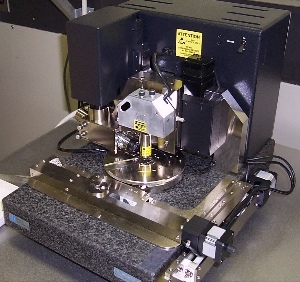
As previously mentioned, a scanning probe is a device used to "scrape" various atoms. A common comparison is to one's finger. Like a finger, the scanning probe or "tip," can scrape a surface or atom. |
|
|
|
|
|
|
http://www.uga.edu/srel/AACES/tunnelingmicron.html |
|
|
|
|
|
Scanning Probe |
|
|
|
 |
|
|
|
There are three commonly used scanning probes in the field of nanoscience...
1. Atomic Force Microscope (AFM) - electrons are used to measure the force on the tip.
2. Scanning Tunneling Microscopy (STM) - this measures the amount of electrical current between the tip and the surface being measured.
3. Magnetic Force Microscopy (MFM) - the tip attracts due to its magnetic force.
Note: All of these methods are monitored by a computer (computer enhanced). |
|
|
|
|
http://www.physics.uoguelph.ca.psi |
|
|
|
|
|
|
Back
Forward |
|